
 bobby
bobby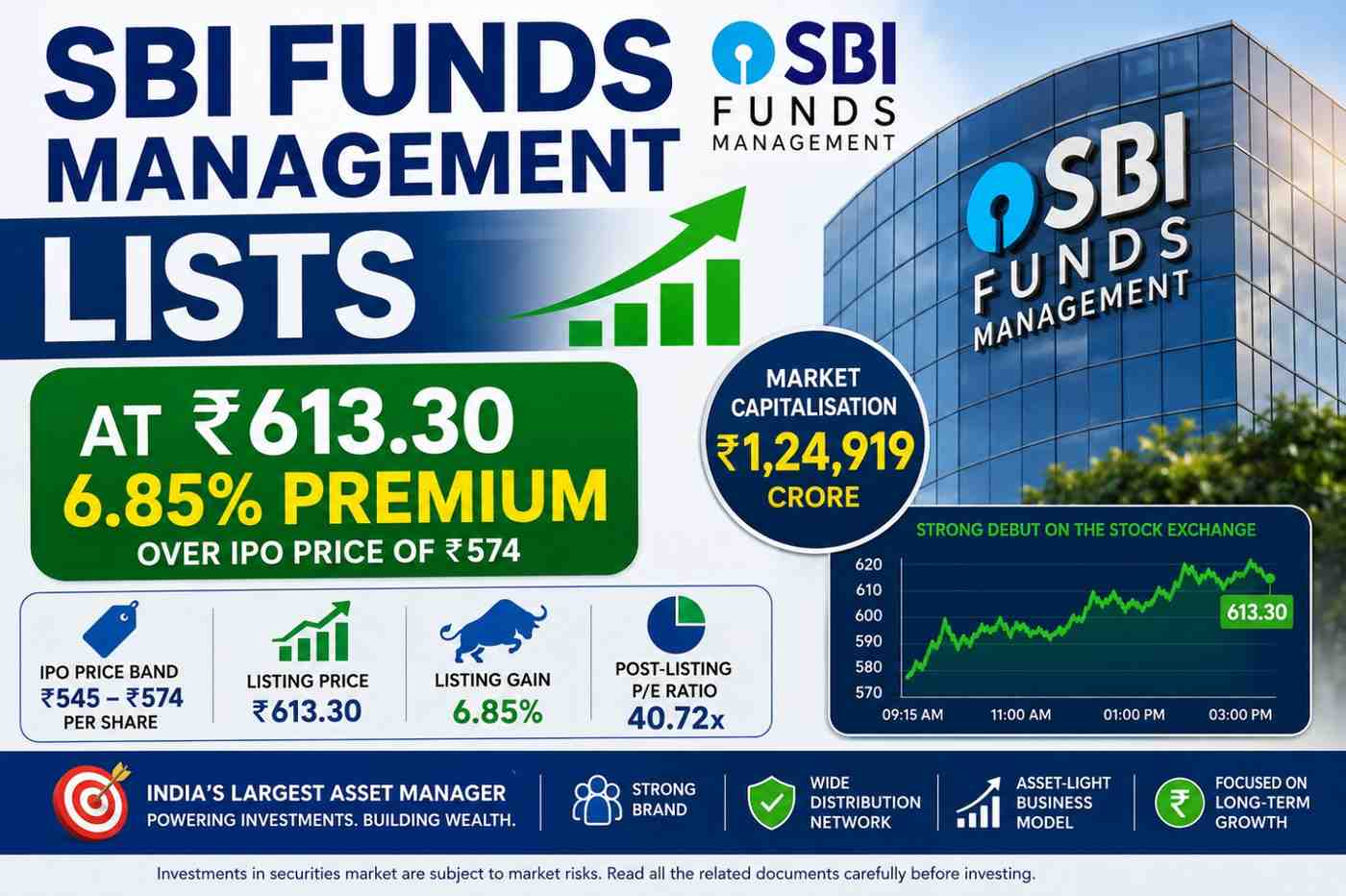
SBI Funds Management Lists at 6.85% Premium: India’s largest asset management company, SBI Funds Management, made a positive debut on the stock exchanges, listing at ₹613.30, a 6.85% premium over its IPO price of ₹574.
While the listing rewarded IPO investors with decent gains, it was more measured than many expected considering the strong subscription demand. The bigger story, however, is valuation.
At the listing price, SBI Funds Management is now trading much closer to the valuation of other listed asset management companies. So, does the stock still offer value, or has most of the upside already been priced in?
Let’s break it down.
📊 SBI Funds Management Listing Highlights
| Particulars | Details |
|---|---|
| IPO Price Band | ₹545–₹574 per share |
| Listing Price | ₹613.30 |
| Listing Gain | 6.85% |
| Market Capitalisation | ₹1,24,919 crore |
| Post-Listing P/E Ratio | 40.72x |
👉 Track the live SBI Funds Management share price here.
🚀 What Does the 6.85% Listing Premium Mean?
A single-digit listing gain indicates that investors welcomed the company but avoided assigning an aggressive premium.
Unlike speculative IPOs that witness huge first-day rallies, SBI Funds Management’s debut reflects the market’s view that it is:
- ✅ A high-quality business
- ✅ A market leader
- ✅ A stable long-term compounder
- ❌ Not a high-risk, high-growth momentum stock
In simple words, investors are willing to pay for quality—but only at a reasonable valuation.
💰 Is SBI Funds Management Still Fairly Valued?
This is the most important question after listing.
During the IPO, the company was valued at approximately 38.12 times earnings.
After listing at ₹613.30, the valuation increased to around 40.72x earnings.
Even after this increase, the company still trades slightly below the listed peer average P/E of 41.64x.
What does this mean?
It suggests the stock is fairly valued, rather than expensive.
The attractive valuation discount available during the IPO has narrowed, but the stock hasn’t become excessively priced.
📉 Why Didn’t India’s Largest AMC Get a Bigger Premium?
Despite being India’s biggest asset manager, SBI Funds Management did not receive an outsized listing gain.
There are several reasons:
📌 Fee Pressure
The rapid growth of passive mutual funds and ETFs continues to reduce management fees across the industry.
📌 Regulatory Changes
SEBI has been tightening regulations to improve investor protection, which could impact profitability over time.
📌 Moderate Growth Expectations
Asset management is a mature business.
Future earnings depend largely on:
- Growth in Assets Under Management (AUM)
- Continued SIP inflows
- Equity market performance
Investors appear to be pricing these opportunities and risks in a balanced manner.
📈 Why Asset Managers Deserve Premium Valuations
Unlike manufacturing companies, asset management businesses require very little capital investment.
Instead of building factories, earnings primarily grow through:
- 📈 Higher AUM
- 👥 More investors
- 💼 Increased mutual fund penetration
- 💰 Rising management fees
This makes AMCs highly cash-generative businesses.
However, valuation depends on whether they can continue attracting investor money consistently.
👨💼 Who Should Consider SBI Funds Management Now?
⚡ Short-Term Traders
The modest listing gain means immediate upside may be limited unless fresh positive triggers emerge.
Near-term price movements will likely depend on:
- Quarterly earnings
- Market sentiment
- Mutual fund industry data
📈 Medium-Term Investors
The company could remain attractive if it continues growing AUM faster than the industry.
Key positives include:
- Strong SIP inflows
- Expanding retail participation
- Growing financialisation of household savings
🏦 Long-Term Investors
For long-term investors, SBI Funds Management offers exposure to one of India’s strongest structural themes:
India’s increasing shift from physical assets to financial investments.
As more households invest through mutual funds, the company could benefit from:
- Higher AUM
- Stable fee income
- Consistent profitability
🛡️ Conservative Investors
Conservative investors may appreciate:
- ✔️ Market leadership
- ✔️ Strong SBI brand
- ✔️ Established distribution network
- ✔️ Asset-light business model
However, with valuations now near industry averages, future returns will likely depend on business performance rather than multiple expansion.
🔍 Key Factors Investors Should Watch
📊 1. Assets Under Management (AUM)
AUM is the biggest earnings driver for any asset management company.
Higher AUM generally leads to:
- Higher revenue
- Better profitability
- Stronger long-term growth
💹 2. Revenue & Profit Growth
With the stock already trading at around 40.72x earnings, investors should expect consistent earnings growth to justify current valuations.
⭐ 3. Performance of Flagship Mutual Funds
Good fund performance attracts more investor money.
Poor performance can reduce inflows and slow AUM growth.
🏛️ 4. Industry Trends
Watch developments related to:
- Passive investing
- Expense ratio regulations
- Mutual fund industry growth
- Retail investor participation
These factors could significantly influence profitability.
🔒 5. Lock-in Expiry
When eligible shareholders complete their lock-in period, additional shares may enter the market.
This can temporarily increase supply and create short-term price pressure—even if business fundamentals remain strong.
📊 SBI Funds Management Valuation: Expensive or Fair?
Here’s the big picture:
| Factor | Assessment |
|---|---|
| Business Quality | ⭐⭐⭐⭐⭐ |
| Market Leadership | ⭐⭐⭐⭐⭐ |
| Listing Premium | Moderate |
| Valuation | Fair |
| Long-Term Growth Potential | Positive |
| Margin of Safety vs IPO | Lower than before |
The stock no longer offers the valuation comfort that investors enjoyed during the IPO.
Instead, it now trades at a level where future returns will depend more on earnings growth than valuation expansion.
🎯 Final Verdict
SBI Funds Management’s market debut sends a balanced and encouraging signal.
The stock delivered a 6.85% listing gain, showing healthy investor confidence without excessive optimism. At around 40.72x earnings, it is now valued close to listed peers, indicating that much of its quality and leadership has already been recognised by the market.
For long-term investors, the investment thesis remains intact. India’s mutual fund industry continues to benefit from rising financial awareness, increasing SIP participation, and the long-term shift toward financial assets. These structural trends could support sustained AUM growth over the coming years.
That said, future returns are likely to depend less on valuation re-rating and more on consistent execution. Investors should closely monitor quarterly AUM growth, earnings performance, fund performance, industry regulations, and competitive fee pressures before making fresh investment decisions.
Disclaimer: This article is for informational purposes only and should not be considered investment advice. Investments in the securities market are subject to market risks. Please read all related documents carefully before investing. Past performance is not indicative of future returns. Investors should evaluate their financial goals, risk tolerance, investment horizon, and consult a qualified financial advisor before making any investment decisions.