 bobby
bobby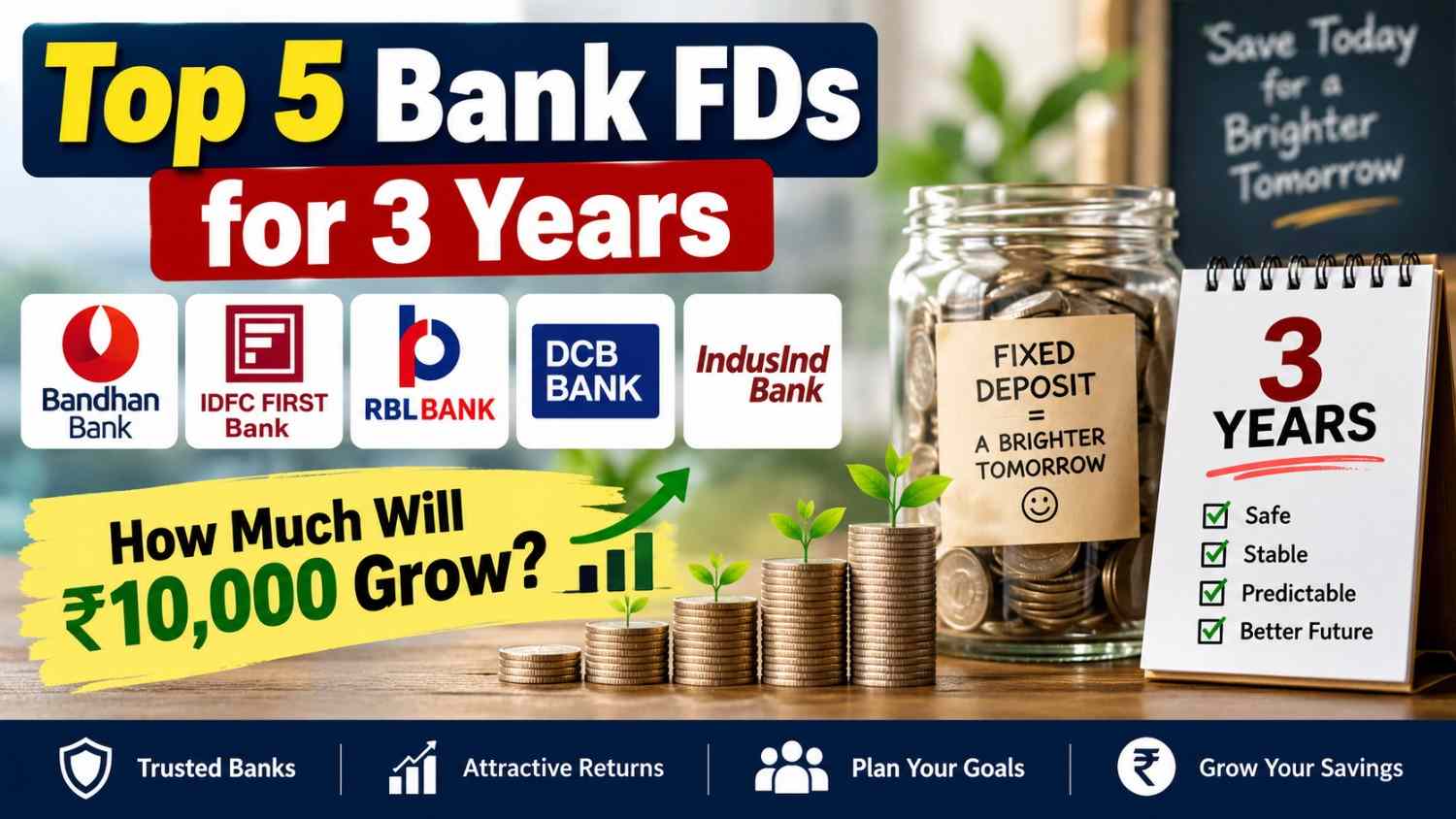
Top 5 Bank FDs for 3 Years: Saving money for future expenses is an important part of financial planning. While investors can choose from mutual funds, equities, government-backed savings schemes and other products, bank fixed deposits (FDs) remain popular among people looking for relatively predictable returns.
But what happens if you put just ₹10,000 into an FD for three years? 🤔
The answer depends primarily on the interest rate, compounding method and FD terms offered by the bank. Even a small difference in the interest rate can affect your final maturity amount.
⚠️ Important: FD interest rates are revised periodically. The rates and maturity figures below should be treated as illustrative unless verified against the bank’s latest rate card on the date you open the deposit.
🔥 Key Takeaways
A ₹10,000 fixed deposit earning around 7%–7.3% annually could grow to roughly ₹12,300–₹12,400 over three years, depending on the applicable rate and compounding method.
The five banks considered in this comparison are Bandhan Bank, IDFC FIRST Bank, RBL Bank, DCB Bank and IndusInd Bank.
However, the bank offering the highest headline interest rate isn’t automatically the best FD for everyone. Tenure, premature-withdrawal rules, senior-citizen benefits, tax implications and the bank’s latest applicable rate should also be checked.
💰 ₹10,000 FD for 3 Years: How Much Can You Get?
Here is an illustrative comparison based on the rates used for this example:
| Bank | Illustrative Interest Rate | Approx. Value of ₹10,000 After 3 Years* |
|---|---|---|
| Bandhan Bank | 7.30% | Around ₹12,400 |
| IDFC FIRST Bank | 7.30% | Around ₹12,400 |
| RBL Bank | 7.20% | Around ₹12,380 |
| DCB Bank | 7.00% | Around ₹12,310 |
| IndusInd Bank | 7.00% | Around ₹12,310 |
*Figures are estimates for illustration. Actual maturity proceeds can differ depending on the bank’s applicable FD rate, exact tenure, compounding frequency, deposit type and other terms.
📌 What Does This Mean?
Suppose you deposit ₹10,000 for three years.
At an annual interest rate of around 7%, your money could grow to approximately ₹12,300+.
At around 7.3%, the maturity value could be approximately ₹12,400, subject to the bank’s compounding method and other conditions.
That means a relatively small difference in the FD rate can increase your earnings—but investors should compare the complete FD terms instead of choosing a bank solely because of the headline rate.
🏦 1. Bandhan Bank FD
Using an illustrative rate of 7.30%, a ₹10,000 investment held for three years could grow to approximately ₹12,400, depending on compounding.
Before investing, check the latest applicable rate for the exact three-year tenure. Banks can offer different rates for different maturity buckets.
🏦 2. IDFC FIRST Bank FD
At an illustrative annual rate of 7.30%, ₹10,000 invested for three years could also reach approximately ₹12,400.
Remember that FD rates can vary according to tenure, deposit amount, customer category and the bank’s prevailing rate card.
🏦 3. RBL Bank FD
Using an illustrative interest rate of 7.20% per annum, a ₹10,000 three-year FD could grow to roughly ₹12,380.
The actual amount received at maturity will depend on the applicable rate and compounding frequency.
🏦 4. DCB Bank FD
At an illustrative rate of 7.00%, a ₹10,000 deposit could become approximately ₹12,310 after three years.
Investors considering premature withdrawal should also check the applicable penalty. Breaking an FD early can reduce the effective return.
🏦 5. IndusInd Bank FD
At an illustrative annual rate of 7.00%, a ₹10,000 FD held for three years could reach approximately ₹12,310.
Again, verify the latest rate for the exact tenure before opening the deposit.
📊 How Is FD Maturity Amount Calculated?
For a cumulative FD, the maturity value depends on four important factors:
Principal: The amount you initially invest.
Interest rate: The annual rate offered by the bank.
Tenure: How long the money remains deposited.
Compounding frequency: How frequently earned interest is added to the principal.
Because compounding conventions can differ, two FDs carrying similar advertised rates may not always produce exactly the same maturity amount.
This is why an official FD calculator or maturity quote from the bank should be used before making the final investment.
🏦 What Is a Fixed Deposit (FD)?
A Fixed Deposit, commonly called an FD, is a bank deposit in which you invest a lump sum for a specified tenure at an agreed interest rate.
Unlike market-linked investments, the applicable FD interest rate is generally fixed when the deposit is booked, subject to the product’s terms.
For example, if you place ₹10,000 in a three-year cumulative FD, the bank calculates interest according to the applicable rate and credits the maturity proceeds according to the chosen FD structure.
✅ Why Do People Choose Bank FDs?
Bank FDs can be attractive to investors who value predictability and simplicity.
Some common advantages include:
- 💰 Predictable interest based on the contracted rate
- 📅 Wide choice of deposit tenures
- 👴 Higher rates may be available to eligible senior citizens
- 🔄 Premature withdrawal may be available on callable deposits, subject to conditions and penalties
- 📱 Many banks allow customers to open and manage FDs online
FDs, however, should not be described as completely risk-free. Depositors should understand the applicable terms and deposit-insurance limits.
⚠️ Can You Withdraw an FD Before Maturity?
In many cases, yes.
Callable FDs generally allow premature withdrawal, but the bank may apply a penalty or calculate interest according to the period for which the money actually remained deposited.
Certain non-callable deposits can have different withdrawal restrictions.
Therefore, check the bank’s premature-closure policy before investing—especially if you may need the money before maturity.
👴 Do Senior Citizens Get Higher FD Interest Rates?
Many banks provide eligible senior citizens with an additional interest rate over the rate available to regular customers.
The additional rate and eligibility conditions vary from bank to bank and can also depend on the deposit type and tenure.
Therefore, senior citizens should compare the dedicated senior-citizen FD rates rather than relying only on standard FD rates.
🧾 Is FD Interest Taxable?
FD interest can be taxable according to the depositor’s applicable tax rules.
Tax deduction at source (TDS) may also apply when relevant conditions and thresholds are met.
Because tax rules can change and individual circumstances differ, investors should check the latest income-tax provisions or consult a qualified tax professional when necessary.
🔎 5 Things to Check Before Opening an FD
Don’t choose an FD based solely on the highest advertised rate.
Before depositing your money, compare the exact tenure and applicable interest rate, maturity value, compounding or interest-payout option, premature-withdrawal conditions, and tax implications.
You should also check whether a higher rate is tied to a special tenure rather than the exact three-year period you want.
❓ Frequently Asked Questions (FAQs)
1. How much will ₹10,000 become in a 3-year FD?
At an illustrative annual rate of around 7%–7.3%, ₹10,000 could grow to approximately ₹12,300–₹12,400 over three years. The actual maturity amount depends on the applicable interest rate and compounding method.
2. Which bank is best for a 3-year FD?
There is no single bank that is best for everyone. Compare the latest three-year FD rate, maturity value, premature-withdrawal policy, senior-citizen benefits and other terms before choosing.
3. What is the full form of FD?
FD stands for Fixed Deposit.
4. Is a bank FD safe?
Bank FDs are generally considered relatively low-risk compared with market-linked investments. However, depositors should understand the financial institution involved and the applicable deposit-insurance rules rather than treating every deposit as completely risk-free.
5. Can I withdraw my FD before three years?
Many callable bank FDs allow premature withdrawal, but a penalty or reduced applicable interest rate may apply. Non-callable deposits can have different restrictions.
6. Do senior citizens receive higher FD rates?
Many banks offer additional interest to eligible senior citizens. The additional rate varies by bank, tenure and product.
7. Can I invest only ₹10,000 in an FD?
Yes, ₹10,000 is sufficient for many retail bank FD products, although minimum-deposit requirements vary between banks and schemes.
8. How much interest can I earn on a ₹50,000 FD?
There is no universal amount. Your earnings depend on the interest rate, tenure and compounding frequency. For example, a ₹50,000 FD at 7% will generate a different maturity amount depending on how interest is compounded and the exact duration.
🎯 Final Word
A ₹10,000 bank FD for three years can be a straightforward way to earn predictable interest without direct exposure to stock-market fluctuations.
If rates are around 7%–7.3%, the investment could grow to approximately ₹12,300–₹12,400 over three years under common compounding assumptions.
But interest rates can change. 🔄
Before booking any FD, compare the bank’s latest official interest rate, exact tenure, maturity value, premature-withdrawal conditions and tax implications.
Disclaimer: This article is for general information and educational purposes only and does not constitute financial, investment or tax advice. Interest rates and banking terms can change. Verify current rates and conditions with the respective bank before investing.