
 bobby
bobby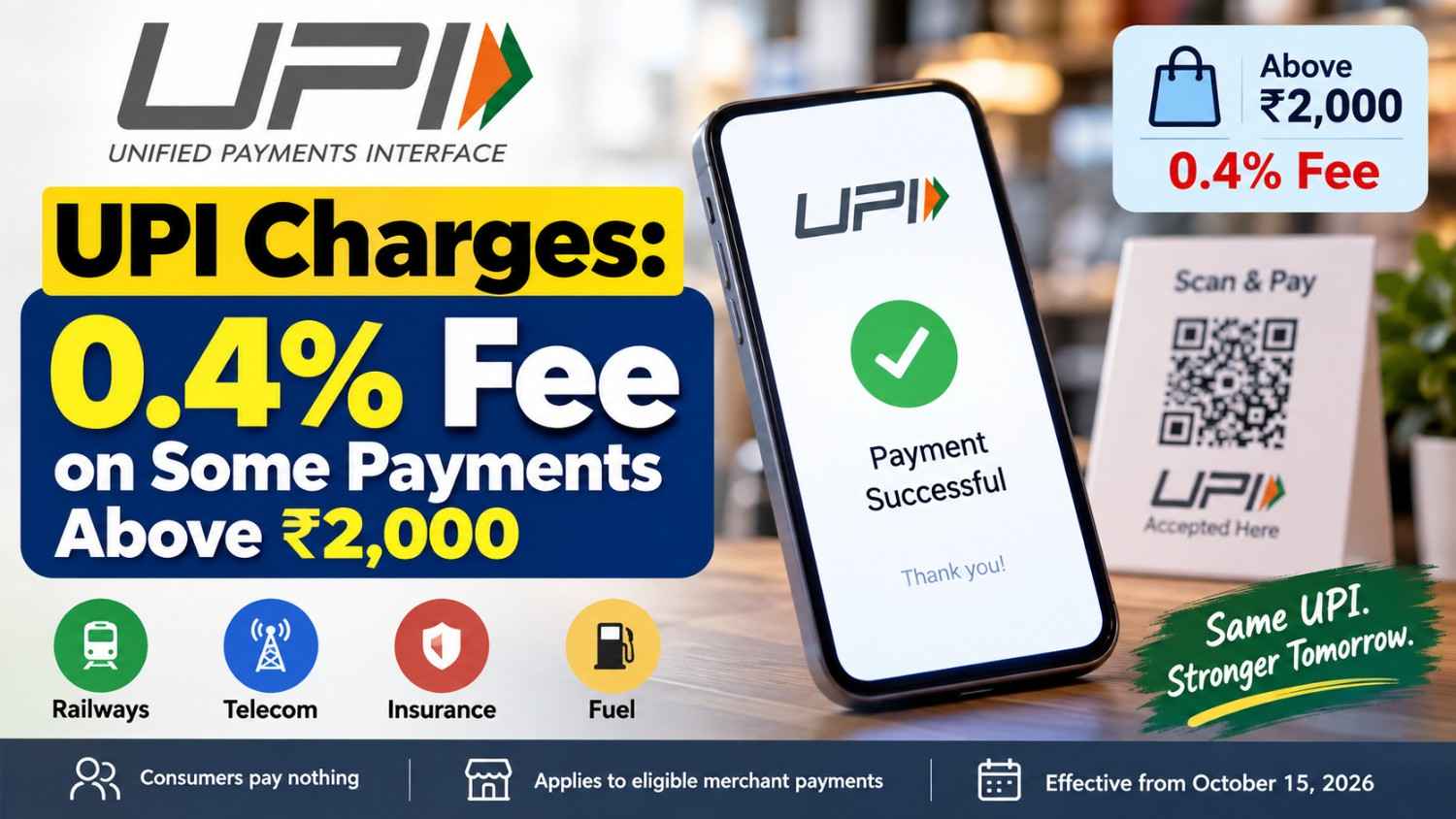
UPI Charges: 0.4% Fee on Some Payments Above ₹2,000: India’s UPI payment system is getting a significant change. From October 15, 2026, certain person-to-merchant (P2M) UPI payments above ₹2,000 will attract a 0.4% Merchant Discount Rate (MDR).
But there is an important distinction: consumers will not have to pay this charge. The MDR will be borne by eligible merchants, while person-to-person (P2P) UPI transfers will continue to remain free.
Here’s exactly how the new UPI charging framework works and what it means for consumers and merchants. 💳📱
🔑 Key Takeaways
- 0.4% MDR will apply to applicable merchant UPI payments above ₹2,000.
- The new framework takes effect on October 15, 2026.
- Consumers will not pay the MDR.
- P2P UPI money transfers remain free, irrespective of whether they exceed ₹2,000.
- Eligible P2M transactions up to ₹2,000 remain outside the new MDR.
- The standard MDR is capped at ₹300 per transaction.
- Railways, telecom, insurance and fuel transactions above ₹2,000 will attract a special flat ₹5 MDR.
💰 What Are the New UPI Charges Above ₹2,000?
Under the new framework, eligible person-to-merchant UPI payments exceeding ₹2,000 will attract a Merchant Discount Rate of 0.4% of the transaction value.
MDR is essentially a payment-processing fee associated with accepting a digital payment. In this case, it is a merchant-side charge rather than a fee that consumers have to pay while using UPI.
The standard MDR is capped at ₹300 for a transaction, limiting the amount payable on high-value purchases.
📊 New UPI MDR Rules at a Glance
| UPI Transaction | New MDR |
|---|---|
| Person-to-Person (P2P) payment | Free |
| Eligible P2M payment up to ₹2,000 | No MDR |
| Eligible P2M payment above ₹2,000 | 0.4% MDR |
| Maximum standard MDR | ₹300 per transaction |
| Railways above ₹2,000 | ₹5 flat MDR |
| Telecom above ₹2,000 | ₹5 flat MDR |
| Insurance above ₹2,000 | ₹5 flat MDR |
| Fuel above ₹2,000 | ₹5 flat MDR |
The key point is that the charge applies on the merchant side of eligible transactions, not as a direct UPI transaction fee for the customer.
🧮 How Much Will the 0.4% UPI MDR Cost?
Consider a customer who purchases an item worth ₹5,000 from a merchant and pays through UPI.
At a 0.4% MDR:
₹5,000 × 0.4% = ₹20
The applicable MDR would therefore be ₹20.
For a ₹10,000 eligible merchant payment, the MDR would be:
₹10,000 × 0.4% = ₹40
For a ₹50,000 transaction:
₹50,000 × 0.4% = ₹200
Because the standard MDR is capped at ₹300, the charge will not continue increasing indefinitely on larger eligible transactions.
Most importantly, the customer is not supposed to be charged this MDR separately.
👥 Are UPI Money Transfers to Friends and Family Still Free?
Yes.
This is one of the most important parts of the announcement.
Person-to-person UPI transactions will continue to remain free. That means sending ₹500, ₹5,000 or even a larger permitted amount to a friend or family member through UPI does not become a merchant transaction merely because it exceeds ₹2,000.
The new MDR framework targets specified person-to-merchant transactions, not ordinary P2P money transfers.
🏪 What Happens When You Pay a Shop More Than ₹2,000?
Suppose you purchase a product worth ₹3,000 and scan an eligible merchant’s UPI QR code.
The transaction is a person-to-merchant (P2M) payment. Because it exceeds ₹2,000, the applicable merchant side of the payment ecosystem may incur the new MDR.
At 0.4%, ₹3,000 corresponds to an MDR of:
₹3,000 × 0.4% = ₹12
You, as the customer, still pay ₹3,000, rather than ₹3,012 as a separate UPI fee.
⛽ Railways, Fuel, Insurance and Telecom Get Special ₹5 Rate
The framework provides different treatment for some important merchant categories.
UPI payments above ₹2,000 involving railways, telecom services, insurance and fuel will attract a flat MDR of ₹5 per eligible transaction, rather than the standard 0.4% rate.
This keeps payment-processing costs lower in these categories.
📱 Will Google Pay, PhonePe, Paytm or Other UPI Users Be Charged?
For consumers, the important issue is the nature of the transaction rather than simply which UPI app is being used.
A consumer making an ordinary UPI payment should therefore not confuse the new merchant MDR with a new universal fee for using a UPI app.
There is no blanket 0.4% charge on every UPI payment above ₹2,000.
The 0.4% MDR applies to specified merchant transactions under the new framework, while P2P transactions remain free.
🤔 What Is MDR?
MDR stands for Merchant Discount Rate.
It is a charge associated with processing digital payments accepted by merchants. Payment systems have traditionally used MDR or similar fees to help cover the cost of infrastructure and services required to process electronic transactions.
The important distinction here is that MDR is not the same thing as a tax on consumers.
The new UPI MDR is intended to support participants in the payments ecosystem and investment in areas such as payment infrastructure, cybersecurity, reliability and innovation.
🛡️ Why Is the UPI MDR Being Introduced?
UPI has grown into an enormous digital-payment network, requiring continuous spending on technology, security, transaction processing and system resilience.
The new framework is intended to create a more sustainable payment ecosystem while protecting consumers and a large share of smaller transactions from direct charges.
The government had already made clear that UPI would remain free for citizens and that any merchant MDR would be nominal and limited to specified merchant transactions. The latest framework provides more clarity about how that approach will work.
🏬 What Does the Change Mean for Small Merchants?
The ₹2,000 threshold is particularly important for merchants processing smaller payments.
Eligible merchant transactions up to ₹2,000 remain outside the new MDR, protecting a large number of everyday low-value digital payments.
That means payments for many routine purchases can continue without the new merchant fee.
🚨 Does This Mean UPI Is No Longer Free?
Not for consumers.
Headlines saying simply “UPI is no longer free above ₹2,000” can create the wrong impression.
The more accurate explanation is:
Certain merchant UPI payments above ₹2,000 will attract MDR, but consumers will continue to use UPI without a direct transaction charge under the framework.
P2P transfers also continue to remain free.
📌 What This Means for You
If you primarily use UPI to send money to friends and family, nothing changes because of this MDR framework.
If you use UPI to pay merchants, you also do not need to calculate and add 0.4% to your payment. The MDR applies on the merchant side of eligible transactions.
So if your shopping bill is ₹5,000, you should not assume that the new rules automatically turn your payable amount into ₹5,020.
For consumers, UPI remains a free payment method under the new framework.
❓ Frequently Asked Questions About New UPI Charges
1. Will UPI payments above ₹2,000 be charged from October 15?
Certain person-to-merchant UPI transactions above ₹2,000 will attract a 0.4% MDR from October 15, 2026. However, this is a merchant-side charge and not a direct transaction fee for consumers.
2. Do customers have to pay the 0.4% UPI charge?
No. Consumers are not supposed to pay the new MDR. It applies to eligible merchant transactions.
3. Is sending more than ₹2,000 to a friend through UPI free?
Yes. Person-to-person UPI transactions remain free under the new framework.
4. What is the maximum UPI MDR?
The standard 0.4% MDR is capped at ₹300 per eligible transaction.
5. What is the MDR for fuel and railway payments?
Eligible UPI transactions above ₹2,000 in railways, telecom, insurance and fuel categories will have a flat ₹5 MDR.
6. Is the UPI MDR a government tax?
No. MDR is a payment-processing charge, not a government tax on the UPI payment itself.
7. When will the new UPI MDR rules take effect?
The new framework is scheduled to become effective from October 15, 2026.
📝 Bottom Line
The new UPI rules do not mean every Indian paying more than ₹2,000 through UPI will suddenly face a 0.4% fee.
From October 15, 2026, a 0.4% MDR will apply to certain person-to-merchant UPI payments above ₹2,000, subject to a ₹300 cap, while select categories such as fuel, railways, telecom and insurance will have a flat ₹5 rate.
For ordinary users, the biggest takeaway is simple:
👉 Consumers continue to pay no direct UPI transaction charge.
👉 P2P UPI transfers remain free.
👉 The new MDR applies to eligible merchant payments, not directly to customers.
That distinction is crucial when interpreting the new UPI charges.