
 bobby
bobby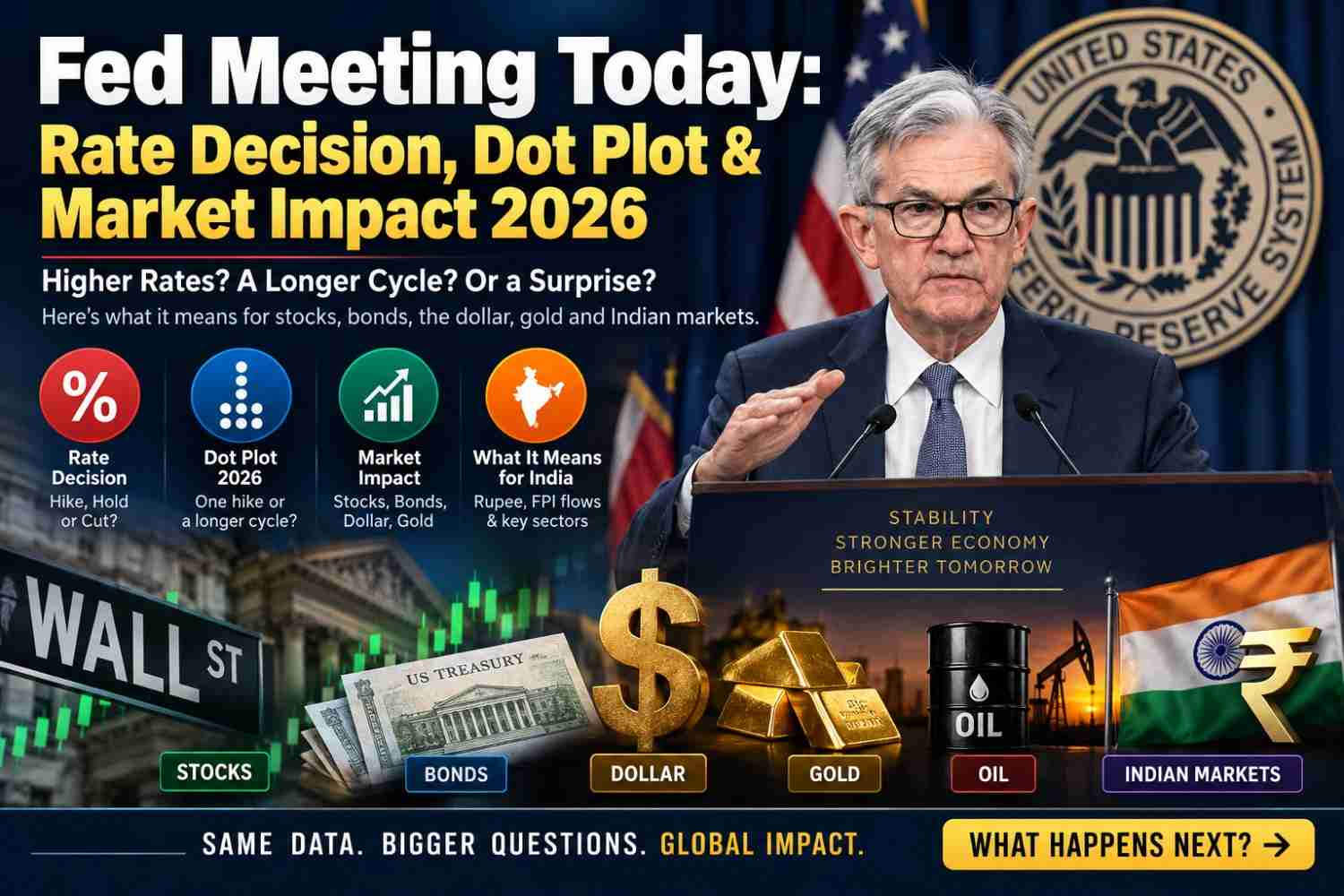
Fed Meeting Today: The Federal Reserve meeting today, September 16, 2026, could deliver the first U.S. interest-rate increase since 2023. Markets are overwhelmingly positioned for a 25-basis-point hike, which would lift the federal funds target range from 3.50%–3.75% to 3.75%–4.00%.
But the rate decision itself may not be the biggest market mover.
Investors will be watching the Fed’s new dot plot, updated inflation forecasts, the FOMC vote and Chair Kevin Warsh’s press conference for clues about whether today’s expected hike is a one-off response to inflation—or the beginning of a broader tightening cycle.
The reaction of the 10-year U.S. Treasury yield could be especially important for stocks, gold and global markets.
🔑 Key Takeaways
- The Fed announces its September decision at 2:00 p.m. ET on September 16, followed by Chair Kevin Warsh’s press conference at 2:30 p.m. ET.
- The current federal funds target range is 3.50%–3.75%.
- Fed-funds futures ahead of the meeting imply roughly a 92.5% probability of a 25-basis-point hike.
- A Reuters poll found 85% of economists expect the Fed to raise rates by 25 basis points.
- The June Fed projections showed a 3.8% median end-2026 policy-rate projection.
- Investors may pay more attention to the new 2026 and 2027 dots than to an expected quarter-point hike.
- Stocks, gold and the dollar could react heavily to movements in Treasury yields after the announcement.
- For India, the combination of U.S. rates, the dollar and oil prices will be critical for the rupee, bonds and foreign portfolio flows.
📋 What’s Covered
This article explains the Fed meeting time, rate-hike expectations, the latest inflation and employment data, the 2026 dot plot, possible FOMC dissent, potential reactions in stocks, bonds, gold and the dollar, and what the decision could mean for Indian markets.
Fed Meeting Today: What Time Is the Fed Rate Decision?
The Federal Open Market Committee concludes its two-day meeting on Wednesday, September 16, 2026.
The Federal Reserve’s official calendar lists the policy announcement for 2:00 p.m. ET, followed by the FOMC press conference at 2:30 p.m. ET.
For Indian investors, that translates to:
| Fed Event | US Time | India Time |
|---|---|---|
| FOMC rate decision | 2:00 p.m. ET | 11:30 p.m. IST |
| Kevin Warsh press conference | 2:30 p.m. ET | 12:00 a.m. IST, Sept. 17 |
The current target range for the federal funds rate is 3.50%–3.75%.
A quarter-point hike would take it to 3.75%–4.00%.
📈 Will the Fed Raise Interest Rates Today?
Financial markets are heavily positioned for a rate increase.
Fed-funds futures were pricing roughly a 92.5% probability of a 25-basis-point hike ahead of the decision. A Reuters survey separately found that 85% of economists expected a quarter-point increase.
That would mark the Fed’s first rate hike since 2023.
| Expectation | Latest pre-decision signal |
|---|---|
| Current Fed target range | 3.50%–3.75% |
| Expected new range after 25 bps hike | 3.75%–4.00% |
| Market-implied probability of 25 bps hike | ~92.5% |
| Reuters economists expecting 25 bps hike | 85% |
| June median end-2026 Fed rate projection | 3.8% |
Because a quarter-point increase is already heavily reflected in market expectations, the bigger surprise may come from what the Fed says about future rates.
That makes the dot plot especially important.
Why Is the Fed Considering a Rate Hike?
The central issue is inflation.
The Federal Reserve targets 2% inflation over the longer run, but recent price data show that inflation remains elevated.
July’s Personal Consumption Expenditures price index—the Fed’s preferred inflation measure—was up 3.7% from a year earlier, while core PCE inflation was 3.3%.
August’s Consumer Price Index increased 0.4% month over month and 3.4% year over year. Core CPI, excluding food and energy, increased 0.3% during August and 2.4% over 12 months.
Producer prices were even hotter. The August Producer Price Index for final demand rose 0.4% for the month and 5.4% from a year earlier.
| Economic indicator | Latest reading | Why it matters |
|---|---|---|
| July headline PCE | 3.7% YoY | Above the Fed’s 2% goal |
| July core PCE | 3.3% YoY | Shows persistent underlying inflation |
| August CPI | 0.4% MoM / 3.4% YoY | Headline inflation remains elevated |
| August core CPI | 0.3% MoM / 2.4% YoY | Underlying inflation is cooler than headline |
| August PPI | 0.4% MoM / 5.4% YoY | Producer-price pressure remains strong |
| August payrolls | +162,000 | Employment growth remains positive |
| August unemployment | 4.1% | Labour market has not deteriorated sharply |
The labour market has also remained relatively resilient. The U.S. economy added 162,000 nonfarm jobs in August, while unemployment held at 4.1%.
Taken together, these figures help explain why expectations shifted sharply toward a September hike.
What Changed Since the July 2026 Fed Meeting?
The Fed held rates steady at its July 28–29 meeting, but the vote showed significant disagreement.
The decision passed 9–3.
Beth Hammack, Neel Kashkari and Lorie Logan dissented because they preferred a 25-basis-point rate increase.
That detail matters today.
If the Fed now raises rates by 25 basis points, the July dissenters would effectively see their preferred policy action adopted. The question then becomes whether officials agree about what should happen after September.
Since July, three developments have become particularly important:
Inflation remains above target. PCE, CPI and producer-price data continue to show price pressures, although underlying measures do not all tell the same story.
Energy prices remain a risk. Oil above $100 a barrel has complicated the inflation outlook.
Long-term Treasury yields have climbed. The 10-year Treasury yield recently moved around the 5% area, meaning financial conditions have already tightened substantially even before today’s Fed decision.
🎯 Fed Dot Plot 2026: Why It Could Matter More Than the Rate Hike
The Fed dot plot is part of the Summary of Economic Projections.
Each dot represents an FOMC participant’s assessment of the appropriate federal funds rate at the end of a particular year.
It is important to understand what the dot plot isn’t: it is not a promise, official forecast or guaranteed policy path.
Instead, it provides a snapshot of how policymakers individually see interest rates evolving under their economic outlooks.
What Did the June 2026 Fed Projections Show?
The June projections showed a significant change in the Fed’s inflation outlook.
| Median projection | March 2026 | June 2026 |
|---|---|---|
| 2026 real GDP growth | 2.4% | 2.2% |
| 2026 unemployment | 4.4% | 4.3% |
| 2026 PCE inflation | 2.7% | 3.6% |
| 2026 core PCE inflation | 2.7% | 3.3% |
| End-2026 federal funds rate | 3.4% | 3.8% |
| End-2027 federal funds rate | 3.1% | 3.6% |
The biggest change was inflation.
The median projection for 2026 PCE inflation jumped from 2.7% in March to 3.6% in June, while the median projected year-end federal funds rate rose from 3.4% to 3.8%.
That is why today’s updated projections could move markets substantially.
🔍 What Should Investors Look for in the September Dot Plot?
If the Fed raises rates to a 3.75%–4.00% range, the new year-end median will help indicate how many additional moves participants consider appropriate.
A simplified way of interpreting the new dots would be:
| New end-2026 median | Possible interpretation |
|---|---|
| Around 3.9% | Consistent with no additional 2026 hike |
| Around 4.1% | Consistent with roughly one additional 25 bps increase |
| Around 4.4% | Consistent with substantially more tightening |
These are scenario interpretations, not forecasts.
The 2027 projection is equally important.
If the 2026 dot moves higher but the 2027 median still points toward lower rates, policymakers could be signalling that the inflation response is temporary.
If both the 2026 and 2027 dots move materially higher, markets could interpret that as evidence of a more persistent higher-rate environment.
Could FOMC Members Dissent Today?
Yes.
July’s three dissenting members wanted rates higher.
If the majority approves a 25-basis-point increase today, the direction of any dissent could change.
| Possible vote | Potential market interpretation |
|---|---|
| Unanimous 25 bps hike | Broad committee support for the move |
| 1–2 votes for no change | Some policymakers prefer patience |
| Vote for a 50 bps hike | At least one participant sees greater inflation urgency |
| No change with multiple hike dissents | Significant disagreement over inflation response |
The vote alone does not determine future policy, but it can reveal how broad the consensus is.
📊 Fed Rate Hike Impact on Stocks
A Fed rate hike is not automatically bearish for stocks.
Markets react to the difference between what happened and what was expected.
Because investors are already heavily positioned for a 25-basis-point hike, that action alone may contain relatively little new information.
The bigger variables are likely to be:
- the 2026 dot;
- the 2027 dot;
- changes to inflation forecasts;
- Chair Warsh’s comments;
- the 2-year Treasury yield; and
- the 10-year Treasury yield.
A quarter-point hike accompanied by a relatively restrained future rate path would send a very different signal from the same hike accompanied by sharply higher rate projections.
Growth and technology shares can be particularly sensitive to long-term yields because higher discount rates reduce the present value investors assign to future earnings.
🏦 Why the 10-Year Treasury Yield Could Be the Key Market Signal
The Fed directly controls a short-term policy rate, not the 10-year Treasury yield.
Long-term yields incorporate expectations about inflation, growth, future monetary policy, fiscal conditions and the term premium.
That creates an interesting possibility.
A rate hike does not necessarily mean the 10-year yield must rise.
If investors believe the Fed’s action increases the probability that inflation will return toward target, long-term inflation compensation could ease.
Conversely, an unexpectedly dovish outcome could lower short-term yields while leaving longer-term yields elevated if investors become more concerned about persistent inflation.
One useful framework is:
Market reaction = decision surprise + policy-path surprise + changes in inflation/growth expectations
Watch the yield curve after the announcement rather than relying only on the S&P 500’s first move.
| 2-Year Yield | 10-Year Yield | One possible interpretation |
|---|---|---|
| 📈 Up | 📉 Down | Tighter near-term policy, softer longer-term inflation expectations |
| 📈 Up | 📈 Up | Markets see rates/inflation staying higher |
| 📉 Down | 📉 Down | Markets price a softer policy path |
| 📉 Down | 📈 Up | Short-term easing expectations but persistent long-term inflation/fiscal concerns |
These are simplified interpretations; Treasury yields can move for several reasons simultaneously.
💵 How Could the Fed Decision Affect the US Dollar?
Higher U.S. interest-rate expectations can support the dollar because higher yields may increase the relative appeal of dollar-denominated assets.
But once again, expectations matter.
If the Fed delivers the widely anticipated quarter-point hike but signals little appetite for further tightening, the dollar could react differently than it would to a hike accompanied by sharply higher 2026 and 2027 dots.
Investors should therefore watch both the rate decision and forward rate expectations.
🪙 What Could the Fed Rate Decision Mean for Gold?
Gold typically faces competing forces around Fed meetings.
Higher real interest rates can create a headwind because gold does not pay interest. A stronger dollar can also make dollar-priced gold more expensive for buyers using other currencies.
However, gold can benefit from inflation concerns, geopolitical uncertainty or falling real yields.
Gold was trading around $4,350 an ounce on September 16, with prices rising as Treasury yields and oil eased ahead of the Fed decision.
For gold investors, the most important post-Fed indicators may therefore be:
real yields + US dollar + inflation expectations
rather than the rate decision alone.
Three Fed Scenarios Markets Could Face Tonight
Scenario 1: Fed Raises Rates by 25 Basis Points
This is the outcome markets have largely anticipated.
Attention would quickly shift to the dots and Warsh’s press conference.
A restrained projected rate path could be interpreted differently from projections showing multiple additional increases.
Scenario 2: Fed Leaves Rates Unchanged
A hold would be a significant surprise relative to current market pricing.
Short-term Treasury yields could fall as traders reprice the near-term policy path.
The longer-term reaction would depend on why the Fed held rates and how markets interpret the inflation outlook.
Scenario 3: Fed Delivers a Larger Increase
A hike larger than 25 basis points would represent a major surprise.
Markets would likely reassess the expected peak in rates and the Fed’s inflation outlook rapidly.
The exact reaction across stocks, bonds, gold and currencies would still depend on the Fed’s explanation and future guidance.
🇮🇳 What Does the Fed Decision Mean for India?
Indian investors face a combination of external pressures rather than the Fed decision in isolation.
Three variables are especially important:
U.S. Treasury yields, crude oil and USD/INR.
The Indian rupee closed around ₹95.96 per U.S. dollar on September 16, after briefly approaching ₹96. Reuters reported that Reserve Bank of India intervention had helped limit losses.
Oil remains another major factor because India imports a large share of its crude requirements. Oil above $100 can increase the import bill and contribute to inflation and currency pressure.
A higher U.S. rate path can also affect the relative attractiveness of emerging-market assets and therefore foreign portfolio flows.
Indian investors may want to watch:
- USD/INR
- Brent crude
- U.S. 10-year Treasury yield
- foreign institutional flows
- Indian government bond yields
- RBI liquidity and currency operations
Oil-sensitive sectors such as airlines, paints and tyres can face higher input costs when crude prices remain elevated.
Export-oriented businesses may receive some translation benefit from a weaker rupee, although the actual impact depends on hedging, input costs and overseas demand.
📌 How to Read the Fed Decision Tonight
Instead of reacting only to the headline, follow the information in this order:
- Rate decision: Did the Fed hike 25 basis points, hold or surprise markets?
- 2026 dot: How much additional tightening do policymakers consider appropriate?
- 2027 dot: Does the higher-rate environment extend into next year?
- Inflation forecast: Did projected PCE inflation rise again?
- Growth forecast: Has the Fed changed its view of economic resilience?
- Vote: Was the decision unanimous?
- Warsh press conference: What does the chair say about inflation and future decisions?
- Treasury market: What happens to the 2-year and 10-year yields?
- Dollar and gold: Do they confirm or contradict the initial bond-market reaction?
The first move after 2:00 p.m. ET may not be the lasting one. The projections arrive with the decision, while the press conference begins 30 minutes later and can change the market’s interpretation.
Fed Meeting Today: What Matters Most
A 25-basis-point increase to 3.75%–4.00% is the dominant pre-meeting expectation, based on both futures pricing and economist surveys.
That means the most important question may not be whether the Fed hikes today.
It may be what happens next.
The September dot plot will show whether policymakers’ rate expectations have shifted higher for 2026 and 2027. The vote will reveal the degree of agreement within the FOMC. Warsh’s press conference will provide additional context.
And the Treasury market will offer an immediate real-world test of how investors interpret the entire package.
For U.S. equities, watch the 10-year yield. For gold, watch real yields and the dollar. For Indian markets, watch USD/INR, crude oil and U.S. Treasury yields.
The central issue for markets tonight is therefore broader than a single 25-basis-point move: does the September decision point to a limited inflation response, or to a longer period of higher U.S. interest rates?
❓ Fed Meeting Today FAQs
What time is the Fed meeting today?
The Federal Reserve is scheduled to announce its September 2026 interest-rate decision at 2:00 p.m. ET on September 16, followed by Chair Kevin Warsh’s press conference at 2:30 p.m. ET. That is 11:30 p.m. IST for the decision and 12:00 a.m. IST on September 17 for the press conference.
Will the Fed raise interest rates today?
Markets strongly expect a rate increase. Ahead of the decision, fed-funds futures implied roughly a 92.5% probability of a 25-basis-point hike, while 85% of economists surveyed by Reuters expected a quarter-point increase.
What is the current Federal Reserve interest rate?
Before today’s decision, the federal funds target range is 3.50%–3.75%. A 25-basis-point increase would move the range to 3.75%–4.00%.
When did the Fed last raise interest rates?
If the Fed raises rates today, it would be the first U.S. rate increase since 2023.
What is the Fed dot plot?
The Fed dot plot shows individual FOMC participants’ assessments of the appropriate federal funds rate at the end of future years. It is not a guaranteed policy forecast. Investors use it to understand how policymakers’ views of the rate path are changing.
What was the Fed’s June 2026 rate projection?
The June Summary of Economic Projections showed a median end-2026 federal funds rate of 3.8%, compared with 3.4% in the March projections. The median 2027 projection was 3.6%.
How could a Fed rate hike affect stocks?
An expected 25-basis-point hike may have a smaller effect than an unexpected change in the Fed’s future rate projections. Growth stocks can be especially sensitive to changes in long-term Treasury yields.
How could the Fed decision affect gold?
Gold’s reaction will depend heavily on real Treasury yields, the U.S. dollar and inflation expectations. Higher real yields can pressure gold, while lower yields, dollar weakness or persistent inflation concerns can support it.
How could the Fed decision affect the Indian rupee?
A higher U.S. rate path can support the dollar and increase pressure on emerging-market currencies. For India, the effect also depends heavily on crude oil prices, foreign capital flows and RBI actions.