
 bobby
bobby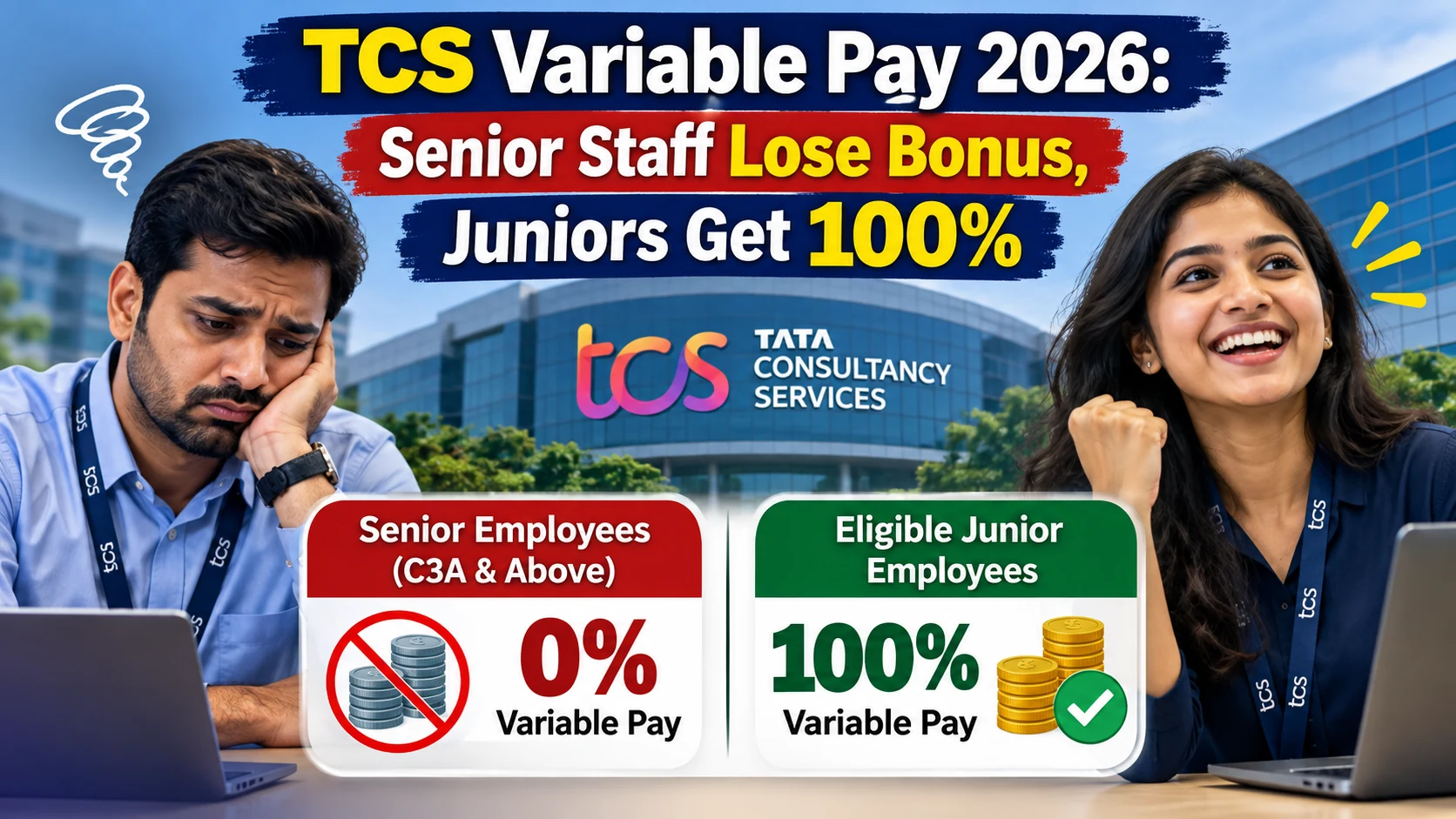
TCS variable pay 2026: India’s largest IT services company, Tata Consultancy Services (TCS), has made a significant decision regarding its quarterly employee bonuses. Senior employees in the C3A grade and above will receive zero quarterly variable allowance (QVA) for the July–September 2026 quarter, while eligible junior employees will receive their full 100% payout.
The development comes after the company failed to achieve its internal performance targets, highlighting the challenges facing India’s information technology sector.
For thousands of technology professionals, the TCS variable pay 2026 update raises important questions about salary structures, performance-linked incentives, employee motivation, and the future of compensation in India’s IT industry.
📢 TCS Quarterly Variable Pay: What Happened?
According to an internal communication attributed to TCS Chief Human Resources Officer Sudeep Kunnumal, the company decided not to distribute quarterly variable allowances to employees holding C3A grades and above.
The decision follows the company’s performance falling short of internal expectations during the September 2026 quarter.
However, junior employees remain eligible for their complete quarterly variable compensation.
This creates a noticeable difference between employee categories, with senior professionals receiving no variable payout and eligible junior staff receiving 100%.
The announcement is particularly significant because employees have indicated that this is the first explicit complete withholding of quarterly variable pay for certain staff groups in at least two years.
💼 Which TCS Employees Will Not Receive Bonuses?
The latest TCS bonus decision primarily affects employees classified under C3A and higher grades.
These positions generally include experienced professionals with approximately seven to ten years of industry experience, extending to senior management roles.
Employees working in these categories may hold responsibilities involving project management, client relationships, technical leadership, and business delivery.
Although these professionals may have individual performance achievements, quarterly variable compensation can also depend on broader organizational results.
Employee Categories and Bonus Eligibility
- C3A grade and above: No quarterly variable allowance for the September 2026 quarter.
- Eligible junior-level employees: Full 100% quarterly variable payout.
- Future quarters: Bonus decisions have not been confirmed under this announcement.
Importantly, the decision concerns quarterly variable compensation, not an announced reduction in employees’ fixed basic salaries.
📊 TCS Variable Pay 2026: Senior vs Junior Employee Comparison
📊 TCS Variable Pay 2026: Senior vs Junior Employee Comparison
Quarterly Variable Allowance (QVA) | July–September 2026
| Employee Category | Quarterly Payout | Status |
|---|---|---|
| Senior Staff (C3A & Above) | 0% | No QVA Payout |
| Eligible Junior Staff | 100% | Full QVA Payout |
Important: These percentages represent quarterly variable allowance payouts, not employees’ total salaries. The comparison relates to the reported September 2026 quarter.
📉 Why Did TCS Stop Variable Pay for Senior Employees?
The main reason behind the TCS quarterly bonus decision is the company’s inability to meet its internal performance targets.
Several business factors provide important context.
1. Slower Revenue Growth
TCS reported its weakest sequential revenue growth for a September quarter in three years.
Slower growth can affect profitability expectations, business planning, and performance-linked compensation budgets.
2. Pressure on Traditional IT Services
Technology companies continue to face challenges in traditional outsourcing and IT services.
Clients are increasingly focused on cost efficiency, automation, and measurable returns from technology investments.
These trends can make revenue growth more difficult even for established industry leaders.
3. Company-Level Performance Requirements
Variable compensation is not always determined solely by individual employee performance.
Business unit results, organizational targets, and company-wide financial performance can influence final payouts.
Consequently, employees may receive reduced incentives even when they successfully complete their assigned responsibilities.
🤖 TCS AI Revenue Rises Nearly 20% Despite Bonus Cuts
One of the most interesting developments is the contrast between TCS’s growing artificial intelligence business and its weaker overall quarterly performance.
The company reported that AI-related revenue increased by nearly 20%, demonstrating demand for emerging technology services.
Businesses worldwide are investing in AI-powered automation, intelligent customer support, data analytics, and digital transformation.
These opportunities could support future revenue growth.
However, expanding AI revenue does not automatically compensate for slower growth across traditional IT services.
The market also reacted positively to AI-related momentum, with TCS shares rising as much as 6.2% during trading on October 9, 2026.
The contrast highlights an important reality: a company can experience strong growth in emerging technologies while simultaneously facing financial pressure in established business segments.
👨💻 How Will the Bonus Decision Affect TCS Employees?
The absence of quarterly variable pay could have several consequences for affected employees.
Reduced take-home compensation: Employees who include performance bonuses in their financial planning may experience lower earnings than expected.
Employee morale: Professionals who have met individual targets may feel disappointed when company-level performance affects their incentives.
Career decisions: Compensation uncertainty could encourage some experienced employees to evaluate alternative employment opportunities.
Financial planning: Workers may need to distinguish guaranteed fixed compensation from performance-linked income when planning household expenses.
These are potential implications rather than confirmed outcomes.
The actual financial impact will depend on each employee’s compensation structure and eligible quarterly allowance.
🏢 What Does This Mean for India’s IT Industry?
The TCS variable pay decision highlights broader challenges facing the Indian technology services industry.
Major IT companies operate in a competitive global environment where customer spending, international economic conditions, and technological disruption can influence business performance.
Artificial intelligence is creating new opportunities, but companies must also manage the transition from traditional services toward advanced digital solutions.
For employees, this environment makes compensation transparency and professional upskilling increasingly important.
Skills involving AI integration, cloud computing, cybersecurity, data engineering, and enterprise automation may become more valuable as businesses adjust their technology strategies.
However, developing these skills does not guarantee higher bonuses or employment security.
🔮 Will TCS Restore Senior Employee Bonuses?
The current decision specifically concerns the September 2026 quarter.
There is no confirmed announcement in the reported memo establishing whether senior employees will receive full variable compensation in subsequent quarters.
Future payouts may depend on business performance, internal compensation policies, and management decisions.
Employees should therefore avoid assuming that the current zero payout will automatically continue or that full bonuses will return immediately.
Official employee communications will remain important for understanding future eligibility.
❓ Frequently Asked Questions About TCS Variable Pay 2026
1. Why did TCS stop quarterly bonuses for senior employees?
TCS withheld quarterly variable pay for C3A-grade employees and above because the company’s performance fell short of internal targets during the September 2026 quarter.
2. Which TCS employees will receive 100% variable pay?
Eligible junior-level TCS employees will receive 100% of their quarterly variable allowance, according to the reported internal communication.
3. What is the C3A grade in TCS?
C3A is an employee grade generally associated with experienced professionals. The affected C3A-and-above group includes employees with approximately seven to ten years of experience through senior management.
4. Does zero variable pay mean a salary cut?
Not necessarily. The announcement concerns quarterly performance-linked compensation. It does not establish a reduction in employees’ fixed salaries.
5. Will TCS employees receive bonuses next quarter?
Future bonus payouts have not been confirmed in the reported announcement. They may depend on company performance and applicable compensation policies.
✅ Conclusion: What Employees Should Know
The TCS variable pay 2026 decision represents a significant compensation development for India’s IT workforce.
While eligible junior employees will receive their full quarterly allowances, senior employees at C3A grade and above will miss their September-quarter variable payouts.
The decision reflects the challenges of balancing employee compensation with organizational performance during a period of changing technology demand.
For affected professionals, understanding salary components, monitoring official company announcements, and maintaining financial flexibility will be particularly important.
As TCS expands its artificial intelligence business, future financial performance could play an important role in determining how employee incentives evolve.