
 bobby
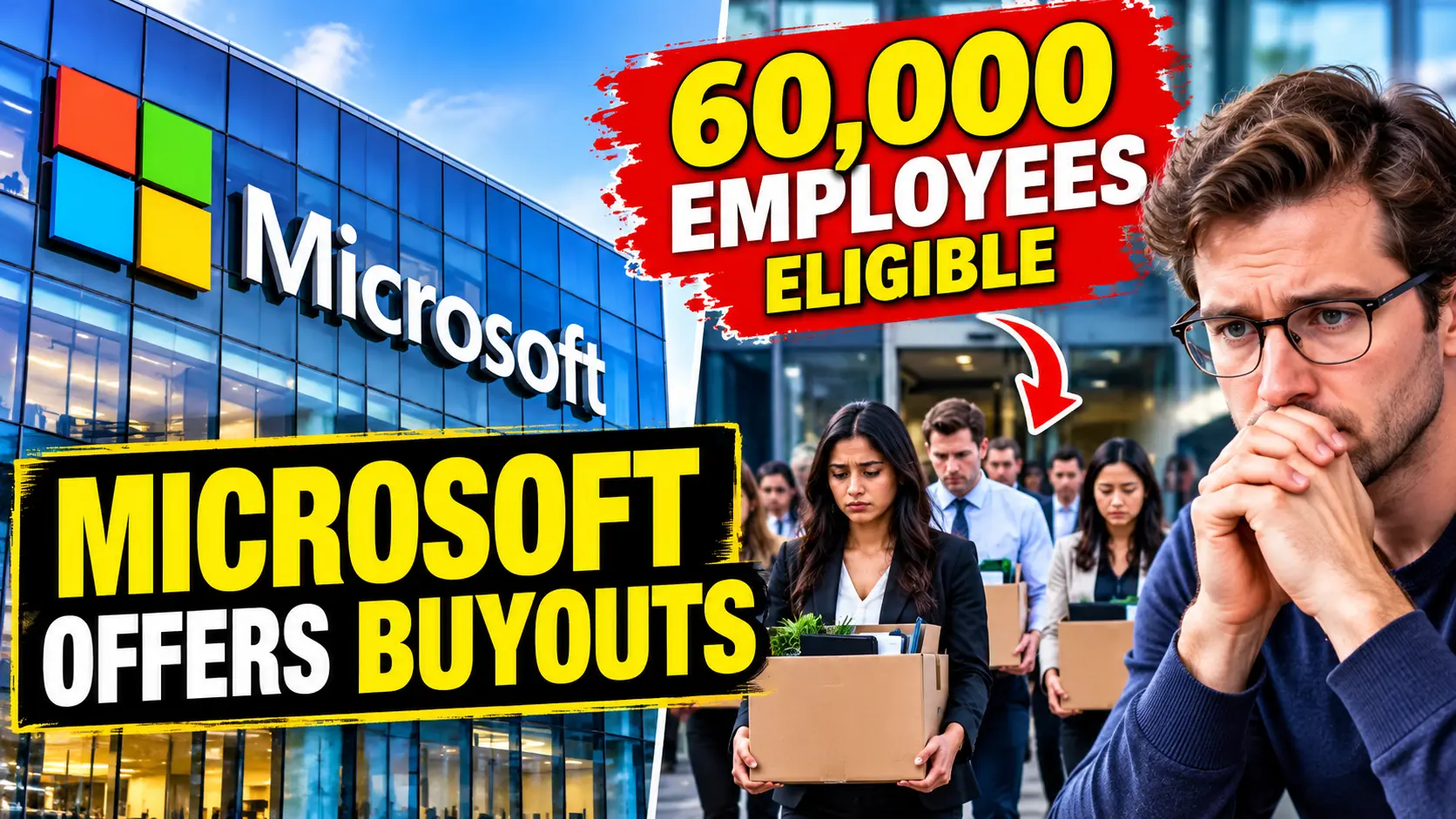
Microsoft Buyouts 2026: Microsoft is offering voluntary buyouts to approximately 60,000 employees across the United States, India, the United Kingdom and Canada, according to a report published on October 26, 2026. The move comes as the technology giant continues investing heavily in artificial intelligence (AI) while seeking to manage costs and adapt its workforce to changing business priorities.
The reported programme covers eligible employees in selected departments and is not a compulsory layoff announcement. However, its potential scale highlights how major technology companies are reassessing their workforce strategies during the rapid expansion of AI.
Microsoft Buyouts 2026: What Is the Latest Announcement?
Microsoft’s reported voluntary exit programme could make approximately 60,000 employees eligible to receive buyout offers. The figure was reported by Business Insider and cited by Reuters.
Microsoft said the programme would be available to eligible employees in participating teams at internal job level 70 and below across four countries.
The company described the initiative as a time-limited, voluntary programme designed to give employees considering opportunities outside Microsoft a supported route to leave. It also gives participating business units another way to adjust their workforce according to changing operational requirements.
Importantly, the reported figure represents the number of potentially eligible employees, not the number of people confirmed to be leaving the company. The eventual number of departures will depend on employee decisions and programme eligibility.
📊 Microsoft Buyouts 2026: Key Facts
A quick overview of Microsoft’s reported voluntary employee exit programme announced in October 2026.
| Key Information | Details |
|---|---|
| Company | Microsoft |
| Announcement Date | October 26, 2026 |
| Potentially Eligible Employees | Approximately 60,000 |
| Programme Type | Voluntary exit / buyout offer |
| Participating Countries | United States, India, United Kingdom and Canada |
| Eligible Job Levels | Level 70 and below in participating teams |
| Reported Participating Divisions | AI experiences, Copilot, Finance, Human Resources, Xbox and Windows + Devices |
| Reported Excluded Units | Marketing, commercial business and security |
| Global Workforce | 223,000 full-time employees as of June 30, 2026 |
| 2026 Capital Expenditure Forecast | Approximately $175 billion |
| Confirmed Number of Departures | Not established by the reported announcement |
Which Countries Are Included in Microsoft’s Buyout Programme?
The voluntary exit offer covers eligible employees in four countries:
- India: Employees in participating teams may qualify under the programme’s eligibility criteria.
- United States: Eligible employees in selected departments can consider the offer.
- United Kingdom: Participating teams are included in the initiative.
- Canada: Eligible employees may also receive voluntary exit offers.
The company has not established that every employee in these countries qualifies. Eligibility depends on the employee’s internal level and whether their team participates in the programme.
The announcement is particularly relevant to India’s technology sector because Microsoft has a substantial workforce in the country. However, the precise number of Indian employees eligible for this offer has not been established in the reported announcement.
Which Microsoft Departments Are Affected?
According to information reported by Reuters from a source familiar with the matter, participating divisions include several important parts of Microsoft’s business.
These include:
- AI experiences
- Copilot
- Finance
- Human resources
- Xbox
- Windows + Devices
The same report identified marketing, commercial business and security as excluded areas.
This distinction matters because the programme is not a company-wide offer available to everyone. Microsoft’s approach allows selected teams to participate while other business units continue operating under their existing workforce arrangements.
The inclusion of AI-related products, Windows and Xbox also demonstrates that workforce planning is taking place across different parts of Microsoft’s technology business. Nevertheless, the announcement alone does not establish that AI has directly replaced particular employees or roles.
Why Is Microsoft Offering Voluntary Buyouts?
1. Managing Operating Costs
Large technology companies must balance employee expenses, product development, infrastructure spending and long-term profitability.
A voluntary buyout programme can help a company adjust its workforce without relying exclusively on compulsory redundancies. Employees who already intend to pursue another opportunity may choose to leave with financial and career-transition support.
For Microsoft, the programme offers participating departments another way to respond to changing business needs.
However, the precise savings expected from the initiative have not been publicly established in the cited report.
2. Expanding Artificial Intelligence Infrastructure
Microsoft is investing heavily in AI capabilities, cloud computing and the infrastructure required to support advanced digital services.
AI systems require substantial computing resources, including specialised chips, servers, networking equipment and data centres. Building and operating this infrastructure can require significant capital expenditure.
Microsoft forecast capital expenditure of approximately $175 billion for calendar year 2026, according to the Reuters report.
That spending highlights the scale of the company’s infrastructure ambitions. It also places greater importance on how efficiently Microsoft allocates its resources across infrastructure, research, product development and staffing.
The buyout announcement comes amid investor scrutiny over whether large AI investments will generate sufficient financial returns.
However, it would be inaccurate to conclude that the programme is solely intended to pay for AI infrastructure. The reported announcement describes a broader effort to adapt the workforce and manage changing business requirements.
3. Restructuring Business Priorities
Technology companies regularly review their organisational structures as customer demand, competition and product strategies evolve.
Microsoft operates across cloud services, productivity software, gaming, operating systems and AI products. Different teams may therefore face different hiring requirements, growth opportunities and cost pressures.
A targeted voluntary exit programme allows participating departments to adjust staffing while giving eligible employees a choice about their future.
How Many Microsoft Employees Could Be Affected?
Microsoft reported having 223,000 full-time employees worldwide as of June 30, 2026.
Compared with that workforce, approximately 60,000 potentially eligible employees represent about 26.9%.
This percentage describes the potential eligibility pool, not the number of employees expected to leave.
If every potentially eligible employee accepted an offer, the number of departures would be substantial. However, there is no basis for assuming that all eligible employees will participate.
The actual outcome will depend on the terms offered, employee circumstances, eligibility requirements and decisions made by participating teams.
Microsoft’s earlier workforce initiatives also show that eligibility and acceptance are different measures. A buyout offer can be extended to thousands of employees without resulting in the same number of departures.
What Does the Programme Mean for Microsoft Employees?
For eligible employees, the decision to accept a voluntary buyout can have important financial and professional consequences.
Employees considering the offer may need to evaluate:
- The financial value of the exit package.
- Their years of service and applicable employment benefits.
- The timing of their departure.
- Health insurance and other benefits, where applicable.
- Opportunities for new employment or further education.
- The possibility of finding another suitable role within Microsoft.
The exact terms should be confirmed through the official offer provided to each eligible employee. Employees should not assume that every country, job level or department receives identical benefits.
For people who want to remain with Microsoft, internal career opportunities and changing skill requirements may become important considerations.
The company has indicated that it will continue supporting employees in developing skills and exploring internal opportunities where appropriate.
Will Microsoft’s Buyouts Lead to More Layoffs?
The current announcement describes a voluntary exit programme, which differs from compulsory layoffs.
Under a voluntary programme, eligible employees can choose whether to accept the offer, subject to its terms. A compulsory redundancy process, by contrast, involves an employer ending employment without requiring the employee to opt into a buyout.
Microsoft has undertaken other workforce changes during 2026. The Reuters report also referred to earlier voluntary buyouts and job cuts associated with changes to its Xbox gaming business.
Nevertheless, the latest programme does not establish that another round of compulsory layoffs will follow.
Employees and investors should distinguish between confirmed workforce actions, potential eligibility and speculation about future restructuring.
What Could This Mean for India’s IT Industry?
India’s inclusion in Microsoft’s voluntary exit programme makes the announcement relevant to the country’s technology workforce.
Global technology companies operating in India are navigating changes in AI adoption, cloud computing, automation and enterprise software development.
These shifts may influence which skills employers prioritise and how teams are organised. Professionals with experience in AI engineering, cloud infrastructure, cybersecurity, data engineering and enterprise technology may wish to monitor changing recruitment requirements.
However, Microsoft’s announcement does not establish that India’s IT industry is facing an identical workforce reduction.
The programme is limited to eligible employees in participating Microsoft teams. The number of affected Indian employees and the broader implications for domestic technology employment remain uncertain.
For technology professionals, the practical lesson is to maintain relevant skills, understand employment benefits and assess career decisions using verified information rather than speculation.
Conclusion: Microsoft’s Workforce Strategy Enters Another Phase
Microsoft’s reported buyout programme could make approximately 60,000 employees eligible for voluntary exit offers across four countries. The initiative covers selected departments and comes as the company balances workforce requirements with substantial investments in AI and cloud infrastructure.
The key distinction is that 60,000 employees may be eligible, but that does not mean 60,000 people will leave Microsoft.
The eventual impact will depend on employee participation, programme terms and the company’s evolving business priorities.
For the wider technology industry, the announcement illustrates the importance of understanding how AI investment, operating costs and workforce planning interact. It also reinforces the need for employees to evaluate voluntary exit offers carefully before making major career decisions.
Frequently Asked Questions (FAQ)
These FAQs can be added at the end of the article to address common search queries.
1. Is Microsoft offering buyouts to 60,000 employees?
Microsoft has announced a voluntary exit programme for eligible employees, with approximately 60,000 potentially eligible according to the reported announcement. This does not mean all 60,000 employees will leave.
2. Which countries are included in Microsoft’s buyout programme?
The programme covers eligible employees in the United States, India, the United Kingdom and Canada.
3. Which Microsoft departments are included?
Reported participating divisions include AI experiences, Copilot, finance, human resources, Xbox, and Windows + Devices. Eligibility depends on the participating team and the employee’s internal level.
4. Why is Microsoft offering voluntary buyouts?
The programme is intended to provide employees with a supported exit option while allowing participating business units to adapt to changing workforce requirements. It comes as Microsoft invests heavily in AI infrastructure and manages operating costs.
5. Does the announcement mean Microsoft is laying off 60,000 employees?
No. The programme is voluntary. Approximately 60,000 employees may be eligible, but the number who ultimately leave will depend on their decisions and the programme’s terms.