
 bobby
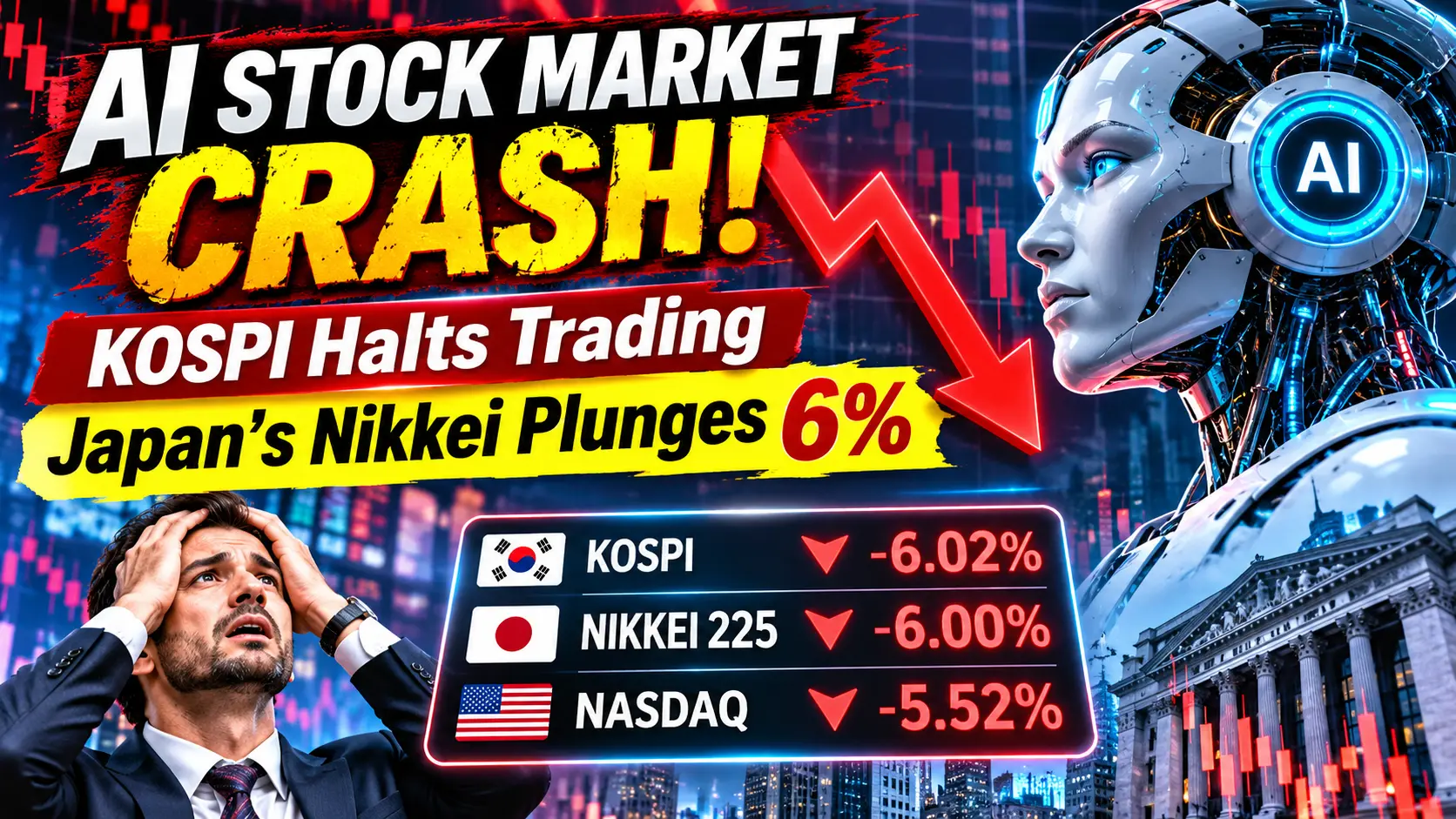
AI Stock Market Crash: Artificial intelligence (AI) has become one of the biggest drivers of global stock market growth. However, growing concerns about AI investments, possible regulatory restrictions, and the future profitability of technology companies have suddenly shaken investor confidence. On November 6, 2026, global technology stocks faced heavy selling pressure, South Korea’s KOSPI triggered a temporary trading halt, and Japan’s Nikkei 225 suffered another major decline.
The latest AI stock market crash fears have raised questions about whether the enormous investments being made in artificial intelligence and data centres can generate sufficient returns. While Wall Street suffered substantial losses, Asian markets also experienced a sharp sell-off. Interestingly, India’s benchmark stock indices moved higher even as many individual investors continued to see losses in their portfolios.
Let’s understand why global markets are falling, what triggered the KOSPI trading halt, and what the latest developments could mean for Indian investors.
📉 Why Is the Global Stock Market Falling?
The latest market sell-off is largely connected to growing uncertainty surrounding the artificial intelligence industry.
Over recent years, technology companies have invested enormous amounts of money in AI infrastructure, advanced semiconductor chips, cloud computing facilities, and data centres. Investors had expected these investments to generate substantial long-term revenue and profits.
However, concerns have emerged about whether this rapid expansion can continue at the same pace.
The November 2026 US midterm election results added another layer of uncertainty. Democratic victories raised investor concerns about potentially tighter regulations affecting AI data centres and infrastructure projects.
Investors are particularly worried that additional restrictions could delay construction, increase operating costs, and affect future investment plans.
This uncertainty triggered selling across major technology stocks, particularly semiconductor companies and businesses closely connected to AI infrastructure.
🌏 Asian Stock Market Performance
November 6, 2026 | Daily closing change
🇺🇸 Wall Street Suffers a Massive Stock Market Sell-Off
The panic first became visible in the US stock market, where major indices experienced significant declines.
According to the November 6 report, the Nasdaq Composite plunged 5.52%, closing at 24,315 points. The S&P 500 also declined by more than 3%, while the Dow Jones Industrial Average suffered a fall of more than 4%.
The combined impact of the sell-off wiped out approximately $3 trillion in market value from US-listed companies, according to the reported estimates.
Technology stocks faced particularly strong selling pressure because investors were reconsidering the valuations of companies benefiting from the AI boom.
The decline also demonstrated how quickly investor sentiment can change when expectations about future profits become uncertain.
For investors who had purchased technology stocks at elevated valuations, the sudden reversal created significant portfolio pressure.
🇰🇷 South Korea KOSPI Crash: Trading Halted for 20 Minutes
One of the most dramatic developments occurred in South Korea.
The country’s benchmark KOSPI index plunged more than 8% during early trading on November 6, briefly falling below the psychologically important 5,000-point level.
The sharp decline triggered a circuit breaker, forcing the exchange to suspend trading for 20 minutes.
A circuit breaker is a temporary trading suspension designed to prevent panic-driven selling from becoming even more extreme during a sudden market decline.
Although the index recovered some losses after trading resumed, it still finished the session down 6.02% at 5,059.69 points.
Major semiconductor companies were among the biggest losers.
Samsung Electronics and SK Hynix experienced significant declines as investors reduced exposure to companies closely connected to the global AI infrastructure expansion.
South Korea’s market reaction highlighted how heavily semiconductor manufacturers can be affected when investors question the future growth of artificial intelligence.
🇯🇵 Japan Nikkei 225 Falls Around 6%
Japan’s stock market also experienced substantial pressure.
The Nikkei 225 declined approximately 6% on November 6, falling to around 57,434 points.
Japanese technology and semiconductor-related companies faced selling pressure as investors reacted to developments in the United States.
Companies associated with chip manufacturing equipment, advanced technology, and AI-related investments were particularly vulnerable.
The decline added to the pressure already affecting Japanese equities during the preceding weeks.
The latest movement also raised concerns about the possibility of a broader correction across Asian technology markets.
Investors are now closely monitoring whether the weakness in semiconductor stocks will continue or whether confidence in AI-related investments will recover.
🌏 Other Asian Stock Markets Also Face Heavy Selling
The weakness was not limited to South Korea and Japan.
Several other Asian markets also recorded losses as investors reduced their exposure to technology-related companies.
Taiwan’s Taiex declined 4.51%, while China’s Shanghai Composite fell 1.17%. Hong Kong’s Hang Seng Index also slipped 1.02%.
Taiwan is particularly important because it plays a major role in the global semiconductor supply chain.
Its technology industry includes companies involved in chip manufacturing, electronics production, and advanced computing infrastructure.
When investors become concerned about the future of AI spending, companies throughout this supply chain can face selling pressure.
The widespread weakness suggests that the market concerns extend beyond individual companies and involve expectations about the future direction of the global technology industry.
🤖 Why Are Investors Suddenly Worried About AI Investments?
Artificial intelligence remains an important technological development, but investors are increasingly focused on one major question: how much money can companies actually earn from their AI investments?
Building AI infrastructure requires enormous capital expenditure.
Technology companies must invest in:
- Advanced semiconductor chips.
- Large-scale data centres.
- High-performance computing systems.
- Electricity and cooling infrastructure.
- Cloud computing networks.
- Research and development.
These investments can support long-term innovation, but they also create financial risks.
If demand grows more slowly than expected, companies may struggle to generate returns quickly enough to justify their spending.
Regulatory uncertainty adds another challenge. Restrictions involving electricity consumption, water usage, environmental concerns, and data-centre construction could increase costs or delay projects.
Investors are therefore reassessing how much they are willing to pay for companies whose valuations depend heavily on future AI growth.
Importantly, the current sell-off does not mean artificial intelligence is disappearing or that the entire AI industry is collapsing. It reflects uncertainty about investment costs, profitability, valuations, and future regulations.
🇮🇳 Indian Stock Market: Why Are Investors Still Seeing Red Portfolios?
Interestingly, the Indian stock market showed a different picture during the reported session.
While several Asian markets declined, India’s Sensex gained approximately 900 points and moved above the 80,000 level. The Nifty 50 also advanced around 200 points, crossing 24,740.
However, many individual investors were still disappointed because their portfolios remained in the red.
Why did this happen?
The main reason was the difference in performance between large-cap stocks and mid-cap and small-cap stocks.
Large-cap companies performed relatively better, supporting the benchmark indices. However, mid-cap and small-cap stocks experienced declines of around 2% in the reported market snapshot.
Many retail investors have considerable exposure to smaller companies through direct stock investments and mutual funds.
Consequently, even when the headline indices rise, individual portfolios can decline if the stocks held by investors underperform.
This is an important lesson about the difference between index performance and personal portfolio performance.
A rising Sensex does not automatically mean every investor is making money.
📊 What Should Investors Watch Next?
The next phase of the global market movement may depend on several important developments.
1. US AI regulations: Investors will monitor whether proposed regulatory changes actually affect data-centre construction and AI infrastructure investments.
2. Semiconductor earnings: Financial results from major chipmakers could provide important information about future demand and profitability.
3. Technology company spending: Investors will examine whether major companies continue increasing AI expenditure and whether those investments generate sufficient revenue.
4. Global interest rates: Changes in borrowing costs can influence technology valuations and investor appetite for risk.
5. Asian market stability: The recovery of South Korea, Japan, and Taiwan’s technology shares will be important indicators of changing market sentiment.
Investors should avoid making decisions based only on dramatic market headlines. Understanding company fundamentals, valuation, financial goals, and risk tolerance is essential.
🔎 Final Thoughts: Is the AI Stock Market Crash a Warning for Investors?
The November 6, 2026 sell-off demonstrates how quickly global financial markets can react when expectations about a major growth industry change.
South Korea’s KOSPI trading halt, Japan’s Nikkei decline, and Wall Street’s technology-led losses highlight the importance of investor confidence in determining market direction.
Artificial intelligence continues to offer significant technological opportunities. However, the latest market reaction shows that investors are becoming more selective about companies benefiting from the AI boom.
For Indian investors, the key takeaway is that benchmark index performance does not always reflect the health of individual portfolios.
Rather than reacting emotionally to sudden market movements, investors should focus on diversification, company fundamentals, and long-term financial objectives.
The big question remains: Is this a temporary correction in the global AI investment boom, or the beginning of a deeper reassessment of technology stock valuations?
Only the coming market sessions will provide more clarity.
Frequently Asked Questions (FAQ) – SEO section
❓ Frequently Asked Questions About the AI Stock Market Crash
1. Why did the global stock market fall on November 6, 2026?
Global markets declined because investors became concerned about possible restrictions on AI data-centre investments, technology spending, and the future profitability of semiconductor companies.
2. Why was South Korea’s KOSPI trading halted?
South Korea’s KOSPI fell more than 8% during early trading, triggering a circuit breaker. Trading was temporarily suspended for 20 minutes to control extreme market volatility.
3. How much did Japan’s Nikkei 225 fall?
Japan’s Nikkei 225 declined approximately 6% during the November 6, 2026 trading session.
4. Why are AI stocks falling?
Investors are concerned about the enormous costs of AI infrastructure, uncertain returns on investment, and possible regulatory restrictions affecting data-centre expansion.
5. Did the Indian stock market also decline?
No. In the reported November 6 session, the Sensex gained around 900 points and the Nifty advanced approximately 200 points. However, several mid-cap and small-cap stocks experienced losses.
6. Does the AI stock market crash mean artificial intelligence is finished?
No. The sell-off reflects concerns about company valuations, investment costs, profitability, and regulation. It does not mean AI technology or its long-term potential has disappeared.
7. What should investors watch after the global market crash?
Investors should monitor AI company earnings, semiconductor demand, data-centre investments, regulatory developments, interest rates, and global market volatility.