 bobby
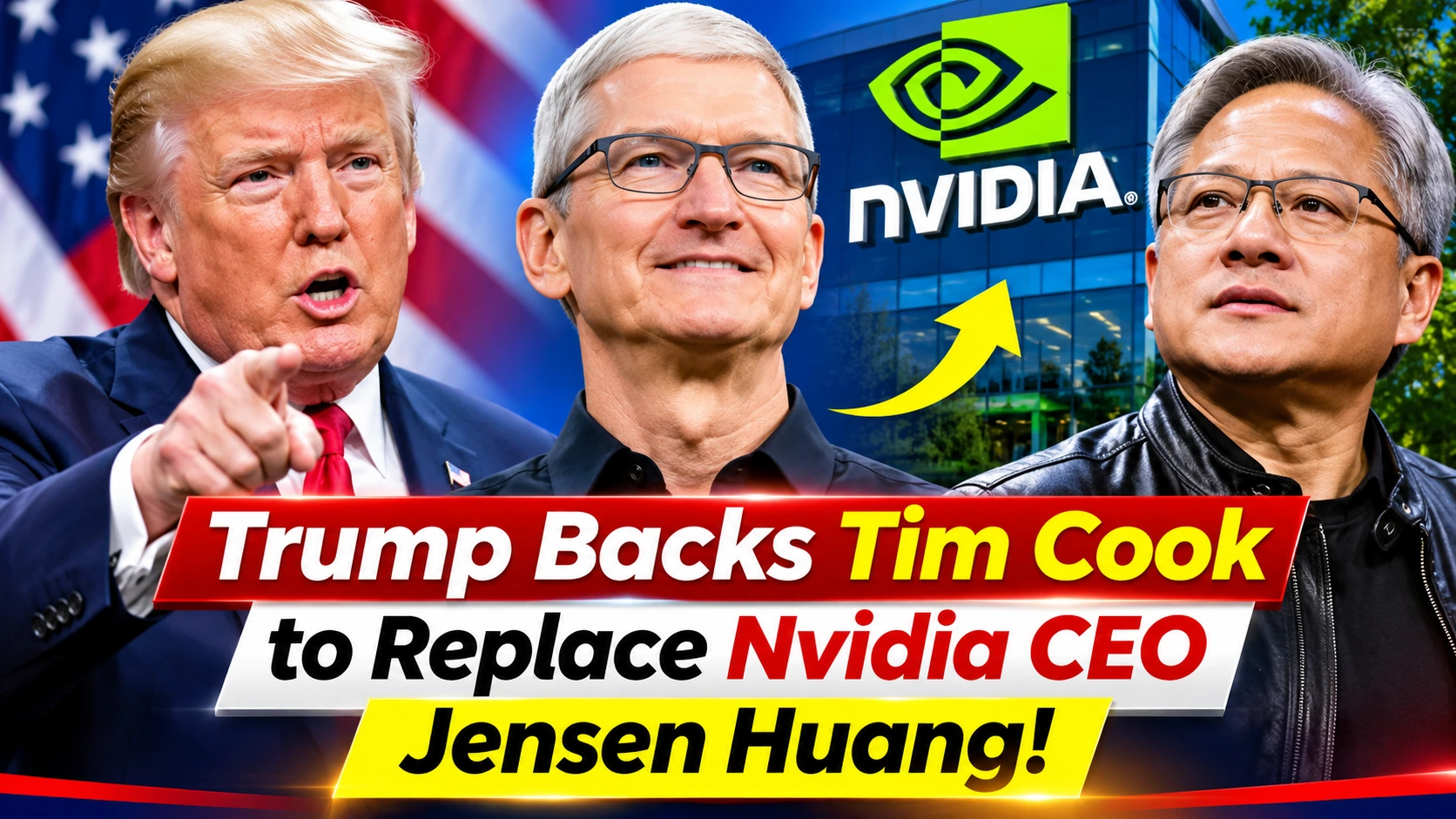
Trump Backs Tim Cook: Donald Trump has publicly backed former Apple CEO Tim Cook as a potential replacement for Jensen Huang at Nvidia, following Huang’s unexpected resignation from the artificial intelligence chip giant.
The US president’s recommendation has attracted widespread attention across Silicon Valley, raising questions about Nvidia’s future leadership and whether one of Apple’s most recognizable executives could take charge of the world’s leading AI chipmaker.
In a Truth Social post on Thursday, Trump praised Huang’s achievements while declaring that Cook was the person he wanted to see succeed him.
The development comes during a turbulent period for Nvidia, whose leadership crisis has intensified scrutiny of its corporate governance and long-term direction.
However, Trump’s endorsement does not mean Tim Cook has been appointed Nvidia CEO. The company has named Chief Financial Officer Colette Kress as interim chief executive while it considers a permanent successor.
Here’s everything you need to know about Trump’s announcement, Jensen Huang’s departure, Tim Cook’s qualifications, and the implications for the global AI industry.
🚨 Trump Says Tim Cook Should Replace Jensen Huang at Nvidia
President Donald Trump made headlines on November 12, 2026, after publicly recommending Tim Cook for Nvidia’s top leadership position.
In his social media statement, Trump praised Jensen Huang for his performance and described Cook as the ideal person to take over.
He concluded with the words: “A Legend replaces a Legend!”
The statement immediately placed Cook at the center of discussions about Nvidia’s leadership transition.
Trump’s endorsement is particularly significant because both Apple and Nvidia are major players in the American technology industry.
Apple has built its reputation around consumer electronics, software, and integrated hardware ecosystems, while Nvidia has become a driving force behind the rapid expansion of artificial intelligence infrastructure.
Although both companies operate in different markets, their businesses increasingly intersect through advanced computing, semiconductor development, and AI technologies.
Trump’s recommendation reflects his confidence in Cook’s leadership experience, but the final decision rests with Nvidia’s board of directors.
📉 Why Did Jensen Huang Resign as Nvidia CEO?
Jensen Huang’s departure represents one of the most significant leadership changes in the technology industry in 2026.
Huang co-founded Nvidia in 1993 and spent more than three decades transforming the company from a graphics-chip specialist into a global leader in AI computing.
Under his leadership, Nvidia’s graphics processing units became essential components for training and running increasingly sophisticated artificial intelligence systems.
However, his resignation followed reports concerning his personal conduct and a subsequent corporate investigation.
The controversy included reports about extramarital relationships, including allegations involving a businesswoman whom US intelligence officials reportedly suspected of connections to Chinese intelligence.
These intelligence-related claims remain allegations and should not be treated as established findings of wrongdoing by Huang.
The reports raised questions about corporate governance, executive accountability, and potential security risks.
Following the controversy, Nvidia announced Huang’s departure and appointed CFO Colette Kress as interim CEO.
His exit leaves the company facing an important challenge: finding a leader capable of maintaining Nvidia’s technological momentum while rebuilding confidence during a period of intense public scrutiny.
🍎 Who Is Tim Cook, Trump’s Preferred Nvidia CEO Candidate?
Tim Cook is one of the most influential executives in modern technology.
He became Apple’s CEO in August 2011, succeeding company co-founder Steve Jobs.
During his 15-year tenure, Cook oversaw the expansion of Apple’s global business, strengthening its supply chain, services ecosystem, and product portfolio.
His leadership helped Apple develop into one of the world’s most valuable companies.
Cook also became known for his operational expertise, international business relationships, and ability to manage a complex global organization.
In April 2026, Apple announced a leadership transition that would move Cook into the executive chairman position.
John Ternus officially succeeded Cook as Apple’s CEO on September 1, 2026.
Cook remains closely connected to Apple through his role as executive chairman, making any potential move to Nvidia a significant corporate development.
While Trump has publicly supported Cook, there has been no confirmed announcement that Cook has accepted or been offered Nvidia’s CEO position.
💼 Why Trump Believes Tim Cook Could Lead Nvidia
Trump’s endorsement highlights Cook’s reputation as an experienced business leader.
Cook successfully managed Apple’s transition following Steve Jobs’ death, demonstrating that he could lead a company previously associated with a highly influential founder.
That experience may be relevant to Nvidia, where Jensen Huang played an unusually central role in the company’s identity, strategic direction, and investor relationships.
Cook’s strengths include global operations, executive management, manufacturing strategy, and international negotiations.
These capabilities could prove valuable for Nvidia as it navigates trade restrictions, semiconductor supply chains, and geopolitical tensions.
However, Nvidia’s business model differs substantially from Apple’s.
The company develops advanced computing platforms and AI accelerators that require deep knowledge of semiconductor engineering, enterprise customers, and data-center infrastructure.
A successful Nvidia CEO would need to combine business leadership with a strong understanding of the rapidly changing AI industry.
Whether Cook would be interested in such a position remains unknown.
🤖 Why Nvidia’s Leadership Transition Matters for Artificial Intelligence
Nvidia occupies a central position in the global artificial intelligence economy.
Its GPUs power many of the computing systems used by AI developers, cloud providers, research institutions, and technology companies.
The company’s hardware and software platforms support workloads ranging from generative AI to scientific computing and autonomous systems.
Because of this influence, changes in Nvidia’s leadership can affect expectations across the broader technology sector.
Investors will be watching how the company manages its executive transition, maintains relationships with customers, and continues developing new AI products.
Nvidia must also respond to increasing competition from other semiconductor companies and technology giants developing their own specialized processors.
A prolonged leadership search could create uncertainty, particularly if it raises questions about future product strategy or organizational stability.
At the same time, Nvidia’s established engineering teams, research capabilities, and customer relationships provide continuity beyond any individual executive.
The company’s next permanent CEO will inherit both enormous opportunities and significant challenges.
👩💼 Colette Kress Named Interim Nvidia CEO
While speculation continues about Tim Cook, Nvidia has appointed Chief Financial Officer Colette Kress as its interim chief executive.
Kress is an experienced financial executive who has played an important role in Nvidia’s growth and financial management.
Her appointment provides the company with an established internal leader during the transition.
As interim CEO, she faces the immediate task of maintaining operational stability and supporting confidence among employees, customers, and investors.
However, an interim appointment does not automatically indicate who will eventually receive the permanent position.
Nvidia’s board will need to evaluate leadership candidates based on their technical understanding, management experience, strategic vision, and ability to guide the company through an increasingly competitive AI market.
📊 Tim Cook vs. Jensen Huang: Leadership Comparison
Although Trump has praised both executives, Tim Cook and Jensen Huang built their careers around different strengths.
Cook is widely associated with Apple’s operational excellence, consumer technology ecosystem, and global supply-chain management.
Huang became known for Nvidia’s semiconductor innovation, GPU technology, and long-term investment in accelerated computing.
Their experiences highlight two different approaches to leading major technology companies.
| Leadership factor | Tim Cook | Jensen Huang |
|---|---|---|
| Company | Apple | Nvidia |
| Most recent executive role | Executive Chairman | Former CEO and co-founder |
| Core expertise | Operations and consumer technology | Semiconductors and AI computing |
| Leadership background | Succeeded Steve Jobs | Co-founded Nvidia |
| Industry strengths | Global supply chains and business management | GPUs, AI infrastructure, accelerated computing |
| Current Nvidia status | Suggested potential successor | Resigned November 2026 |
The comparison does not establish that one executive would necessarily be better suited to Nvidia.
Instead, it illustrates the different capabilities the company may consider while choosing its next leader.
🔮 Will Tim Cook Become Nvidia’s Next CEO?
The biggest question is whether Trump’s public endorsement will translate into a formal leadership appointment.
For now, there is no confirmed agreement between Cook and Nvidia.
Trump’s statement represents a recommendation rather than an official corporate decision.
Nvidia’s board remains responsible for selecting a permanent chief executive.
Any appointment would also require the chosen candidate to accept the role and resolve potential professional commitments.
Cook’s continuing responsibilities at Apple could make such a transition especially complicated.
Other technology executives and internal Nvidia leaders may also emerge as potential candidates.
Until the company announces a permanent successor, speculation should not be confused with a confirmed appointment.
🌍 What Happens Next for Nvidia and the AI Industry?
Nvidia’s immediate priorities include stabilizing its leadership, maintaining customer confidence, and continuing its technology development plans.
The company will also need to reassure investors that its strategic direction remains intact despite Huang’s departure.
The search for a permanent CEO is likely to attract significant attention because Nvidia plays such an important role in AI infrastructure.
Meanwhile, Trump’s recommendation has introduced a prominent outside name into the discussion.
Whether Cook becomes a serious candidate or remains a publicly suggested option will depend on future developments.
For investors and technology observers, the most important signals will come from Nvidia’s official leadership announcements and the company’s operational performance.
❓ Frequently Asked Questions
1. What did Donald Trump say about Tim Cook and Nvidia?
Trump publicly recommended former Apple CEO Tim Cook as Jensen Huang’s successor, praising both executives and suggesting Cook could lead Nvidia.
2. Has Jensen Huang resigned from Nvidia?
Yes. Jensen Huang resigned as Nvidia’s CEO on November 12, 2026, following a period of controversy and corporate scrutiny.
3. Is Tim Cook the new CEO of Nvidia?
No. Tim Cook has not been officially appointed Nvidia CEO. Trump’s statement was a public endorsement, not a confirmed hiring decision.
4. Who is Nvidia’s interim CEO?
Nvidia has appointed Chief Financial Officer Colette Kress as interim CEO while the company searches for a permanent replacement.
5. Is Tim Cook still Apple’s CEO?
No. Tim Cook became Apple’s executive chairman in September 2026, while John Ternus succeeded him as CEO.
6. Why is Nvidia’s CEO transition important?
Nvidia is a major supplier of AI computing hardware. Its leadership decisions could influence corporate strategy, investor confidence, semiconductor development, and the broader AI industry.
🏁 Conclusion: A Major Turning Point for Nvidia
President Donald Trump’s recommendation of Tim Cook has added a surprising development to Nvidia’s leadership transition.
Following Jensen Huang’s resignation, the AI chipmaker faces the challenge of choosing a leader capable of protecting its technological strengths while guiding its next stage of growth.
Cook brings extensive experience in global technology management, but there is no confirmation that he will join Nvidia.
With Colette Kress serving as interim CEO, the industry now awaits the board’s decision.
Will Nvidia select an experienced technology executive such as Tim Cook, or choose a leader from within its own organization?
The answer could help shape the future of one of the world’s most influential AI companies.