
 bobby
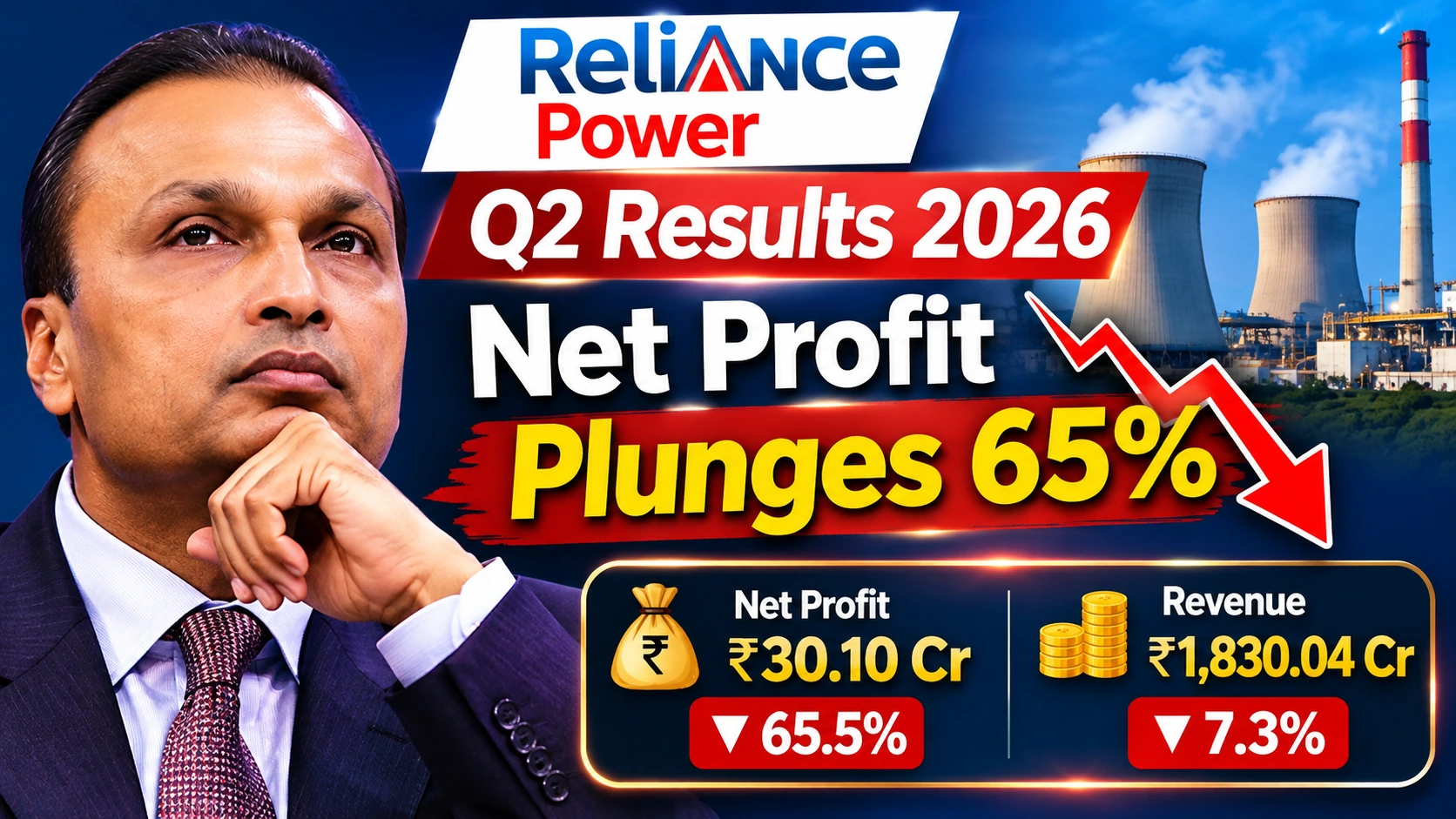
Reliance Power Q2 Results 2026: Anil Ambani-led Reliance Power Limited has reported a sharp decline in profitability for the second quarter of financial year 2026–27. The company’s consolidated net profit dropped approximately 65.5% year-on-year to ₹30.10 crore, compared with ₹87.32 crore in the corresponding quarter last year.
Revenue from operations also declined 7.3% to ₹1,830.04 crore. The results, announced on November 12, 2026, highlight weaker earnings and pressure on operating margins, raising important questions about the company’s financial performance and near-term outlook.
📉 Reliance Power Q2 FY27 Results: Key Highlights
Reliance Power’s September-quarter earnings revealed a significant gap between the decline in revenue and the much steeper fall in net profit.
Although the company remained profitable, its earnings were considerably weaker than in the same period last year.
The major financial highlights include:
- Net profit: Fell 65.5% to ₹30.10 crore from ₹87.32 crore.
- Revenue from operations: Declined 7.3% to ₹1,830.04 crore from ₹1,974.03 crore.
- Total income: Dropped to approximately ₹1,889.87 crore from ₹2,067.10 crore.
- Operating profitability: Weakened as the EBITDA margin contracted to approximately 28%.
- Quarter-on-quarter performance: Net profit fell from ₹64.71 crore in the June 2026 quarter.
- Management development: The company also announced a change in its chief financial officer position.
These figures show that the company experienced pressure on both its operating performance and bottom-line earnings.
📊 Reliance Power Q2 Results 2026: Financial Comparison
The following table compares Reliance Power’s consolidated performance for the September 2026 quarter with the corresponding quarter of the previous financial year.
| Financial Metric | Q2 FY27 | Q2 FY26 | YoY Change |
|---|---|---|---|
| Net profit | ₹30.10 crore | ₹87.32 crore | -65.5% |
| Revenue | ₹1,830.04 crore | ₹1,974.03 crore | -7.3% |
| Total income | ₹1,889.87 crore | ₹2,067.10 crore | -8.6% |
| EBITDA margin | Approximately 28.0% | Approximately 31.3% | -3.3 percentage points |
| Basic EPS | ₹0.07 | ₹0.21 | Decline |
The comparison makes one point particularly clear: Reliance Power’s profitability deteriorated much faster than its revenue.
For investors, this difference is important because it indicates that sales performance alone does not fully explain the decline in earnings.
💰 Why Did Reliance Power’s Net Profit Fall 65%?
Reliance Power’s consolidated net profit declined by approximately ₹57.22 crore compared with the year-ago quarter.
In percentage terms, this represents a fall of around 65.5%.
The company’s revenue decline was relatively smaller, at approximately 7.3%.
A fall in profit that is substantially larger than the decline in revenue can indicate pressure from operating expenses, financing costs, depreciation, tax adjustments, or other accounting factors.
In Reliance Power’s case, the contraction in operating margins is one important indicator of weaker profitability.
However, investors should avoid attributing the entire profit decline to a single factor without examining the complete financial statements.
Net profit reflects multiple income and expense items, not merely electricity sales or operating revenue.
The company’s quarterly disclosures therefore deserve closer attention when evaluating the sustainability of future earnings.
📊 Reliance Power Q2 Results 2026
Q2 FY27 vs Q2 FY26 | Consolidated financial results
| Metric | Q2 FY26 | Q2 FY27 |
|---|---|---|
| Net Profit | ₹87.32 Cr | ₹30.10 Cr |
| Revenue | ₹1,974.03 Cr | ₹1,830.04 Cr |
| Total Income | ₹2,067.10 Cr | ₹1,889.87 Cr |
Source: Reliance Power consolidated financial results, November 12, 2026. Bar widths compare the two periods within each metric, not across different metrics. Figures are rounded.
⚡ Revenue From Operations Declines to ₹1,830 Crore
Reliance Power reported revenue from operations of ₹1,830.04 crore during the quarter ended September 30, 2026.
This compares with ₹1,974.03 crore during the corresponding quarter of FY26.
The decline amounts to approximately ₹143.99 crore.
Revenue is a key indicator of the company’s business activity, but it does not reveal profitability on its own.
For power-generation businesses, financial performance can be influenced by generation volumes, plant availability, fuel costs, contractual arrangements, and operating efficiency.
The latest numbers establish that Reliance Power generated lower operating revenue than a year earlier.
They do not, by themselves, establish which operational factor contributed most to the decline.
Investors will need to review the company’s detailed disclosures and subsequent performance to determine whether the weakness is temporary or persistent.
📉 Operating Margins Show Additional Pressure
Another important development in Reliance Power’s Q2 FY27 results is the contraction in its operating margin.
The EBITDA margin declined to approximately 28%, compared with around 31.3% in the corresponding quarter last year.
This represents a reduction of approximately 3.3 percentage points.
EBITDA stands for earnings before interest, taxes, depreciation, and amortisation.
It is commonly used to evaluate operating profitability before certain financing and accounting expenses.
A lower EBITDA margin means the company generated less operating earnings relative to its revenue.
This is significant because weaker operating margins can make it harder for a business to absorb other expenses.
Nevertheless, EBITDA should not be confused with net profit or operating cash flow.
Each measures a different aspect of financial performance.
🏢 Reliance Power Announces CFO Leadership Change
Alongside its quarterly financial results, Reliance Power announced a change in its finance leadership.
Rajendra Vishwanath Pawar was appointed chief financial officer.
Neeraj Parakh, who had been handling the additional responsibility of interim CFO, relinquished that position.
Parakh continued in his role as executive director and chief executive officer.
The distinction is important because the announcement concerned his additional finance responsibility rather than his CEO position.
A CFO plays a central role in financial reporting, treasury management, compliance, and financial planning.
The leadership transition is therefore another corporate development investors may monitor alongside the company’s earnings.
However, the announcement alone does not establish a connection between the management change and the decline in quarterly profitability.
📈 Reliance Power Share Price: What Should Investors Watch?
Reliance Power shares closed at approximately ₹19.30 on November 12, 2026, according to the reported market data.
The stock was therefore trading below the ₹20 level at that point.
However, a low share price does not automatically make a stock undervalued.
Investors should consider the company’s earnings, debt obligations, cash flows, business outlook, and valuation before making investment decisions.
The sharp decline in quarterly profit may increase attention on the company’s future financial results.
Three areas are particularly important: whether revenue stabilizes, whether operating margins recover, and whether net profit improves in subsequent quarters.
Market movements can also be influenced by broader stock-market conditions and investor sentiment.
Consequently, the quarterly earnings report should be considered alongside the company’s overall financial position rather than used as the sole basis for an investment decision.
🔎 What Do the Results Mean for Reliance Power’s Future?
The September 2026 quarter presents a mixed picture.
Reliance Power remained profitable, but its net earnings fell sharply from the previous year.
Revenue and operating margins also weakened.
The results highlight the importance of consistent business performance and cost management.
For future quarters, investors may monitor changes in revenue, profitability, financing expenses, and operating cash generation.
An improvement in margins could support profitability, while continued pressure may affect future earnings.
There is currently no basis in these quarterly figures alone to predict a guaranteed recovery or further decline.
Future performance will depend on business operations, financial conditions, and other company-specific developments.
❓ Reliance Power Q2 Results 2026: Frequently Asked Questions
1. What is Reliance Power’s net profit in Q2 FY27?
Reliance Power reported consolidated net profit of ₹30.10 crore for the September 2026 quarter, compared with ₹87.32 crore in the corresponding quarter last year.
2. How much did Reliance Power’s profit decline?
The company’s consolidated net profit fell approximately 65.5% year-on-year, representing a decline of ₹57.22 crore.
3. What was Reliance Power’s revenue in Q2 2026?
Revenue from operations stood at ₹1,830.04 crore, down approximately 7.3% from ₹1,974.03 crore in the year-ago quarter.
4. What happened to Reliance Power’s operating margin?
Its EBITDA margin contracted to approximately 28% from around 31.3%, indicating weaker operating profitability.
5. Who is the new CFO of Reliance Power?
Reliance Power appointed Rajendra Vishwanath Pawar as chief financial officer, while Neeraj Parakh relinquished his additional interim CFO responsibility.
6. Is Reliance Power a good stock to buy after its Q2 results?
The results alone cannot determine whether the stock is a good investment. Investors should evaluate valuation, financial risks, debt, cash flow, and future earnings before deciding.
✅ Conclusion: Reliance Power Faces a Challenging Earnings Quarter
Reliance Power’s Q2 FY27 financial results underline a challenging period for the company.
With consolidated net profit falling 65.5%, revenue declining 7.3%, and operating margins narrowing, the latest earnings indicate pressure on overall profitability.
The appointment of a new CFO adds another development for investors to follow.
The key question now is whether Reliance Power can stabilize revenue and improve its margins in the coming quarters.
For shareholders and market observers, future earnings reports will be crucial in assessing whether the company’s financial performance is improving.
Disclaimer: This article is for informational purposes only and does not constitute investment advice. Stock-market investments involve financial risk.