
 bobby
bobby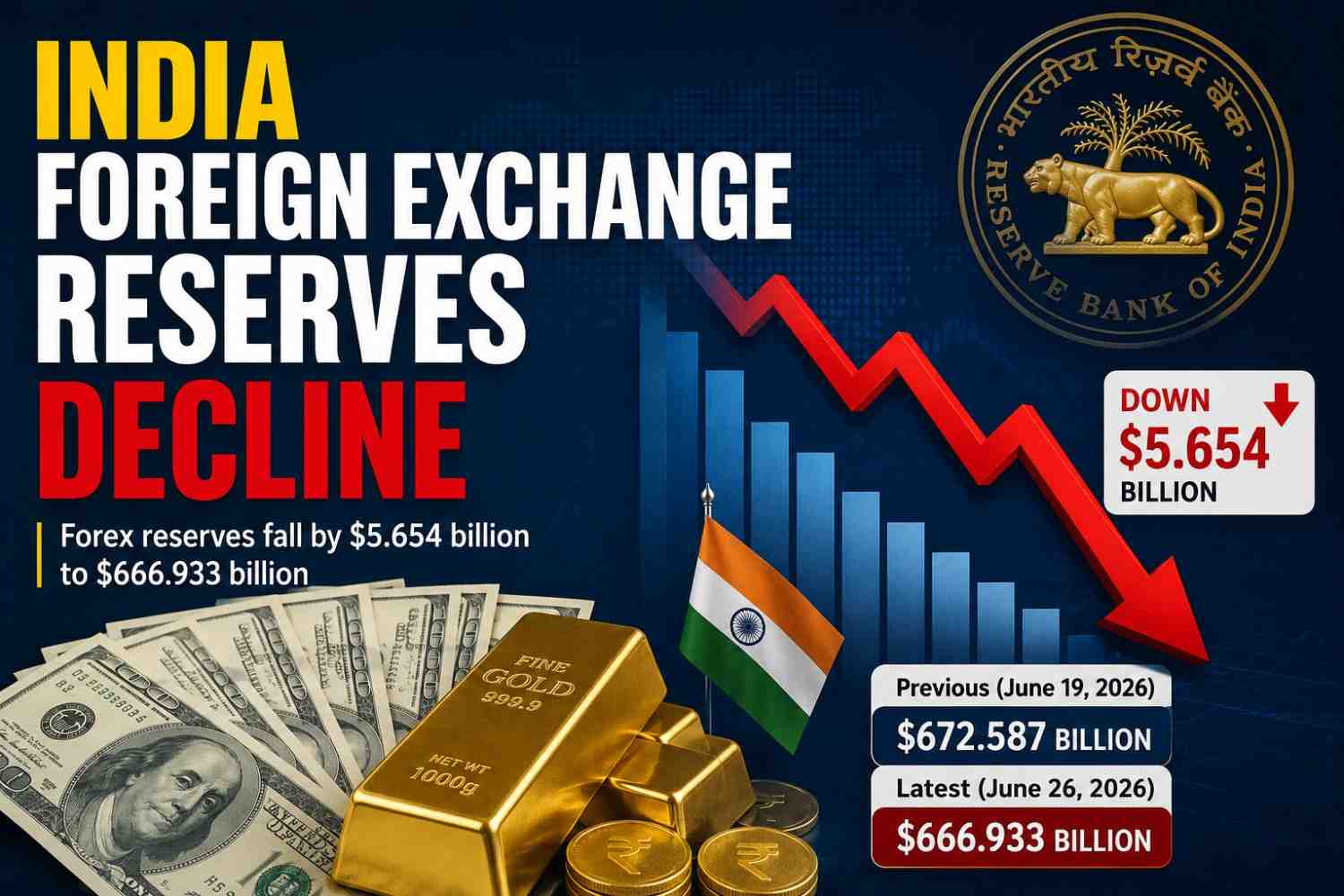
India Foreign Exchange Reserves: India’s foreign exchange reserves declined sharply during the week ending June 26, 2026, with gold reserves witnessing a major drop, according to the latest data released by the Reserve Bank of India (RBI).
The country’s foreign exchange (forex) reserves fell by $5.654 billion to $666.933 billion, reversing the previous week’s gain of $963 million, when reserves had climbed to $672.587 billion.
📉 India’s Forex Reserves Decline
According to the RBI, Foreign Currency Assets (FCAs)—the largest component of India’s forex reserves—declined by $150 million to $541.067 billion.
The central bank noted that fluctuations in the value of major global currencies, including the Euro, British Pound, and Japanese Yen, against the US dollar also influenced the overall valuation of India’s foreign exchange reserves.
📊 Latest RBI Forex Reserve Data
- 💵 Total Forex Reserves: $666.933 billion (⬇️ $5.654 billion)
- 💱 Foreign Currency Assets: $541.067 billion (⬇️ $150 million)
- 🪙 Gold Reserves: $102.536 billion (⬇️ $5.394 billion)
- 🌍 Special Drawing Rights (SDRs): $18.558 billion (⬇️ $89 million)
- 🏦 Reserve Position with the IMF: $4.7772 billion (⬇️ $21 million)
🪙 Gold Reserves Register Sharp Weekly Decline
India’s gold reserves recorded the biggest decline among all reserve components, falling by $5.394 billion to $102.536 billion during the reporting week.
The decline mainly reflects changes in the market value of gold held as part of the country’s reserves. Gold prices and valuation movements can significantly impact the reported value of RBI’s gold holdings from week to week.
📈 Forex Reserves Had Hit a Record High Earlier This Year
India’s foreign exchange reserves had touched an all-time high of $728.494 billion during the week ending February 27, 2026.
Since then, reserves have moderated amid global market volatility and pressure on the Indian rupee.
💹 Why Are India’s Forex Reserves Falling?
Economists say several factors have contributed to the recent decline in forex reserves:
- 🌍 Volatility in global currency markets.
- 💵 Changes in the valuation of foreign assets due to the strengthening or weakening of the US dollar.
- 🇮🇳 RBI’s interventions in the foreign exchange market to reduce excessive volatility in the rupee.
- 📉 Decline in the market value of gold holdings.
During periods of pressure on the rupee, the RBI may sell US dollars from its reserves to help stabilize the domestic currency. Such interventions can temporarily reduce the overall level of foreign exchange reserves.
❓What About Gold Imports?
While government policies, import duties, and consumer demand can influence gold imports, they do not directly determine the RBI’s reported gold reserves. The value of gold reserves released by the RBI primarily changes because of international gold prices, valuation adjustments, and the central bank’s own gold holdings.
🔍 Why Forex Reserves Matter
India’s foreign exchange reserves play a crucial role in maintaining financial stability. Healthy reserves help the country:
- ✅ Meet import obligations.
- ✅ Support the Indian rupee during periods of volatility.
- ✅ Boost investor confidence.
- ✅ Strengthen India’s ability to manage external economic shocks.
Investors, businesses, and policymakers closely monitor weekly RBI data to assess the country’s external financial position and the overall health of the economy.
With forex reserves still well above $660 billion, India remains among the countries with one of the world’s largest foreign exchange reserve holdings, despite the latest weekly decline.
Keypoints:
- India’s forex reserves
- India foreign exchange reserves
- RBI forex reserves
- Gold reserves India
- RBI reserve data
- India’s forex reserve latest news
- Foreign currency assets
- India economy news
- RBI weekly forex data