 bobby
bobby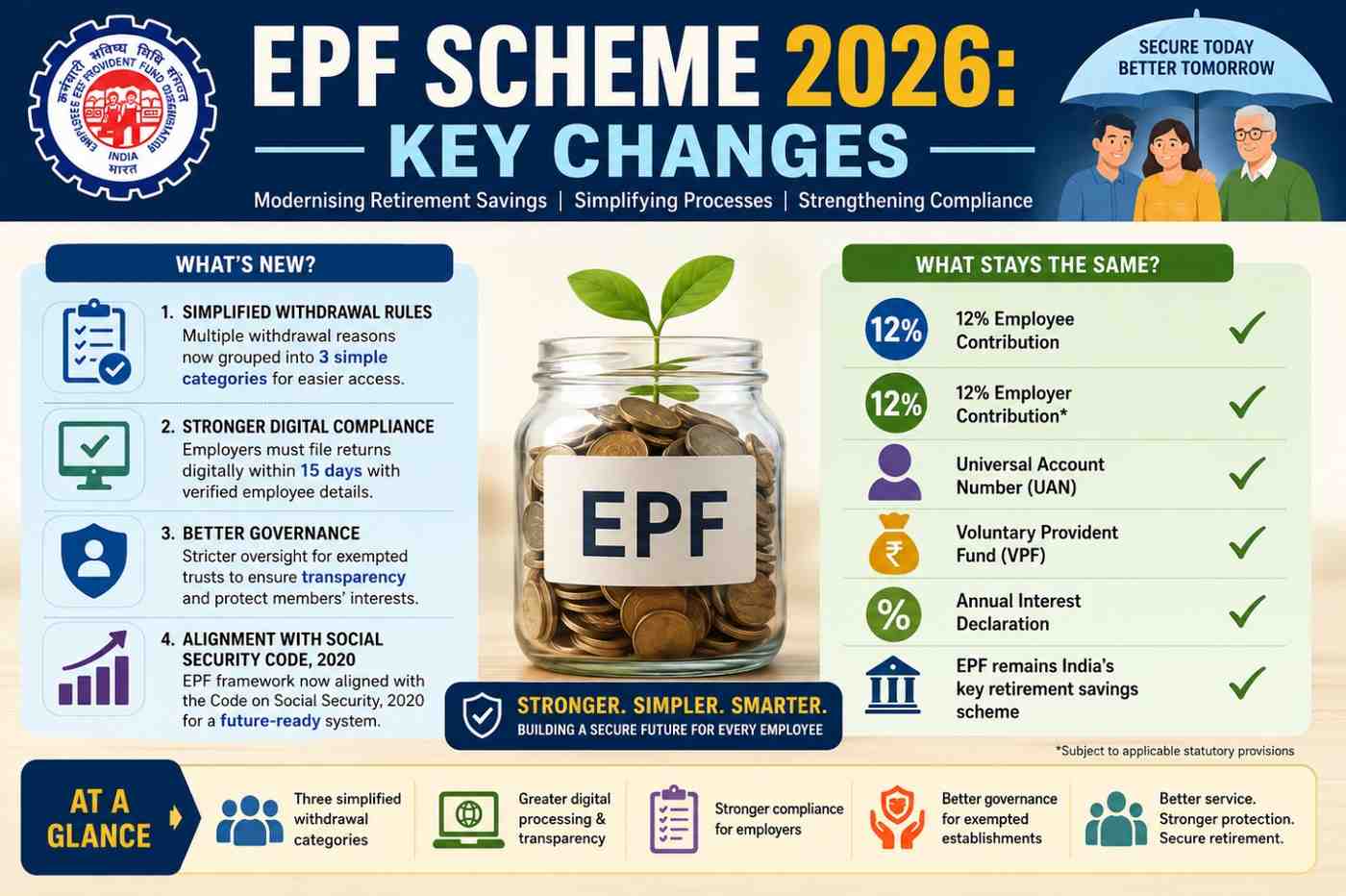
EPF Scheme 2026: The Employees’ Provident Fund (EPF) is one of India’s most important retirement savings schemes, helping millions of salaried employees build long-term financial security.
From 2026, the Government has notified the EPF Scheme, 2026, replacing the long-standing Employees’ Provident Fund Scheme, 1952 under the framework of the Code on Social Security, 2020.
The good news? 🎉
For most employees, your EPF account will continue to work much the same as before. However, the new scheme introduces several improvements aimed at making EPF more transparent, digital and easier to use.
In this guide, you’ll learn:
- ✅ What has changed under EPF Scheme 2026
- 💰 Whether your salary or PF deductions will change
- 🏠 New withdrawal rules explained
- 📱 Digital services and compliance updates
- 👨💼 What employers need to know
- ❓Frequently asked questions
Let’s dive in.
📌 EPF Scheme 2026 at a Glance
| Feature | EPF Scheme 1952 | EPF Scheme 2026 |
|---|---|---|
| Governing Law | EPF Scheme, 1952 | EPF Scheme, 2026 |
| Legal Framework | EPF & MP Act | Code on Social Security, 2020 |
| Withdrawal Categories | Multiple categories | Simplified categories |
| Digital Compliance | Partial | Expanded digital processes |
| Employer Reporting | Existing compliance | Stronger digital reporting |
| UAN | Continues | Continues |
| Contribution Rate | No change | No change |
| Wage Ceiling | No change | No change |
Key Takeaway: The EPF Scheme 2026 is primarily an administrative and procedural update. It modernizes the system while preserving the core retirement savings structure that employees already know.
🆕 What Is EPF Scheme 2026?
The EPF Scheme, 2026 replaces the Employees’ Provident Fund Scheme, 1952, bringing the provident fund system in line with the Code on Social Security, 2020.
Rather than redesigning EPF, the new scheme focuses on:
- 🚀 Faster digital services
- 📑 Simpler withdrawal procedures
- 🛡️ Better protection for members
- 💻 Improved online compliance
- 🏢 Stronger governance for employers and exempted trusts
- 📊 Better record management
These changes aim to make EPF easier to administer while improving the overall experience for both employees and employers.
🔥 Major Changes Under EPF Scheme 2026
1️⃣ Simplified PF Advance Withdrawal Rules 🏥🏠🎓
One of the biggest improvements is the simplification of advance (partial) withdrawal provisions.
Previously, members had to choose from numerous specific withdrawal categories, often leading to confusion and delays.
The new scheme groups withdrawals into broader categories.
New Withdrawal Categories
| Category | Examples |
| ❤️ Essential Needs | Medical treatment, higher education, marriage and other important family expenses |
| 🏠 Housing Needs | Buying land, purchasing or constructing a home, home loan repayment |
| 🌧️ Special Circumstances | Natural disasters and other approved emergency situations |
The objective is to make claims easier to understand and process while maintaining safeguards for retirement savings.
2️⃣ Stronger Digital Compliance 💻
The new framework significantly expands digital governance.
Employers are expected to maintain accurate employee records, including:
- Aadhaar
- PAN
- UAN
- Monthly wages
- EPF wages
- Employment details
Digital verification is expected to reduce errors, speed up claim processing and improve transparency.
3️⃣ Better Governance for Exempted Trusts 🏛️
The EPF Scheme 2026 introduces stronger oversight of exempted establishments that manage their own provident fund trusts.
The objective is to ensure:
- Better investment management
- Timely credit of interest
- Stronger compliance
- Improved protection of members’ retirement savings
This enhances accountability while helping safeguard employees’ accumulated PF balances.
💰 Will Your PF Contribution Change?
No.
For most employees, the standard contribution structure remains unchanged.
| Contribution | Status |
| Employee Contribution | ✅ No change |
| Employer Contribution | ✅ No change |
| UAN | ✅ Continues |
| Interest Declaration | ✅ Continues |
| VPF | ✅ Continues |
If you’re already contributing to EPF, you generally do not need to take any action simply because the new scheme has come into effect.
📢 Important Note
Some reports and social media posts have claimed that the EPF Scheme 2026 introduces a mandatory contribution cap of ₹1,800 per month or fundamentally changes how employers must calculate contributions. As of the official notifications available, such claims have not been confirmed. Employees should rely on official EPFO notifications before making financial decisions.
💰 Will EPF Scheme 2026 Affect Your Salary?
One of the most common questions employees are asking is:
“Will my take-home salary increase under EPF Scheme 2026?”
The Short Answer: For most employees, No.
The EPF Scheme 2026 does not change the standard EPF contribution rate or the existing wage ceiling. If your employer currently deducts EPF as per the applicable rules, your monthly salary structure is generally expected to remain the same.
However, your salary may change if:
- 📌 Your employer revises your salary structure.
- 📌 Your organisation updates its Cost-to-Company (CTC) policy.
- 📌 Future government notifications introduce changes to EPF contribution rules.
As of now, the notified EPF Scheme 2026 mainly modernises administration and compliance rather than changing employee contribution percentages.
📊 EPF Scheme 2026: What Changed vs What Stayed the Same
| ✅ Changed | 🔒 Remains the Same |
|---|---|
| EPF Scheme, 2026 replaces the 1952 Scheme | Standard EPF contribution structure |
| Simpler withdrawal framework | Universal Account Number (UAN) |
| Stronger digital compliance | EPF remains a retirement savings scheme |
| Better governance for exempted trusts | Voluntary Provident Fund (VPF) continues |
| Enhanced employer reporting | Annual EPF interest declaration mechanism |
| Alignment with the Code on Social Security, 2020 | Existing EPF account continues |
🏢 What Employers Need to Know
The new framework places greater emphasis on timely and accurate compliance.
Employers are expected to:
✅ Submit required returns within the prescribed timelines.
✅ Maintain updated employee records.
✅ Verify employee identity details, including:
- Aadhaar
- PAN
- UAN
- Salary information
- EPF wages
✅ Ensure statutory compliance for eligible employees.
For organisations employing contract workers, principal employers may continue to have compliance responsibilities under applicable labour laws if contractors fail to meet statutory obligations.
📱 A More Digital EPF Experience
The Government is steadily moving EPF services toward a fully digital ecosystem.
Employees can expect improvements such as:
📲 Faster online claim processing
📄 Reduced paperwork
⚡ Better verification systems
🔐 Improved data security
💻 Easier online record management
These initiatives aim to reduce delays while improving transparency for both employees and employers.
🏦 Why EPF Remains One of India’s Best Retirement Savings Options
Despite the procedural changes, EPF continues to offer several long-term benefits.
🌟 Tax Benefits
Depending on the applicable tax rules and limits, EPF contributions and interest may continue to enjoy significant tax advantages.
📈 Power of Compounding
Regular monthly contributions combined with annual interest can help build a substantial retirement corpus over time.
🛡️ Government-Backed Savings
EPF remains one of India’s most trusted long-term retirement savings schemes.
💼 Employer Contribution
Eligible employers continue contributing to employees’ EPF accounts under the applicable statutory provisions, helping accelerate retirement savings.
❌ Common Myths About EPF Scheme 2026
❌ Myth 1: Everyone’s PF contribution has changed.
Fact: The notified scheme does not introduce a blanket change to the standard EPF contribution rate.
❌ Myth 2: Employees will automatically receive a higher salary.
Fact: There is no automatic increase in take-home salary under the EPF Scheme 2026.
❌ Myth 3: Existing PF accounts will be closed.
Fact: Existing EPF accounts and UANs continue.
❌ Myth 4: Employees must apply for a new UAN.
Fact: No new UAN application is required solely because of the new scheme.
❌ Myth 5: VPF has been discontinued.
Fact: Voluntary Provident Fund (VPF) continues to be available for eligible employees.
👨💼 Expert View
The EPF Scheme 2026 should be viewed as a modernisation of India’s provident fund administration, rather than a complete overhaul of the retirement savings system.
Its primary objectives include:
- 🚀 Faster service delivery
- 📲 Digital-first governance
- 📋 Simplified compliance
- 🏢 Better employer accountability
- 🔒 Stronger protection for EPF members
For most salaried employees, there is no immediate action required. Your EPF account, UAN, contribution mechanism and accumulated balance continue under the updated framework.
📌 Quick Summary
👍 What’s New
- ✨ EPF Scheme, 2026 replaces the 1952 framework.
- 📱 Greater focus on digital governance.
- 🏠 Simplified withdrawal categories.
- 🏢 Enhanced employer compliance.
- 🛡️ Better governance of exempted trusts.
👍 What Hasn’t Changed
- 💰 Standard EPF contribution structure.
- 👤 Existing UAN.
- 📈 EPF interest declaration process.
- 💼 VPF option.
- 🏦 EPF remains India’s primary retirement savings scheme.
🔍 Key Takeaways
✔️ EPF Scheme 2026 modernises the provident fund framework.
✔️ It aligns EPF with the Code on Social Security, 2020.
✔️ Most employees will notice little change in their monthly EPF contributions.
✔️ Digital services and compliance are expected to become faster and more transparent.
✔️ Existing UANs, EPF accounts and core benefits continue without interruption.
1. What is the EPF Scheme, 2026?
The EPF Scheme, 2026 replaces the Employees’ Provident Fund Scheme, 1952 under the Code on Social Security, 2020. It modernises the administration of the EPF system through improved digital compliance, simplified withdrawal provisions and stronger governance, while preserving the core retirement savings structure.
2. Has the EPF contribution rate changed in 2026?
No. The notified EPF Scheme, 2026 does not change the standard EPF contribution rate. Eligible employees and employers continue to contribute as per the applicable statutory provisions.
3. Has the EPF wage ceiling increased?
No. The notified scheme does not increase the statutory EPF wage ceiling.
4. Will my take-home salary increase?
For most employees, no. The EPF Scheme, 2026 itself does not automatically increase your take-home salary. Any change in salary would depend on your employer’s compensation policy or future government notifications.
5. Do I need to open a new PF account?
No. Your existing EPF account continues without interruption.
6. Will my Universal Account Number (UAN) change?
No. Your existing Universal Account Number (UAN) remains valid.
7. Is Voluntary Provident Fund (VPF) still available?
Yes. Employees who wish to contribute more than the mandatory EPF amount can continue using the Voluntary Provident Fund (VPF), subject to applicable rules.
8. What are the biggest changes under EPF Scheme 2026?
The major changes include:
- 📱 Greater digital compliance
- 🏠 Simplified withdrawal categories
- 🏢 Stronger employer reporting
- 🛡️ Better governance for exempted establishments
- 📋 Alignment with the Code on Social Security, 2020
9. Can I withdraw my full PF balance?
Not automatically. EPF withdrawals continue to be governed by the eligibility conditions specified under the applicable rules.
10. Does EPF Scheme 2026 affect pension benefits?
The notified changes primarily relate to the EPF framework. Employees covered under the Employees’ Pension Scheme (EPS) should continue to follow the applicable EPS provisions unless separate notifications are issued.
11. Is Aadhaar still required for EPF services?
Yes. Aadhaar remains an important identity document for many EPF-related online services and verification processes.
12. Is EPF interest affected by the new scheme?
No. The EPF Scheme, 2026 does not change the annual interest declaration mechanism. Interest rates continue to be notified separately.
13. Is EPF still tax-efficient?
EPF continues to offer tax benefits subject to the provisions of the Income-tax Act and the applicable limits in force.
14. Who should read the EPF Scheme 2026?
This guide is useful for:
- 👨💼 Salaried employees
- 🏢 HR professionals
- 💰 Payroll managers
- 📊 Finance teams
- 🧾 Chartered Accountants
- 👩💻 Employers
- 🎓 Students preparing for competitive exams
15. Should employees take any immediate action?
For most employees, no immediate action is required. Continue monitoring official EPFO notifications and ensure your Aadhaar, PAN and bank details linked to your UAN remain updated.
📌 Conclusion
The EPF Scheme, 2026 represents an important step in the evolution of India’s provident fund system. Instead of changing the fundamentals of how EPF works, it focuses on modernising administration, improving digital services, simplifying withdrawals and strengthening compliance.
For the vast majority of employees, the essentials remain familiar: your EPF account, UAN, contribution structure and retirement savings continue as before. The key difference is a more streamlined and technology-driven framework that aims to make services faster, more transparent and easier to access.
As with any major policy update, it’s important to rely on official EPFO notifications rather than social media posts or unverified claims. Staying informed will help you make better financial decisions and take full advantage of your EPF benefits.
🔎 Keypoint
- EPF Scheme 2026 PDF
- EPF Scheme 2026 Explained
- EPF Scheme 2026 Notification
- EPF New Rules 2026
- EPF Withdrawal Rules 2026
- EPF Interest Rate 2026
- EPF Wage Ceiling
- EPF Contribution Rules
- EPF vs VPF
- Code on Social Security, 2020
Secondary Keypoint
- EPF New Rules 2026
- EPF Scheme 2026 Explained
- EPF Latest Update
- EPF Withdrawal Rules 2026
- New PF Rules
- EPF Contribution Rules
- Employees’ Provident Fund 2026
- EPF Changes 2026
- EPFO Update
- Social Security Code EPF
Long-Keypoint
- What is EPF Scheme 2026?
- Will EPF Scheme 2026 affect salary?
- Has EPF contribution changed in 2026?
- EPF Scheme 2026 withdrawal rules explained
- EPF Scheme 2026 for private employees
- EPF Scheme 2026 FAQs
- EPF new rules for employers
- EPF digital compliance changes
- EPF Scheme 2026 summary