
 bobby
bobby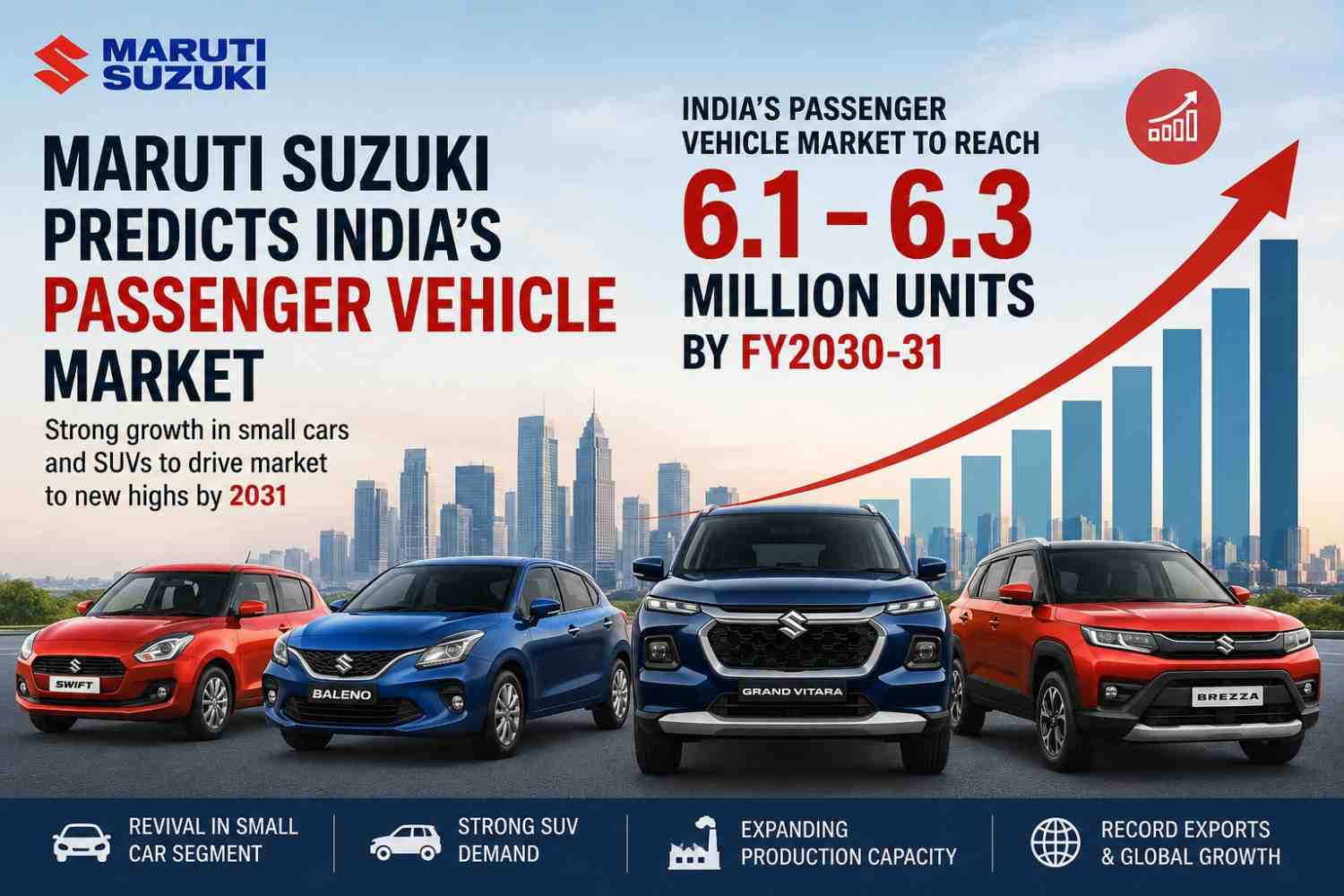
India passenger vehicle market 2031: Maruti Suzuki India expects the country’s passenger vehicle market to grow to between 6.1 million and 6.3 million units by fiscal year 2030-31, Chairman R.C. Bhargava said, pointing to a potential revival in small-car demand and continued strength in the SUV segment.
The projection comes as India’s largest carmaker reassesses its five-year growth strategy. According to the company, the small-car segment could grow significantly faster than it did over the previous five years, creating fresh opportunities for manufacturers.
🔑 Key Highlights
- 🇮🇳 India’s passenger vehicle market could reach 6.1-6.3 million units by FY2030-31.
- 🚗 Maruti Suzuki recorded 2,422,713 total vehicle sales in FY2025-26.
- 🌍 The company exported a record 447,774 vehicles in FY2025-26.
- 🏭 Maruti is expanding manufacturing capacity to support future demand.
- 🚙 The company plans to strengthen its SUV portfolio with new launches.
- 🌱 Maruti has also approved investment in biogas plants as part of its clean-energy strategy.
- 🔧 Localisation and supplier development remain important parts of its strategy.
📈 India’s Passenger Vehicle Market Could Reach 6.3 Million Units
Maruti Suzuki’s latest outlook suggests that India’s passenger vehicle market could expand substantially over the next five years.
The company expects the domestic market to reach 6.1 million to 6.3 million passenger vehicles annually by FY2030-31. The forecast is being supported by expectations of stronger demand for both small cars and SUVs.
The small-car market is particularly important for Maruti Suzuki because the company has traditionally maintained a strong presence in this segment. The automaker now expects small-car demand to recover more strongly than it did during the previous five-year period.
🚗 Small Cars Could Make a Strong Comeback
One of the most significant elements of Maruti Suzuki’s latest outlook is its expectation of a revival in small-car demand.
The company has said the small-car segment could expand considerably faster in the coming years. This could be important for Indian consumers, particularly buyers looking for relatively affordable passenger vehicles.
Maruti Suzuki’s own FY2025-26 results also showed strong momentum in smaller vehicles. The company reported that the recovery in the Indian car market during the second half of FY2025-26 was primarily led by the small-car segment.
🚙 SUVs Remain a Major Growth Driver
While Maruti Suzuki expects small cars to regain momentum, SUVs will remain a major part of its future growth strategy.
The company has been expanding its utility-vehicle portfolio as consumer preference shifts toward SUVs and SUV-style vehicles. Its domestic portfolio includes models such as the Brezza, Fronx, Grand Vitara, Jimny, Invicto, Victoris, Ertiga and XL6.
Maruti Suzuki Managing Director and CEO Hisashi Takeuchi has indicated that the company plans to launch seven new SUVs over the next five to six years, highlighting the importance of this segment to its long-term strategy.
📊 Maruti Suzuki Records 2.42 Million Vehicle Sales
Maruti Suzuki entered FY2026-27 after recording its strongest-ever annual sales performance.
The company sold 2,422,713 vehicles in FY2025-26, including 1,974,939 domestic sales and 447,774 exports. All three figures represented records for the company.
Its FY2025-26 performance also included record net sales and net profit, according to the company’s financial results.
🌍 Exports Hit Record High
Maruti Suzuki exported more than 447,000 vehicles in FY2025-26, representing growth of more than 34% over the previous financial year.
The company also began exporting its first battery electric vehicle, the e VITARA, during FY2025-26. Maruti said the Hansalpur facility in Gujarat serves as the global production hub for the model.
🏭 Maruti Suzuki Expands Production Capacity
To prepare for rising domestic and international demand, Maruti Suzuki is significantly expanding its manufacturing footprint.
The company achieved record production of more than 2.34 million vehicles in FY2025-26. It currently has four manufacturing facilities, while a fifth facility is planned at Khoraj Industrial Estate in Sanand, Gujarat.
Maruti Suzuki has said the fifth facility will eventually have an annual production capacity of 1 million vehicles, further strengthening its manufacturing base in India.
🌱 Maruti Suzuki Steps Up Clean-Energy Plans
Maruti is also increasing its focus on alternative energy and sustainability.
The company’s board has approved an initial investment of ₹561 million (₹56.1 crore) to establish four biogas plants. The initiative is aimed at supporting the company’s clean-energy strategy while potentially reducing dependence on imported compressed natural gas.
The broader move aligns with India’s push toward cleaner energy and lower emissions.
🔧 Localisation and Supply-Chain Strategy
Maruti Suzuki is also prioritising localisation, alternative sourcing and supplier capability development to reduce exposure to geopolitical and supply-chain risks.
For a company operating at such large production volumes, a stronger domestic supplier network can help improve resilience, control costs and reduce potential disruptions.
The company has also highlighted its increasingly integrated relationship with parent company Suzuki Motor Corporation, which it says can help shorten vehicle-development cycles and reduce costs.
💰 What the 6.3 Million-Unit Forecast Means for India
If the Indian passenger vehicle market reaches 6.1-6.3 million units by FY2030-31, the implications could extend beyond Maruti Suzuki.
A larger market could mean:
- More vehicle choices for consumers
- Increased competition between carmakers
- Greater investment in manufacturing
- More demand for auto components
- Expansion of dealership and service networks
- Increased opportunities for vehicle exports
- Faster development of electric and alternative-fuel vehicles
For Maruti Suzuki, the projected market expansion provides an opportunity to increase volumes while strengthening its presence across small cars, SUVs and emerging vehicle technologies.
🔮 Maruti Suzuki’s 2031 Growth Outlook
Maruti Suzuki’s latest forecast indicates that the company expects India’s automobile market to enter a new phase of growth through the end of the decade.
The combination of a potential small-car revival, continued SUV demand, higher production capacity and growing exports could support the company’s long-term expansion plans.
At the same time, changing consumer preferences, vehicle affordability, fuel prices, economic conditions and competition from domestic and international automakers will remain important factors for the Indian passenger vehicle industry.
❓ Frequently Asked Questions
What is Maruti Suzuki’s forecast for India’s passenger vehicle market by 2031?
Maruti Suzuki expects India’s domestic passenger vehicle market to reach approximately 6.1 million to 6.3 million units by FY2030-31.
Why does Maruti Suzuki expect the Indian car market to grow?
The company expects growth to be supported by a revival in the small-car segment and continued strength in the SUV segment.
How many vehicles did Maruti Suzuki sell in FY2025-26?
Maruti Suzuki recorded total sales of 2,422,713 vehicles in FY2025-26, including domestic sales and exports.
How many vehicles did Maruti Suzuki export in FY2025-26?
Maruti Suzuki exported 447,774 vehicles in FY2025-26, its highest-ever annual export volume.
Is Maruti Suzuki focusing on SUVs?
Yes. SUVs and utility vehicles are an important part of Maruti Suzuki’s growth strategy, with the company planning multiple new SUV launches over the coming years.
Is Maruti Suzuki expanding production capacity?
Yes. Maruti Suzuki is expanding its manufacturing footprint, including plans for a new facility at Sanand, Gujarat, with a planned annual capacity of 1 million vehicles once fully operational.
🏁 Conclusion
Maruti Suzuki’s forecast of a 6.1-6.3 million-unit Indian passenger vehicle market by FY2030-31 highlights the company’s confidence in the country’s long-term automobile growth story.
A revival in small-car demand, strong SUV sales, expanding manufacturing capacity and rising exports could create significant opportunities for Maruti Suzuki and the wider Indian automotive industry.
With the company investing in new products, production capacity and cleaner technologies, the next five years could be crucial for determining how Maruti Suzuki positions itself in India’s rapidly evolving car market.
Keypoints:
- India passenger vehicle market 2031
- Maruti Suzuki 2031 forecast
- 6.3 million passenger vehicles
- Maruti Suzuki sales FY2026
- India car market growth
- Maruti Suzuki SUV strategy
- small car market India