 bobby
bobby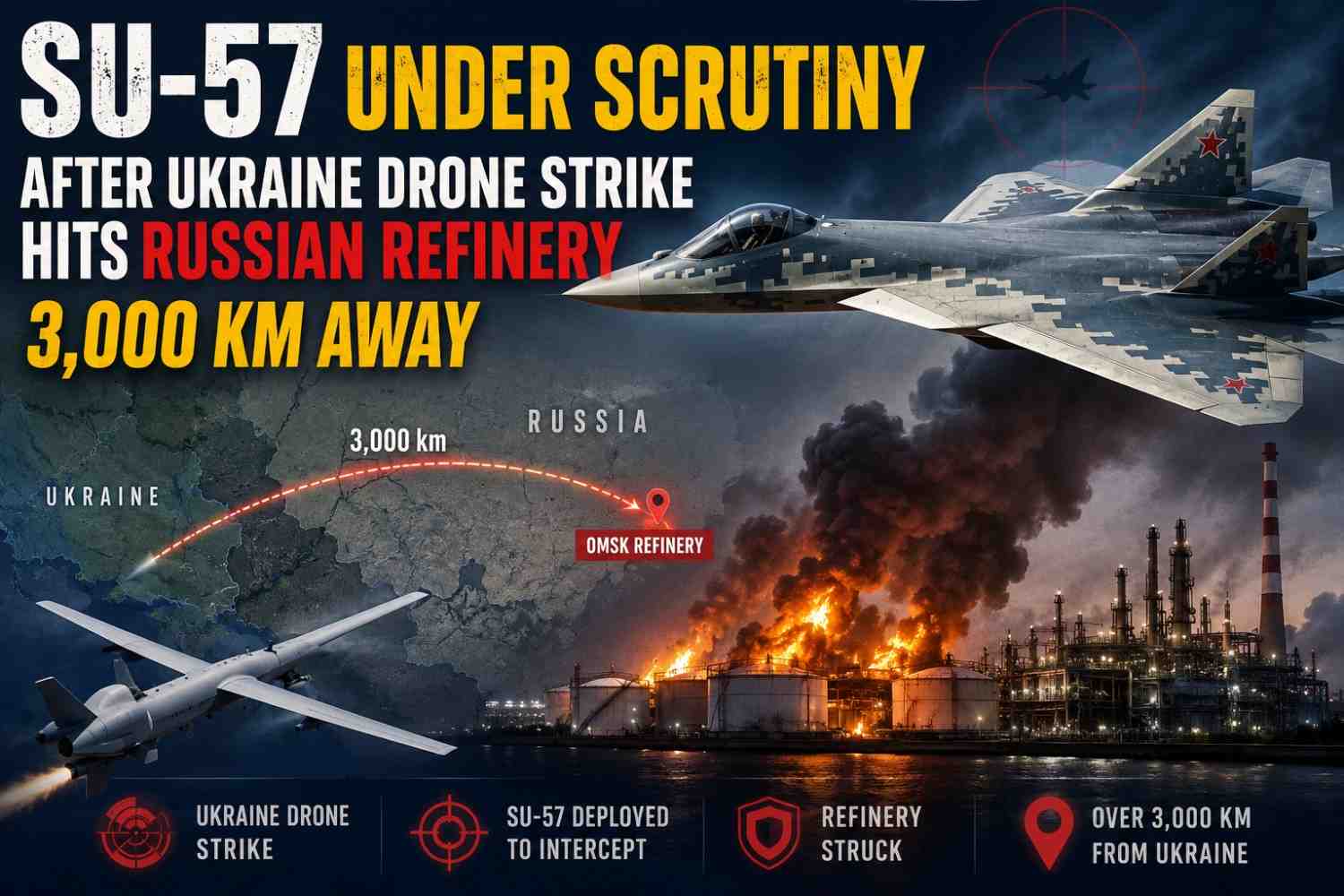
Su-57 : Russia’s Su-57 Felon, the country’s only operational fifth-generation stealth fighter, has rarely been seen in direct combat during the war in Ukraine. Military analysts have long argued that Moscow has been cautious about exposing the aircraft to significant risks, partly because the Kremlin hopes to expand Su-57 export sales. Any combat loss or serious damage could hurt the fighter’s reputation in the international arms market.
Now, however, new reports suggest the aircraft is taking on a different mission—hunting long-range Ukrainian drones. ✈️
According to Ukrainian sources, Russia deployed Su-57 fighters during Ukraine’s July 6 drone attack on the Omsk oil refinery, located more than 3,000 kilometers from Ukrainian-controlled territory. Despite the interception effort, the refinery was reportedly struck, raising fresh questions about Russia’s evolving air-defense strategy.
🎯 Ukraine’s 3,000-km Drone Strike Reached Deep Inside Russia
The attack on the Omsk oil refinery represents one of Ukraine’s deepest reported drone strikes since the war began.
According to a Kyiv Post report, Russia scrambled Su-57 stealth fighters to intercept the incoming drones. Video circulating on social media appears to show an Su-57 flying at high speed near the refinery during the attack. Ukrainian monitoring channel Exilenova+ claimed the aircraft attempted to engage the drones.
However, publicly available footage does not conclusively confirm whether the Su-57 destroyed any drones or failed in every engagement. Exilenova+ claimed one drone was intercepted while others continued toward their targets.
📍 Key Takeaways
- 🚁 Ukraine reportedly launched drones that traveled over 3,000 km
- ✈️ Russia reportedly deployed the Su-57 for drone interception
- 🔥 The Omsk oil refinery was reportedly struck despite the interception effort
- ⛽ Reuters reported that operations at the refinery were temporarily halted after the attack
The incident highlights the growing challenge posed by long-range drone warfare rather than providing definitive evidence about the Su-57’s overall effectiveness.
✈️ Why Is Russia Using the Su-57 Against Drones?
The Su-57 was originally designed as a stealth multirole fighter capable of defeating advanced enemy aircraft while conducting precision strikes.
Using such an expensive platform to hunt drones may seem unusual, but there are practical reasons.
Unlike most Russian fighters, the Su-57 is equipped with an Active Electronically Scanned Array (AESA) radar, allowing it to detect and track multiple aerial targets more effectively than conventional mechanically scanned radars.
The aircraft also carries the 101KS electro-optical system, which includes:
- 🔍 Infrared Search and Track (IRST)
- 🌙 Imaging infrared sensors
- 🎯 Passive target detection without radar emissions
These sensors are particularly useful for locating small, low-flying drones that often present minimal radar signatures.
🚀 External Missiles Suggest a New Operational Role
Another development attracting attention is the appearance of R-73 short-range air-to-air missiles mounted on the Su-57’s external wing pylons.
Normally, stealth aircraft carry weapons inside internal bays to minimize radar visibility.
External weapons increase the aircraft’s radar signature, reducing one of its key advantages.
However, if the Su-57’s mission is to intercept relatively slow drones operating deep inside Russian territory—where stealth is less critical—external missile carriage may provide operational flexibility and faster engagement capability.
This suggests Russia may be adapting the Su-57 for homeland air-defense missions rather than frontline penetration operations.
📉 Russia Still Has a Small Su-57 Fleet
Another major limitation is fleet size.
Russia currently operates around 30 Su-57 fighters, according to publicly available estimates. That is significantly below Moscow’s previously announced objective of receiving 76 aircraft by 2027.
Because of the limited fleet, every aircraft represents a valuable strategic asset.
Many defense analysts believe this is one reason the Su-57 has rarely been deployed close to heavily contested front lines in Ukraine.
Instead, Russia appears to be assigning the aircraft to specialized missions where its advanced sensors and long-range detection capabilities can be used while reducing the risk of losing one of its most advanced fighters.
⚔️ Drone Warfare Is Changing Air Combat
The conflict in Ukraine continues to demonstrate that cheap, long-range drones can threaten infrastructure located thousands of kilometers from the battlefield.
For Russia, protecting strategic facilities such as oil refineries is becoming increasingly difficult as Ukrainian drone technology evolves.
Deploying high-end fighters like the Su-57 may improve interception capability, but drone swarms remain challenging targets because they are:
- 🚁 Small and difficult to detect
- 💰 Far cheaper than advanced fighter aircraft
- 🎯 Able to attack from multiple directions simultaneously
- 📡 Increasingly resistant to traditional air-defense networks
The battle between sophisticated stealth fighters and inexpensive drones is becoming one of the defining trends of modern warfare.
🔍 What the Omsk Strike Really Reveals
The reported interception attempt over Omsk does not by itself prove that the Su-57 is ineffective. Publicly available evidence remains limited, and claims from both sides of the conflict should be treated cautiously.
What the incident does show is that Russia is willing to employ its most advanced fighter for homeland drone defense, highlighting the growing importance of protecting critical infrastructure far from the front lines.
As Ukraine expands the range and sophistication of its drone operations, the Su-57 may increasingly serve as part of Russia’s layered air-defense network—placing one of Moscow’s most advanced combat aircraft into a role few expected when it first entered service.
🔑Keypoints
Ukraine drone strike, Su-57 stealth fighter, Omsk oil refinery attack, Russian stealth fighter, Ukraine long-range drones, Russia air defense, Su-57 drone interception, Russia Ukraine war, AESA radar, Su-57 Felon.