 bobby
bobby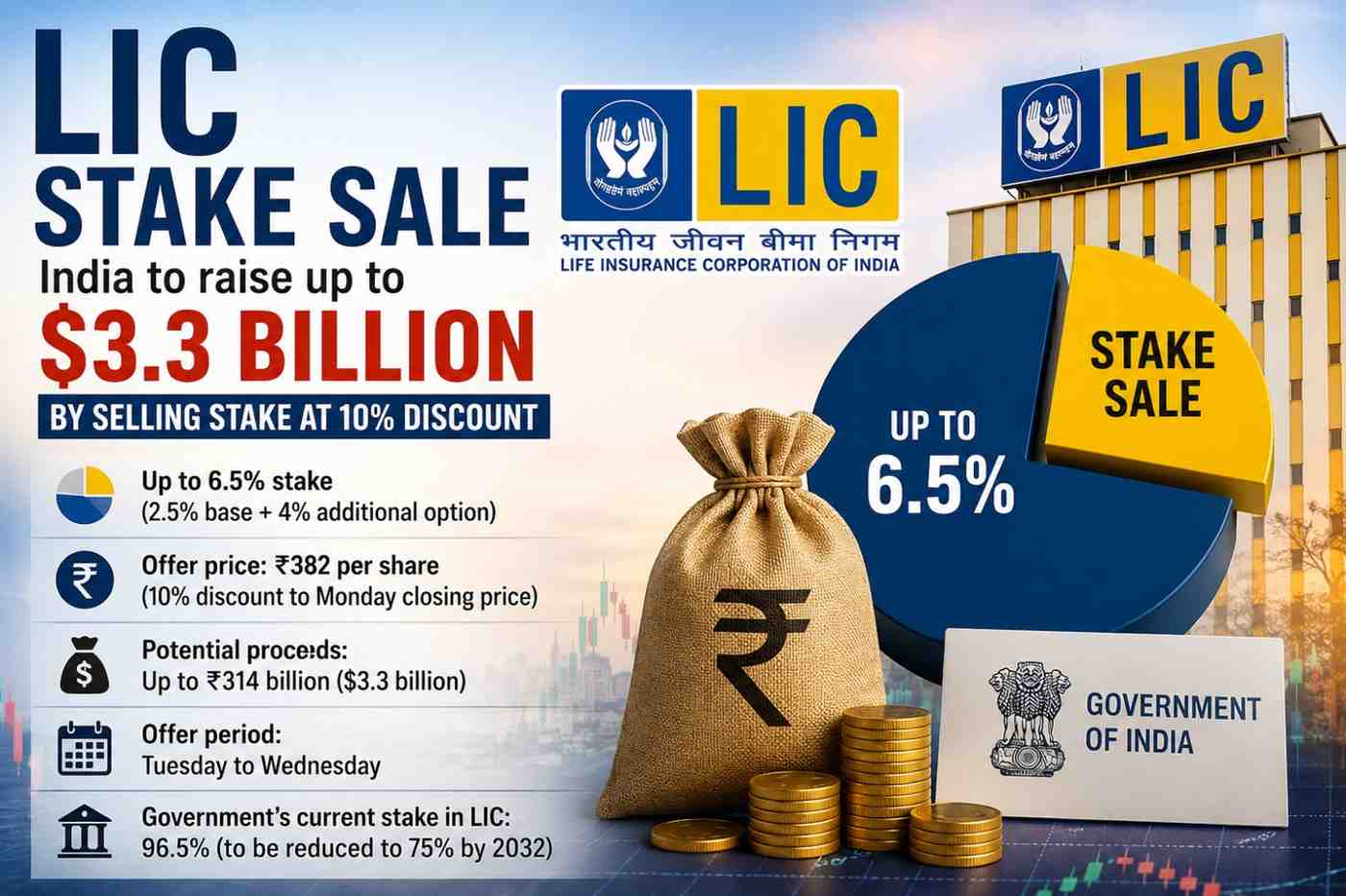
LIC stake sale : The Indian government is set to sell up to a 6.5% stake in Life Insurance Corporation of India (LIC) at a 10% discount to the insurer’s Monday closing price, targeting proceeds of up to ₹314 billion ($3.3 billion).
The LIC stake sale is part of the government’s efforts to reduce its ownership in the country’s largest life insurer and comply with minimum public shareholding requirements.
The offer for sale (OFS) will have a base size of 2.5% of LIC’s equity, with an option to sell an additional 4% stake if there is sufficient demand, according to a stock exchange filing by LIC on Monday.
💰 LIC stake sale price set at ₹382 per share
The government has set the LIC stake sale price at ₹382 per share, representing a 10% discount to the company’s Monday closing price.
The offer will open on Tuesday and close on Wednesday.
If the government exercises the full 4% additional sale option, the total stake offered could reach 6.5%, potentially generating as much as ₹314 billion ($3.3 billion).
Key details of the LIC stake sale
- 📌 Company: Life Insurance Corporation of India (LIC)
- 📉 Maximum stake on offer: 6.5%
- 🏦 Base offer: 2.5%
- ➕ Additional stake option: 4%
- 💵 Offer price: ₹382 per share
- 💰 Potential proceeds: Up to ₹314 billion ($3.3 billion)
- 📅 Offer period: Tuesday to Wednesday
- 🇮🇳 Current government ownership: 96.5%
🇮🇳 Why is the government selling LIC shares?
The Indian government currently owns 96.5% of LIC. It needs to reduce its holding to 75% by 2032 to comply with minimum public shareholding requirements.
The latest LIC stake sale therefore represents another step in the government’s broader disinvestment strategy.
Reducing its ownership also increases the portion of LIC shares available to public investors, potentially improving the stock’s free float and liquidity over time.
📊 LIC remains India’s largest life insurer
LIC continues to dominate India’s life insurance market, holding more than 56% market share based on premium income.
As of the end of March 2026, the insurer had ₹57.29 trillion (about $600 billion) in assets under management, highlighting its enormous scale within India’s financial sector.
The company’s size also makes the government’s stake sale one of the more significant disinvestment transactions in the Indian stock market.
🏦 LIC IPO raised more than $2.7 billion in 2022
The government previously sold a 3.5% stake in LIC during the company’s 2022 initial public offering.
The IPO raised more than $2.7 billion, making it one of the largest share offerings in India at the time.
The latest sale will further reduce the government’s ownership while increasing the number of LIC shares available to public investors.
📉 LIC shares fall sharply as stake sale begins
LIC shares have come under pressure around the latest stake sale.
On a year-to-date basis, India’s benchmark Nifty 50 index is down 5.25%, while LIC shares have declined by about 0.5% over the same period.
However, LIC shares were trading nearly 9% lower on Tuesday, reflecting the market reaction surrounding the discounted government stake sale.
The 10% discount on the offer price is particularly important for existing shareholders because it can influence market sentiment and the near-term trading price of LIC shares.
💼 Government steps up disinvestment
The LIC stake sale comes as the Indian government continues to pursue its broader disinvestment programme.
Earlier this year, the government sold stakes in companies including Cochin Shipyard, Indian Railway Finance Corporation, NHPC and Coal India, raising a combined ₹210 billion ($2.2 billion), according to data from India’s Ministry of Finance.
The government is seeking to increase proceeds from asset sales as it manages its fiscal position and continues efforts to reduce its holdings in state-owned companies.
🔮 Citi sees more than $8 billion in disinvestment receipts
Citi expects the Indian government to significantly increase its disinvestment receipts during the fiscal year ending March 2027.
The bank forecasts that disinvestment proceeds could exceed $8 billion, which would be the highest level in seven years.
According to Citi, the government may continue offering shares at sizeable discounts to attract buyers for large transactions. While this approach can help ensure that sizeable share sales are completed, it may also leave additional value on the table for the government.
📌 What the LIC stake sale means for investors
The latest LIC stake sale is important for investors for several reasons.
First, the government’s lower ownership should gradually increase LIC’s public float. A larger public float can improve trading liquidity and broaden institutional and retail participation.
Second, the 10% discount makes the offer price a key factor for the market. Investors will closely watch demand for the shares and LIC’s trading performance after the offer closes.
Finally, the transaction provides another indication of the government’s willingness to accelerate disinvestment through large public-sector share sales.
Bottom line
🇮🇳 The LIC stake sale could raise up to ₹314 billion ($3.3 billion) for the Indian government while helping it move closer to its 75% public-shareholding target by 2032.
With LIC remaining India’s dominant life insurer and holding assets worth more than ₹57 trillion, the transaction is significant for both the government’s disinvestment programme and the country’s stock market.
Investors will now watch LIC shares, demand for the discounted offer, and the government’s next steps on public-sector disinvestment closely.