 bobby
bobby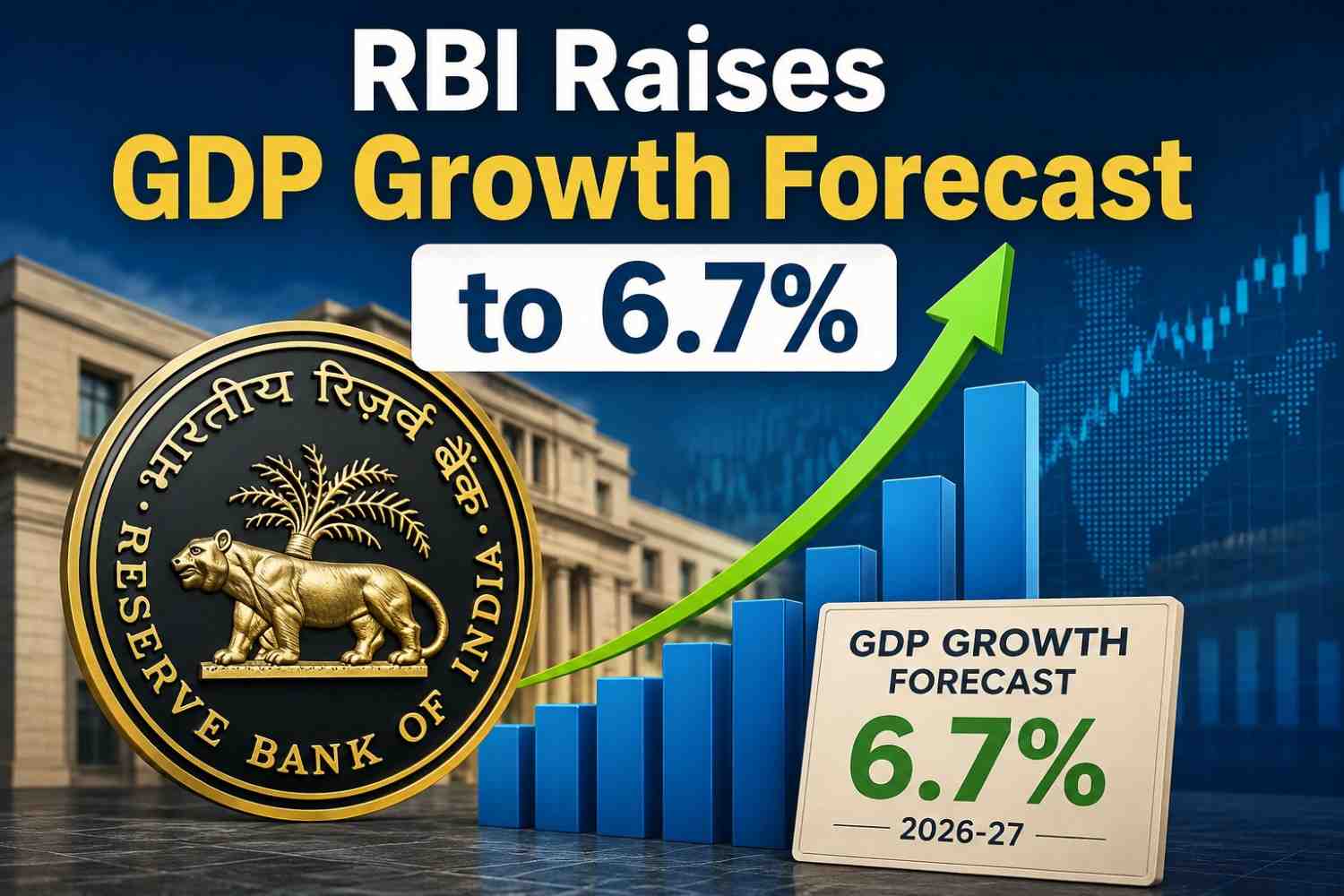
RBI GDP growth forecast 6.7%: The Reserve Bank of India (RBI) has raised its real GDP growth forecast for India to 6.7% for 2026-27, while keeping the repo rate unchanged at 5.25% and maintaining a neutral monetary policy stance.
RBI Governor Sanjay Malhotra said India’s economic growth continues to be supported by resilient domestic demand and that the country remains the world’s fastest-growing large economy.
The Governor also said the Indian economy performed better than expected during the April-June quarter, prompting the central bank to revise its growth outlook.
RBI Keeps Repo Rate Unchanged at 5.25% 🏦
Announcing the decision of the Monetary Policy Committee (MPC), Governor Sanjay Malhotra said the RBI has decided to maintain the repo rate at 5.25% and retain its neutral stance.
The repo rate is the interest rate at which the RBI lends short-term money to commercial banks against government securities. Changes in the repo rate can influence borrowing costs, lending rates and overall economic activity.
Key RBI monetary policy decisions
- 📈 GDP growth forecast: 6.7% for 2026-27
- 🏦 Repo rate: 5.25%
- ⚖️ Monetary policy stance: Neutral
- 📉 CPI inflation projection: 5%
- 💰 Foreign exchange reserves: Nearly $693 billion
- 🌍 Import cover: More than 10 months
RBI Raises GDP Growth Forecast to 6.7%
The RBI has revised its real GDP growth projection for 2026-27 to 6.7%, citing better-than-expected economic performance during the first quarter of the financial year.
According to Governor Malhotra, resilient domestic demand continues to support economic activity. Robust exports, steady investment activity and easing supply-side disruptions have also strengthened the domestic macroeconomic outlook.
The latest projection reflects the RBI’s relatively optimistic assessment of India’s economic growth despite continued global uncertainties.
Inflation Forecast Lowered to 5% 📉
Along with raising its growth outlook, the RBI has lowered its CPI inflation projection to 5%, compared with its earlier estimate of 5.1% for financial year 2027.
Governor Malhotra said the recent increase in inflation was largely driven by food and fuel prices, rather than broad-based demand pressures.
The lower inflation projection, alongside the higher growth forecast, points to a more favorable domestic economic outlook, although risks remain from developments in the global economy.
Global Uncertainty Remains a Challenge 🌍
The RBI has also highlighted risks arising from the global economic environment.
Governor Malhotra said the West Asia conflict continues to pose challenges to the global economy, particularly by disrupting important trade routes.
Despite these external risks, the RBI struck an optimistic tone on India’s domestic economy, pointing to strong exports, steady investment and improvements in supply-side conditions.
India’s Forex Reserves Near $693 Billion 💵
On the external sector, the RBI said foreign direct investment (FDI) inflows remained robust, while foreign portfolio investment (FPI) flows have shown a turnaround in recent months.
India’s foreign exchange reserves remain comfortable at nearly $693 billion, according to the Governor.
The reserves provide the country with more than 10 months of import cover, offering an important buffer against external economic and financial shocks.
Polymer Notes Expected Next Financial Year 💴
Governor Sanjay Malhotra also said polymer currency notes are expected to enter circulation at the beginning of the next financial year, provided everything proceeds according to schedule.
Speaking at a press conference in Mumbai, he said polymer notes offer greater durability. Further details about their security features and other aspects will be communicated later.
CBDC and Unified Lending Interface Gain Momentum 💻
The RBI also discussed developments related to the Central Bank Digital Currency (CBDC) and the Unified Lending Interface (ULI).
Deputy Governor Rohit Jain said the use of these initiatives is increasing, with various stakeholders increasingly accepting and adopting them.
The developments underline the RBI’s continued focus on digital payments, financial technology and modern lending infrastructure.
Key Takeaways: What the RBI’s Decision Means
👉 India’s GDP growth forecast has been raised to 6.7% for 2026-27.
👉 The repo rate remains unchanged at 5.25%.
👉 The RBI has retained a neutral monetary policy stance.
👉 CPI inflation projection has been lowered to 5%.
👉 Forex reserves remain strong at nearly $693 billion.
👉 Global risks, including disruptions linked to the West Asia conflict, remain a concern.
👉 Polymer currency notes could enter circulation at the beginning of the next financial year, subject to schedule.
Bottom Line 📊
The RBI’s latest monetary policy decision presents a relatively positive picture of the Indian economy. The central bank has raised its GDP growth forecast to 6.7% while lowering its inflation projection to 5%, even as it keeps the repo rate unchanged at 5.25%.
Strong domestic demand, exports and investment are supporting growth, while comfortable foreign exchange reserves provide additional resilience. However, global uncertainties and geopolitical tensions remain key risks that could influence India’s economic outlook in the months ahead.