
 bobby
bobby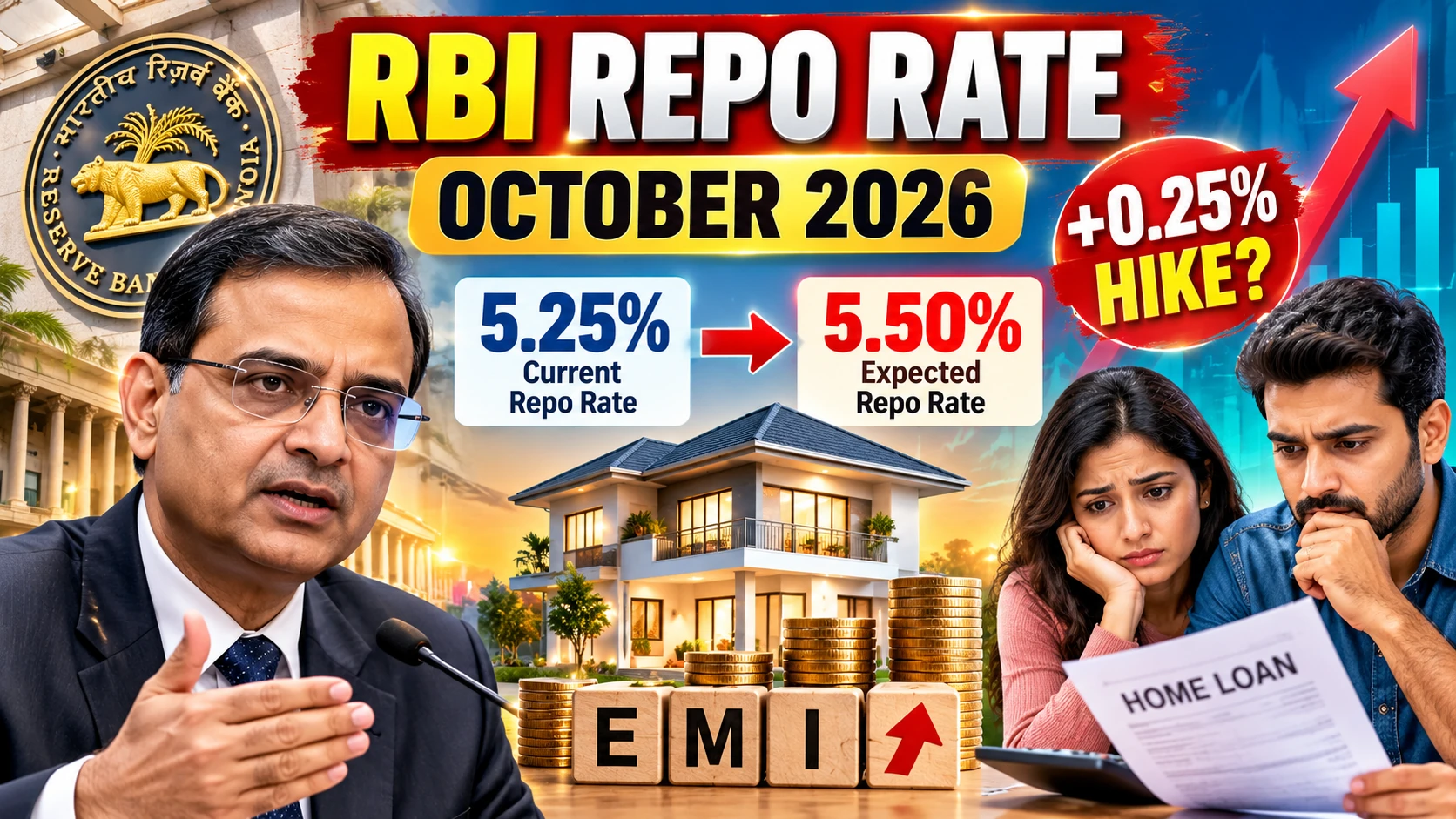
RBI Repo Rate Hike: Home loan borrowers in India could face higher borrowing costs if the Reserve Bank of India (RBI) decides to increase the repo rate at its October 2026 monetary policy review.
The RBI’s Monetary Policy Committee (MPC) meeting is scheduled to begin on October 5, 2026, against a backdrop of rising inflation risks and elevated crude oil prices. A survey of 16 economists and banking experts cited in the source suggests that many expect a 0.25 percentage-point increase, although some believe the central bank could keep rates unchanged.
For borrowers, the key question is straightforward: Will an RBI repo rate hike increase home loan EMIs?
The answer depends on the type of loan, benchmark, lender and reset terms—but borrowers with repo-linked floating-rate loans could feel the impact if banks pass on higher rates.
📌 RBI Repo Rate Hike: Key Points at a Glance
Here are the major developments borrowers and investors should watch:
- RBI’s MPC meeting begins on October 5, 2026.
- The repo rate is currently 5.25%, according to the source.
- A 25-basis-point hike would take it to 5.50%.
- Rising inflation and expensive crude oil are key concerns.
- India’s retail inflation reached 4.82% in August, up from 4.45% in July.
- A rate hike could affect repo-linked floating-rate loans.
- Economists remain divided, so a rate increase is not yet confirmed.
📊 RBI Repo Rate October 2026: Important Numbers
These figures illustrate why the October monetary policy decision is particularly important for borrowers.
🏠 Will Home Loan EMI Increase After a Repo Rate Hike?
A repo rate hike does not automatically mean every borrower’s EMI rises immediately.
The repo rate is the rate at which RBI lends short-term funds to commercial banks against eligible securities. When RBI raises it, borrowing can become more expensive for banks.
Lenders may subsequently pass some of that increase to customers.
For borrowers with repo-linked floating-rate home loans, an increase in the applicable benchmark could result in a higher loan interest rate when the rate resets.
Depending on the lender and loan agreement, this can generally be handled by:
1. Increasing the EMI
The monthly instalment may rise while the remaining loan tenure stays broadly similar.
2. Extending the Loan Tenure
Instead of substantially increasing the monthly EMI, the lender may extend the repayment period, subject to its policies and applicable conditions.
Either outcome can increase the overall interest burden compared with a scenario in which rates remain unchanged.
💰 Why Is RBI Facing Pressure to Consider Higher Rates?
Inflation is at the heart of the debate. India’s retail inflation increased to 4.82% in August 2026 from 4.45% in July, according to the figures reported in the source. Inflation had also remained above RBI’s 4% target for three consecutive months.
Another concern is energy.
The source reports crude oil prices moving above $100 per barrel amid renewed tensions in the Middle East. Expensive oil can be particularly important for India because higher energy costs can spread through transportation, manufacturing and other parts of the economy.
If those pressures persist, controlling inflation could become a bigger priority for the central bank.
📈 Could RBI Increase the Repo Rate to 5.50%?
If RBI raises the current 5.25% repo rate by 25 basis points, it would reach 5.50%.
Such a decision would also represent a shift from the easing cycle that began in 2025 and the subsequent period of stable rates described in the source.
But borrowers should not treat the 5.50% figure as confirmed.
Some economists believe inflation risks justify monetary tightening, while others argue there are not yet sufficiently strong signs of demand-driven inflation or economic overheating to require an immediate hike.
🔍 What Are Economists Expecting?
Expert opinion is divided.
Some economists see a combination of stronger economic activity, inflation risks, higher commodity prices and global monetary conditions as providing RBI with room to increase rates.
Others believe waiting may be preferable.
The survey cited in the source also indicates that several economists expect at least two rate increases during FY 2026–27, while some see the possibility of two or three hikes. These are forecasts, not announced RBI decisions.
That distinction matters for anyone making financial decisions based on the expected direction of interest rates.
📉 What Should Home Loan Borrowers Do Now?
Borrowers do not necessarily need to make drastic changes based on a forecast.
Instead, this may be a good time to review your loan documents and understand how your interest rate is calculated.
Check your outstanding principal, current interest rate, remaining tenure, benchmark, reset frequency and any applicable spread or margin.
If rates rise, compare whether increasing your EMI slightly or making permitted prepayments could reduce the additional long-term interest burden.
Borrowers considering refinancing should also account for processing charges and other switching costs rather than looking only at the advertised interest rate.
🚗 Will Car and Personal Loans Also Become Costlier?
Potentially—but not every loan responds to RBI policy in exactly the same way.
Floating-rate products linked to an external benchmark can react more directly to benchmark changes. Fixed-rate loans generally do not change simply because RBI announces a new repo rate during the fixed-rate period, though exact contractual terms matter.
New borrowers could also encounter different lending rates if banks adjust their pricing after an RBI decision.
Therefore, home loan, car loan and personal loan customers should check their individual loan terms instead of assuming that every EMI will increase simultaneously.
📊 RBI Must Balance Inflation and Economic Growth
The central bank faces a familiar challenge: controlling inflation without unnecessarily slowing economic activity.
RBI’s August policy had projected 6.7% GDP growth for FY 2026–27, according to the source, while some economists expected the outlook could be revised slightly higher.
Strong growth can give a central bank more room to focus on inflation.
However, higher interest rates also make credit more expensive, which can influence household spending, housing demand and business investment.
The October decision therefore involves balancing multiple economic signals rather than reacting to a single inflation figure.
❓ Frequently Asked Questions
What is the RBI repo rate in October 2026?
The repo rate stands at 5.25% ahead of the October policy decision, according to the source report.
Will RBI increase the repo rate by 0.25%?
A 0.25 percentage-point increase is expected by several economists surveyed in the source, but RBI has not yet confirmed such a hike.
What will the repo rate be after a 25-basis-point hike?
A 25-basis-point increase from 5.25% would take the repo rate to 5.50%.
Will my home loan EMI increase if RBI hikes the repo rate?
It may, particularly for eligible floating-rate loans linked to the repo rate or another affected benchmark. The exact impact depends on your lender, benchmark, reset date and loan terms.
Can the loan tenure increase instead of the EMI?
Depending on the lender and loan conditions, an interest-rate increase may result in a higher EMI, a longer repayment tenure, or another adjustment permitted under the loan agreement.
Why might RBI raise interest rates?
The main concerns highlighted in the source are rising inflation, higher crude oil and commodity prices, and broader global economic developments.
When does the RBI MPC meeting begin?
The October 2026 Monetary Policy Committee meeting is scheduled to begin on October 5, 2026, according to the report.
🏁 Conclusion
The possibility of an RBI repo rate hike in October 2026 has put home loan borrowers on alert. With the repo rate at 5.25%, a widely discussed 25-basis-point increase would take it to 5.50% and could eventually make some floating-rate loans more expensive.
Rising retail inflation and high crude oil prices strengthen the case for tighter monetary policy, but the outcome is not predetermined. Economists remain divided over whether RBI should act immediately or wait for more evidence.
For borrowers, the best approach is to focus on what can be controlled: understand your loan’s benchmark and reset terms, maintain some room in the household budget for higher repayments, and avoid making major financial decisions solely on forecasts.
The official RBI policy decision—not market speculation—will ultimately determine what happens next to the repo rate and its impact on borrowers.