
 bobby
bobby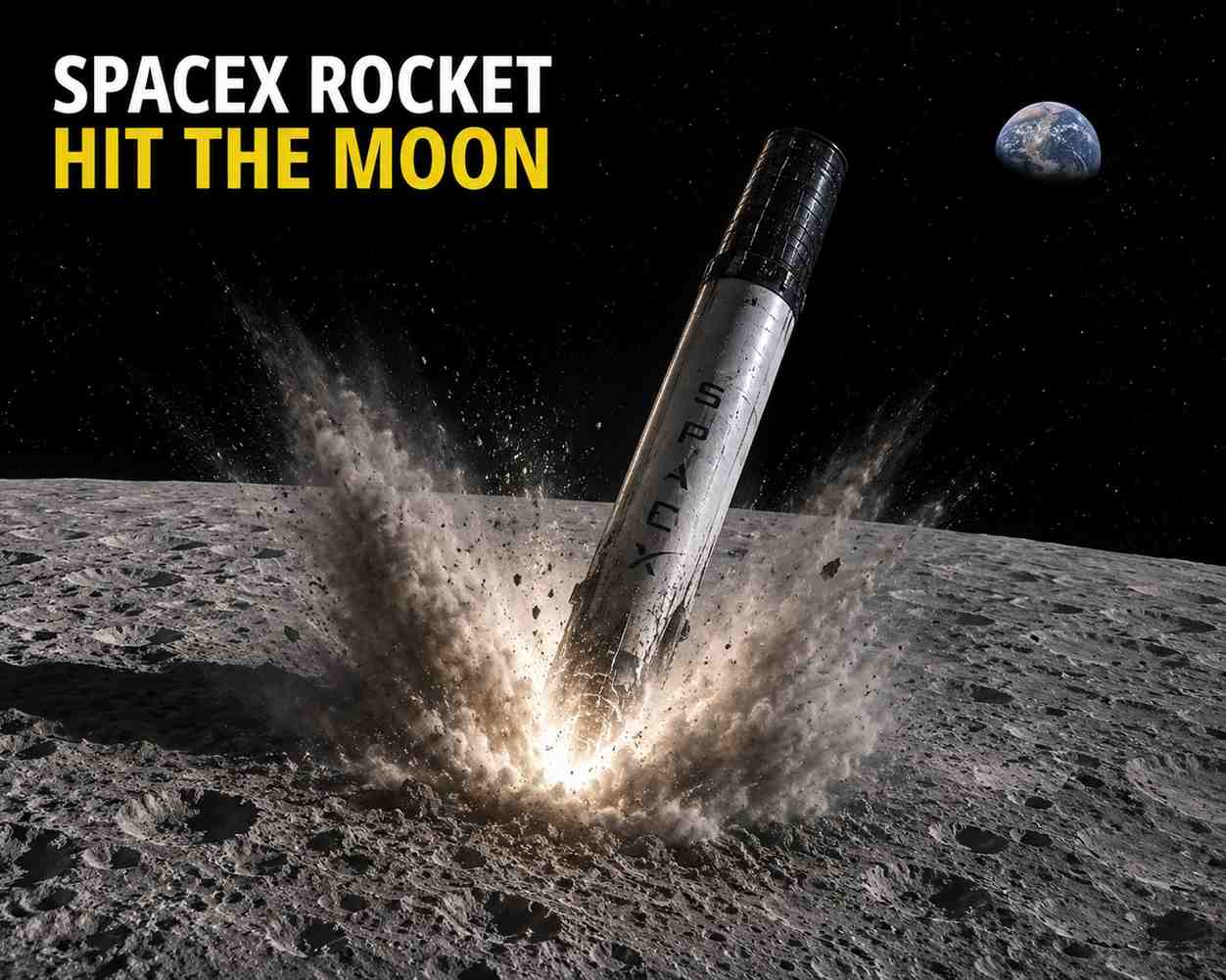
SpaceX rocket hit the moon: When a SpaceX rocket hit the Moon, astronomers witnessed far more than a dramatic collision. Powerful telescopes captured a glowing dust plume, unusual spectral lines, and chemical signatures that could reshape scientists’ understanding of lunar impacts and future Moon missions.
The collision, involving the upper stage of a Falcon 9 rocket, occurred at an astonishing speed of 8,690 km/h (5,400 mph). Although no spacecraft directly observed the impact, researchers at the European Southern Observatory (ESO) successfully detected valuable evidence using one of the world’s most advanced telescopes.
🚀 Key Highlights
- 🌕 SpaceX rocket struck the Moon at nearly 8,700 km/h
- 🔭 ESO’s Very Large Telescope detected glowing spectral lines
- ✨ Scientists identified traces of sodium and lithium
- 🌫️ A massive lunar dust plume stretched several kilometres
- 📡 Data could improve future lunar exploration and space debris research
🔭 ESO Telescope Captures Rare Spectral Lines
The European Southern Observatory’s Very Large Telescope observed colorful spectral lines shortly after the impact.
These glowing chemical fingerprints revealed the presence of sodium and lithium within the expanding dust cloud.
The dust plume remained visible for approximately five to ten minutes, providing astronomers with a rare opportunity to study the aftermath of a high-speed collision on the Moon.
Astronomer Carl Schmidt from Boston University’s Center for Space Physics estimated that the dust cloud expanded across tens of kilometres.
“This observation did not go perfectly and this is a very crude analysis, but we can say much more as additional data is studied,” Schmidt explained.
🌕 Where Did the SpaceX Rocket Hit the Moon?
The impact occurred near the Moon’s terminator, the boundary separating the illuminated and dark sides.
This location made observations particularly challenging because sunlight only briefly illuminated the dust cloud before it faded.
Despite several telescopes monitoring the Moon, no observatory managed to capture a direct image of the collision itself.
🧪 Scientists Discover Sodium and Lithium
One of the most exciting discoveries came from the detected chemical signatures.
Researchers believe:
- 🟡 Sodium originated from lunar soil.
- 🔋 Lithium likely came from the Falcon 9 rocket stage.
These observations help scientists better understand both the Moon’s surface composition and how artificial objects behave during high-speed impacts.
🚀 Why the SpaceX Rocket Hit the Moon Matters
Although the Moon is regularly struck by meteoroids, artificial impacts remain relatively rare.
Scientists believe this event provides valuable information for future lunar exploration.
Benjamin Fernando of Los Alamos National Laboratory previously noted that studying this impact could improve:
- Future lunar seismic experiments
- Space debris risk assessments
- Lunar landing safety
- Long-term Moon base planning
With NASA and international partners preparing for sustained human exploration of the Moon, understanding orbital debris has become increasingly important.
🌫️ A Giant Lunar Crater May Have Formed
Australian astrophysicist Dr. Sara Webb believes the collision likely produced a fresh crater measuring roughly:
- 📏 20 metres wide
- 📏 5 metres deep
She noted that while astronomers expected a large dust cloud, they were surprised by how difficult it proved to observe.
“We expected a vast plume, but what surprised us was how hard it was to actually see the impact.”
📸 Spacecraft Will Search for the Crash Site
NASA’s Lunar Reconnaissance Orbiter and South Korea’s Danuri (Pathfinder Lunar Orbiter) are expected to photograph the impact site.
These images could reveal:
- The newly formed crater
- Remaining rocket debris
- Changes to the surrounding lunar surface
However, scientists say it could take several days before high-resolution images become available.
🚀 How the Rocket Ended Up on the Moon
The Falcon 9 mission launched in January 2025, carrying two commercial lunar landers.
While the reusable first-stage booster safely returned to Earth, the upper stage continued into deep space after completing its mission.
Eventually, gravitational forces altered its trajectory until it collided with the Moon.
The rocket stage measured roughly the height of a five-storey building and weighed around four tonnes.
🌍 Why This Discovery Is Important
The SpaceX rocket hit the Moon event demonstrates how advanced telescopes can study impacts even when no spacecraft directly observes them.
The newly detected spectral lines provide scientists with valuable clues about:
- Lunar surface chemistry
- High-speed impact physics
- Space debris behavior
- Future Moon missions
- Planetary defense research
As humanity prepares to establish a permanent presence on the Moon, understanding these events becomes increasingly significant.
❓Frequently Asked Questions (FAQ)
What happened when the SpaceX rocket hit the Moon?
The Falcon 9 upper stage collided with the Moon at nearly 8,690 km/h, creating a massive dust plume and new impact crater.
What are spectral lines?
Spectral lines are unique chemical signatures that allow scientists to identify elements such as sodium and lithium in gases.
Why is the impact important?
The event helps researchers study lunar geology, space debris, and the effects of high-speed collisions, improving future Moon exploration.
Did anyone see the actual impact?
No spacecraft directly witnessed the collision. However, powerful telescopes detected the impact plume and its chemical composition.
Will NASA photograph the impact site?
Yes. NASA’s Lunar Reconnaissance Orbiter and South Korea’s Danuri lunar orbiter are expected to capture images of the crash site.