
 bobby
bobby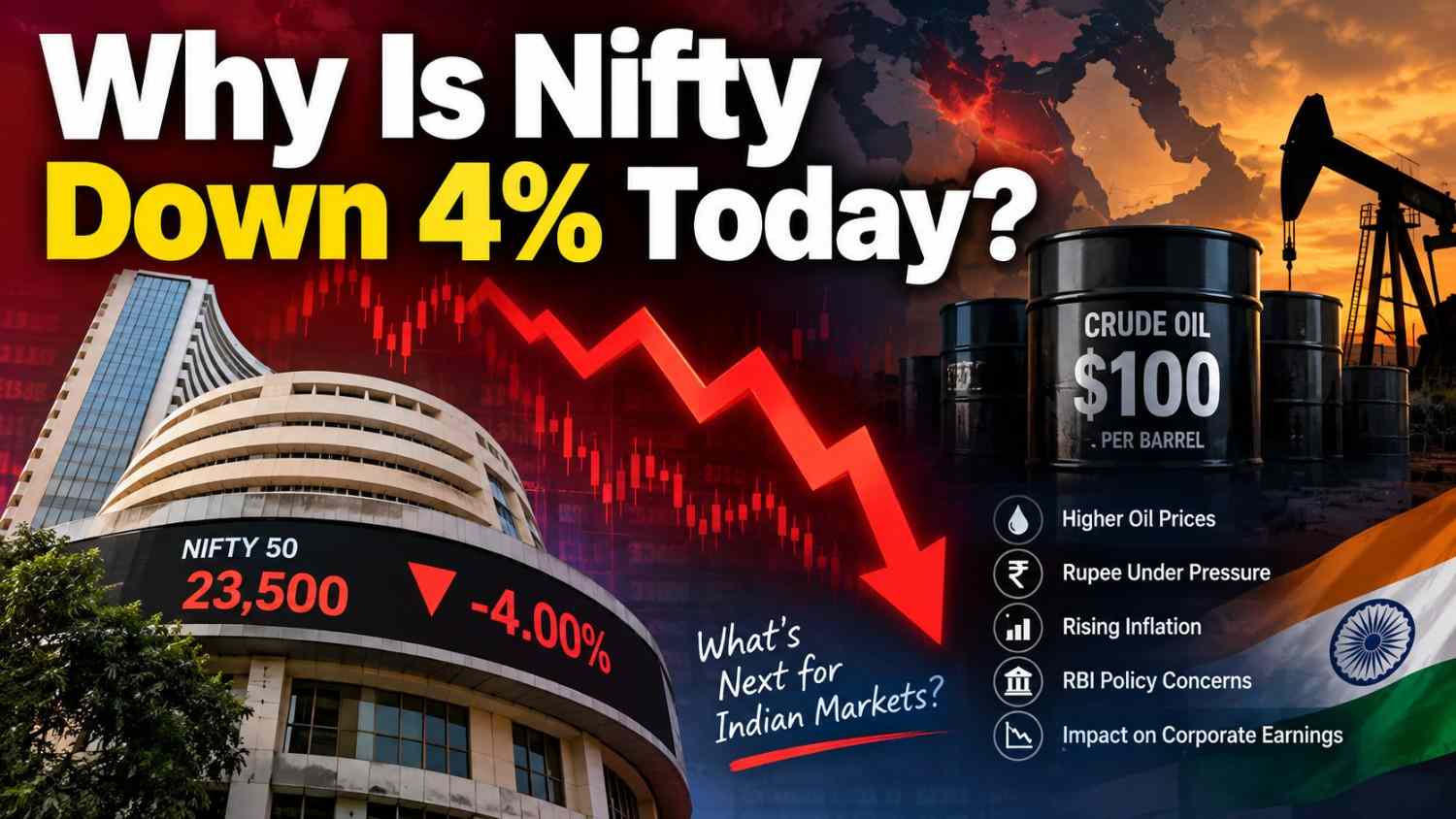
Why Is Nifty Down 4% Today:The Indian stock market is facing a fresh macroeconomic challenge as Brent crude oil crosses the psychologically important $100-a-barrel level.
The Nifty 50 closed at 23,431.50 on September 9, 2026, falling 0.86% for the session and extending a broader period of market weakness.
But crude oil is not solely responsible for the fall.
Indian equities are simultaneously dealing with weakness in IT stocks, elevated global yields, geopolitical uncertainty and cautious investor sentiment. Expensive crude, however, could make these pressures more difficult for India because the country imports nearly nine out of every 10 barrels of crude oil it needs.
The crucial question for investors is therefore no longer simply whether Brent can touch $100.
It is this:
What happens to India if crude oil stays around $100 for weeks or months?
📊 Why Is Nifty Falling?
The Nifty 50 ended September 9 at 23,431.50, down 203.60 points, or 0.86%, as Indian equities fell to their lowest levels in roughly three months.
IT stocks were among the biggest drags on the market, while rising crude prices and broader global uncertainty further weakened investor sentiment.
This means blaming the entire market correction on crude would oversimplify what is happening.
Several pressures are working together:
- 📉 Sharp weakness in major IT stocks
- 🛢️ Brent crude above $100 a barrel
- 🌍 Escalating geopolitical tensions
- 📈 Elevated global bond yields and interest-rate concerns
- 💵 Pressure on the Indian rupee
- 🏦 Changing expectations around global monetary policy
Crude is nevertheless particularly important because it can transmit a global geopolitical shock directly into India’s domestic economy.
Higher oil can affect the trade deficit, rupee, inflation, interest rates and corporate profits simultaneously.
🛢️ Why Has Brent Crude Crossed $100?
Brent crude crossed $100 per barrel on September 9 amid escalating conflict in the Middle East and growing concerns about disruption to global energy supplies.
Markets are particularly sensitive to developments affecting major oil-producing regions and strategically important shipping routes.
Oil prices do not need an actual long-term shortage before reacting.
If traders believe future production or transportation could be disrupted, they can immediately price a larger geopolitical risk premium into crude futures.
For an oil-importing economy such as India, that can quickly become a macroeconomic concern.
🇮🇳 Why Is $100 Crude Oil a Problem for India?
India’s biggest vulnerability is straightforward: it depends heavily on imported crude oil.
India’s crude import dependency reached about 88.6% during April–January FY26.
That means a major increase in global crude prices sends substantially more money overseas to purchase essentially the same commodity.
Recent import data illustrates the problem clearly.
India’s Crude Import Bill
| Metric | April–July 2025 | April–July 2026 | Change |
|---|---|---|---|
| Crude import volume | 81.5 MMT | 81.9 MMT | Almost flat |
| Crude import bill | $40.5 billion | $63.4 billion | +56.5% |
India’s crude import bill surged 56.5% year-on-year to $63.4 billion during April–July 2026.
Yet crude import volumes increased only marginally—from 81.5 million metric tonnes to 81.9 million metric tonnes.
That distinction matters.
India did not consume 56% more imported crude.
It paid dramatically more for almost the same quantity.
💰 What Does a $10 Rise in Crude Oil Mean for India?
A simple calculation illustrates why sustained high oil prices matter.
At an illustrative annual crude-import volume equivalent to roughly 1.8 billion barrels, every sustained $1-per-barrel increase could represent around:
$1.8 billion in additional annualised gross crude-import cost
That means:
$10 increase × 1.8 billion barrels ≈ $18 billion
So, all else being equal, a sustained $10 increase in crude could add roughly $18 billion to the annualised gross crude-import cost.
⚠️ This is an illustrative estimate, not a forecast. Actual costs depend on India’s crude basket, supplier discounts, exchange rates, freight, import volumes and other factors.
The key word is sustained.
A temporary $10 spike lasting a few days is very different from oil remaining $10 more expensive for an entire year.
💵 How Can $100 Crude Affect the Indian Rupee?
Most international crude transactions are denominated in US dollars.
When oil becomes more expensive, Indian refiners generally need more dollars to pay for imports.
That can increase demand for dollars and put pressure on the rupee, particularly when other global conditions are also unfavourable.
The rupee closed around ₹94.81 per US dollar on September 8, weakening sharply as crude approached $100.
This can create a potentially painful feedback loop:
Higher crude → larger dollar requirement → pressure on rupee → more expensive imports
And if crude rises at the same time as the rupee depreciates, India can effectively suffer a double shock.
The country pays a higher dollar price for oil while each dollar itself costs more rupees.
🔥 What Does $100 Crude Mean for Inflation?
Higher crude does not automatically produce an equivalent increase in petrol and diesel prices.
Taxes, government policy and oil marketing company margins influence how much of the international price increase eventually reaches consumers.
But sustained expensive crude can spread through the economy indirectly.
Higher diesel prices can increase freight and transportation costs. Aviation turbine fuel can become more expensive. Petrochemical-derived inputs used in plastics, paints, tyres and chemicals can also face cost pressure.
Those businesses then have two broad choices:
Absorb the additional costs → profit margins suffer
or
Pass the costs to consumers → inflationary pressure increases
Either outcome matters for investors.
🏦 Could Higher Crude Affect RBI Interest Rates?
Potentially, yes—especially if elevated oil prices persist.
A Reserve Bank of India study published in July 2025 estimated that a 10% increase in international crude oil prices could raise India’s headline inflation by around 20 basis points, although the eventual impact depends on factors including government intervention and domestic price pass-through.
That creates a difficult policy equation.
If oil pushes inflation higher, the RBI may have less flexibility to support economic activity through easier monetary policy.
In simplified form:
Higher oil → inflation pressure → reduced monetary-policy flexibility → potentially tighter financial conditions
An oil shock is particularly uncomfortable because it can increase prices while simultaneously putting pressure on economic growth.
For equity investors, that combination deserves attention.
✈️ Which Indian Sectors Could Be Hit by $100 Crude?
Not every company reacts to higher crude prices in the same way.
Some sectors are much more exposed.
| Sector | Likely Impact | Main Reason |
|---|---|---|
| ✈️ Airlines | Negative | Aviation fuel is a major operating expense |
| 🎨 Paints | Negative | Several inputs are linked to crude/petrochemicals |
| 🚗 Tyres | Negative | Synthetic rubber, carbon black and chemicals can become costlier |
| ⛽ Oil marketing companies | Mixed/Negative | Marketing margins can come under pressure |
| 🚚 Logistics | Negative | Higher fuel and transportation expenses |
| 🧪 Chemicals | Mixed | Depends on feedstock exposure and pricing power |
✈️ Airlines
Fuel is one of the biggest expenses for airlines.
If aviation turbine fuel remains expensive, airlines either have to absorb the additional cost or increase ticket prices.
Higher fares, however, can eventually affect passenger demand.
🎨 Paint Companies
Several paint-industry raw materials are linked directly or indirectly to crude and petrochemical prices.
If input costs rise faster than selling prices, margins can come under pressure.
🚗 Tyre Companies
Synthetic rubber, carbon black and other chemicals are important tyre-manufacturing inputs.
Persistent crude inflation can therefore raise production costs.
For investors, the crucial question is not merely whether input prices rise.
It is:
Does the company have enough pricing power to pass those costs on without destroying demand?
⏳ $100 Crude for Three Days vs Three Months: Why Duration Matters
This may be the most important distinction in the entire oil story.
Markets naturally focus on psychologically powerful numbers such as $100 per barrel.
But the economic impact depends much more on how long oil stays expensive.
Scenario 1: Oil briefly crosses $100
If geopolitical tensions ease and Brent quickly retreats, much of the impact could remain concentrated in:
- Stock-market volatility
- Rupee volatility
- Short-term pressure on crude-sensitive stocks
- Investor risk aversion
Corporate earnings might experience relatively limited damage.
Scenario 2: Oil stays around $100 for months
This is considerably more serious.
Refiners repeatedly purchase expensive crude.
Airlines repeatedly pay higher fuel costs.
Manufacturers repeatedly face higher raw-material expenses.
India’s import bill stays elevated.
Dollar demand can remain stronger.
Inflation risks become harder to ignore.
Corporate earnings estimates may eventually have to adjust.
At that stage, crude is no longer simply a market-sentiment story.
It becomes an earnings, inflation, currency and economic-growth story.
👀 What Should Nifty Investors Watch Now?
Investors trying to understand whether the oil shock could deepen should monitor five indicators.
1. 🛢️ Brent Crude Price
Don’t watch only whether Brent is above or below $100.
Watch its average price over several weeks.
Persistence matters more than a single intraday print.
2. 🌍 Middle East Developments
Further disruption to oil production, infrastructure or major shipping routes could keep a geopolitical premium embedded in crude prices.
Any meaningful de-escalation could have the opposite effect.
3. 💵 USD/INR
A simultaneous rise in crude and fall in the rupee can magnify India’s imported-energy burden.
4. ⛽ Domestic Fuel Prices
If higher international costs are absorbed rather than passed through, oil-company margins can face pressure.
If more of the increase reaches consumers, inflation becomes the bigger concern.
5. 📊 Corporate Margins
Quarterly results from airlines, paints, tyres, chemicals, logistics companies and other oil-sensitive industries should eventually reveal how much of the additional cost companies can absorb or pass on.
📈 Can Nifty Recover if Crude Falls?
A decline in crude would remove one important macroeconomic headwind, but it would not automatically guarantee a Nifty rally.
The market is currently responding to several variables at once.
Investors would also need to watch global interest-rate expectations, bond yields, foreign institutional flows, corporate earnings, IT-sector performance and geopolitical developments.
That is why the relationship between crude and Nifty should not be reduced to:
Oil up = Nifty down.
Markets are more complicated than that.
🧠 Author’s Take: $100 Isn’t the Most Important Number
The dramatic headline is obvious: Nifty is under pressure while Brent crude has crossed $100.
But investors should avoid concluding that crude caused the entire market decline.
It didn’t.
The more important issue is what happens next.
India’s dependence on imported crude means a sustained oil shock can move through several layers of the economy:
🛢️ Crude → 💵 Import bill → ₹ Rupee → 🔥 Inflation → 🏦 RBI → 📉 Corporate margins → 📊 Equity valuations
Recent import data already demonstrates how quickly higher oil prices can increase India’s bill even when physical import volumes barely change.
At illustrative current import volumes, a sustained $10-per-barrel increase could represent roughly $18 billion in additional annualised gross crude-import costs, all else being equal.
Someone ultimately has to absorb that higher cost—consumers, companies, oil marketers, the government, or some combination of them.
That is why investors should not obsess over whether Brent trades at $99, $100 or $101 on a particular afternoon.
The more consequential number is the average crude price India faces over the coming weeks and months.
If oil retreats quickly, the damage could remain largely concentrated in sentiment and short-term volatility.
If Brent stays around $100 for several months, however, the consequences could spread into inflation, the rupee, RBI policy expectations, corporate earnings and ultimately Nifty valuations.
For Indian investors, the duration of the oil shock may matter far more than the $100 headline itself.
❓ Frequently Asked Questions
Why is Nifty falling?
Nifty is facing a combination of pressures, including weakness in IT stocks, higher crude oil prices, global bond-yield concerns and geopolitical uncertainty. Crude is an important additional risk because India imports most of the oil it consumes.
How does crude oil affect Nifty?
Higher crude can increase India’s import bill, pressure the rupee, raise inflation and increase costs for businesses. These effects can hurt corporate earnings and investor sentiment, although crude is only one of many factors influencing Nifty.
What happens to India if crude reaches $100?
A brief move above $100 may mainly create market and currency volatility. If crude remains near $100 for months, however, it could increase India’s import costs, inflation risks and pressure on corporate margins.
Which stocks are negatively affected by high crude oil prices?
Airlines, paints, tyres, logistics businesses and some oil marketing companies can face pressure from higher crude or fuel costs. The actual impact depends heavily on each company’s pricing power and ability to pass costs to customers.
Does higher crude weaken the Indian rupee?
It can. Because India imports large quantities of crude and international oil purchases generally require dollars, higher oil prices can increase dollar demand and add pressure to the rupee. Currency movements, however, depend on many other factors as well.
Will RBI raise interest rates because of crude oil?
Not necessarily. RBI considers the overall inflation and growth outlook rather than crude prices alone. But sustained expensive oil can increase inflationary pressure and potentially reduce the central bank’s room to ease monetary policy.
Is $100 crude bad for the Indian stock market?
Sustained $100 crude is generally a macroeconomic headwind for India because of its high dependence on imported oil. A short-lived spike, however, can have a much smaller economic impact than crude remaining elevated for several months.