
 bobby
bobby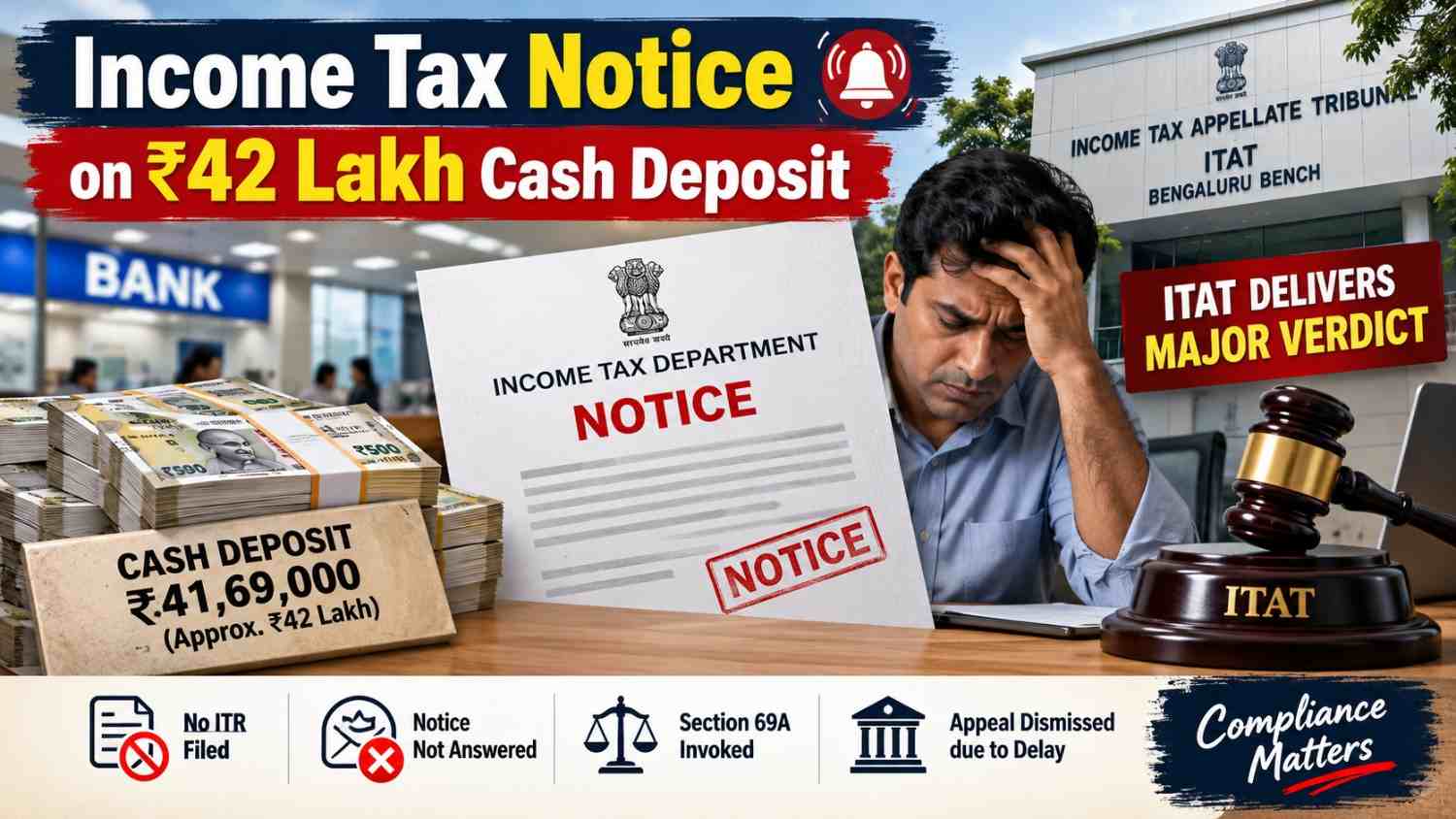
Income Tax Notice on ₹42 Lakh Cash Deposit: A Bengaluru taxpayer has failed to obtain relief from the Income Tax Appellate Tribunal (ITAT) in a case involving cash deposits of ₹41.69 lakh—approximately ₹42 lakh.
The Bengaluru Bench of the ITAT refused to admit the taxpayer’s appeal because it was filed after a delay of around 1,480 days, or roughly four years. The taxpayer claimed that he had been unaware of the income tax proceedings and discovered the issue only while arranging documents for a foreign visa.
Importantly, the ITAT’s decision concerned the delay in filing the appeal. The tribunal did not decide the underlying ₹41.69 lakh tax addition on its merits.
🔎 What Was the ₹41.69 Lakh Cash Deposit Case?
The dispute involved Reddy, a Bengaluru resident who claimed that rental income was his main source of earnings and that his annual income was below ₹5 lakh.
According to his explanation, his wife and father met a substantial portion of his expenses. He therefore claimed that he did not regularly file Income Tax Returns (ITRs) or routinely check his email and the Income Tax Department’s online portal.
However, the tax authorities did not accept his explanation regarding the transactions identified in his case.
The Assessing Officer treated ₹41.69 lakh in cash deposits as unexplained money under Section 69A of the Income Tax Act.
Other additions mentioned in the proceedings included:
- 💰 ₹41.69 lakh treated as unexplained cash under Section 69A
- 📑 ₹3.69 lakh relating to undisclosed credits
- 💼 ₹1.5 lakh as business or professional income
- ⚠️ Applicable interest
- ⚖️ Initiation of penalty proceedings
The dispute ultimately reached the appellate authorities, but the substantial delay in filing the appeals became the decisive issue.
📩 Tax Proceedings Allegedly Discovered During Visa Application
The taxpayer claimed that he became aware of the income tax proceedings only in March 2023.
According to his explanation, he needed an ITR while arranging documentation for a visa for foreign travel. It was during this process that he allegedly discovered the pending income tax matter.
He argued that he had remained unaware of the earlier proceedings because he had limited knowledge of income tax requirements and, given his relatively low income, was not accustomed to regularly filing ITRs.
He also referred to disruption caused by the COVID-19 pandemic as part of the circumstances surrounding the delay.
After discovering the matter, he reportedly consulted a tax professional and proceeded with an appeal.
⏳ Appeal Filed Around 1,480 Days Late
The biggest hurdle was not simply the amount of cash involved—it was the extraordinary delay in challenging the tax proceedings.
When the case reached the ITAT Bengaluru, the main appeal had been filed with a delay of approximately 1,480 days.
Two related penalty appeals were also delayed by around 1,298 days.
Before the matter reached the tribunal, the Commissioner of Income Tax (Appeals), or CIT(A)/NFAC, had declined to condone the delay.
The appellate authority found that the reasons provided to explain the delay were general in nature and were not sufficiently supported by documentary evidence.
The matter was then taken before the Bengaluru Bench of the ITAT.
⚖️ Why Did ITAT Refuse to Condon the Delay?
The taxpayer argued that his lack of awareness of income tax procedures contributed to the late filing.
However, the ITAT noted an important fact: he had filed Income Tax Returns in earlier years.
That weakened the argument that he was entirely unfamiliar with the income tax system.
The tribunal essentially found that a lengthy delay is not automatically fatal, but a taxpayer seeking condonation must demonstrate a credible and sufficiently supported reason explaining why the appeal could not be filed within the prescribed period.
In this case, the explanation was not considered sufficient to justify a delay running into several years.
As a result, the appeals were dismissed as time-barred.
🏛️ ITAT Refers to Supreme Court Principles on Delayed Appeals
While dealing with the request to condone the delay, the tribunal referred to principles laid down by the Supreme Court concerning delayed legal proceedings.
The key principle is significant for taxpayers: an exceptionally long delay cannot be excused simply on sympathetic grounds.
A person seeking condonation generally needs to demonstrate sufficient cause and support the explanation with credible circumstances or evidence.
Therefore, merely saying that a taxpayer was unaware of the proceedings may not, by itself, be enough—particularly where other facts indicate previous familiarity with income tax compliance.
💡 What Is Section 69A of the Income Tax Act?
Section 69A can become relevant when a taxpayer is found to be the owner of money, bullion, jewellery or other valuable articles that are not recorded in the books of account, where applicable, and the taxpayer either provides no satisfactory explanation about their nature and source or the explanation is not accepted by the tax authority.
In such circumstances, the unexplained amount may be treated as the taxpayer’s income under the applicable provisions of the Income Tax Act.
In the present matter, the Assessing Officer invoked Section 69A in relation to the ₹41.69 lakh cash deposits.
However, this distinction is crucial: the ITAT’s dismissal of the delayed appeal should not be interpreted as a fresh ruling by the tribunal that the ₹41.69 lakh necessarily constituted unexplained income on the merits.
The appeals failed at the limitation stage.
❓ Did ITAT Cancel the ₹41.69 Lakh Addition?
No.
The ITAT did not grant the taxpayer relief against the underlying addition because the appeals were dismissed on the issue of delay.
At the same time, the tribunal did not adjudicate the substantive merits of the ₹41.69 lakh addition in these appeals.
Consequently, the existing orders affecting the taxpayer continue to operate unless they are successfully challenged through an available legal remedy.
🏦 Why Large Cash Deposits Require Proper Documentation
The case highlights the importance of maintaining records that can explain the source of substantial bank deposits.
Depending on the circumstances, relevant documentation could include bank records, income records, transaction documents, books of account, agreements, or other evidence establishing the nature and source of the money.
A large deposit does not, by itself, tell the entire tax story. What becomes important in a dispute is whether the taxpayer can credibly explain and substantiate the source when required.
📱 Ignoring Income Tax Portal or Email Can Become Costly
Another important lesson from the dispute is the risk of failing to monitor tax communications.
Taxpayers should keep their contact information updated and periodically review relevant communications and proceedings on the Income Tax portal.
Missing a notice can have serious consequences because statutory deadlines may continue to run even when a taxpayer does not actively respond.
Discovering a tax dispute years later can make obtaining appellate relief considerably more difficult.
⚠️ What Taxpayers Can Learn From This ITAT Verdict
This case offers several practical lessons:
- Do not ignore income tax communications. Check registered email addresses and the tax portal regularly.
- Respond within the prescribed deadline. Delayed responses can restrict available remedies.
- Keep evidence explaining large cash deposits. Documentation can be critical if the source is questioned.
- File appeals on time. A delay of several years requires a particularly convincing explanation.
- Document the reason for unavoidable delays. Statements unsupported by evidence may not be sufficient.
- Seek professional advice early. Waiting until enforcement or another financial requirement exposes the issue can make the dispute harder to address.
🏛️ What Can the Taxpayer Do Next?
According to the procedural position described in the case, the taxpayer may seek to approach the Karnataka High Court under Section 260A of the Income Tax Act, subject to the statutory requirements governing such an appeal.
Section 260A provides for an appeal from an ITAT order to the jurisdictional High Court where the case involves a substantial question of law.
Whether such an appeal is maintainable or ultimately succeeds would depend on the facts, legal questions raised, limitation requirements, and the High Court’s assessment.
📌 Key Takeaways
The Bengaluru ITAT case is a reminder that procedural deadlines can be just as important as the underlying tax dispute.
The matter involved cash deposits of ₹41.69 lakh (approximately ₹42 lakh) that the Assessing Officer treated as unexplained money under Section 69A. But when the taxpayer eventually pursued his appeal, he faced a delay of approximately 1,480 days.
His explanation—including claimed lack of awareness and discovering the proceedings while arranging visa-related documents—was not sufficient to secure condonation of the lengthy delay.
The ITAT therefore dismissed the appeals as time-barred rather than deciding the substantive ₹41.69 lakh addition on merits.
Frequently Asked Questions (FAQs)
1. What happened in the ₹42 lakh cash deposit income tax case?
The case involved approximately ₹41.69 lakh in cash deposits that the Assessing Officer treated as unexplained money under Section 69A. The taxpayer’s subsequent ITAT appeal was filed around 1,480 days late and was dismissed as time-barred.
2. Did ITAT give relief to the Bengaluru taxpayer?
No. The ITAT refused to condone the substantial delay and dismissed the appeals.
3. Did ITAT rule that the ₹41.69 lakh was definitely undisclosed income?
The tribunal did not decide the underlying ₹41.69 lakh addition on its merits in these appeals. Its decision centered on the delay in filing the appeals.
4. What is Section 69A of the Income Tax Act?
Section 69A deals with certain unexplained money, bullion, jewellery or other valuable articles where ownership is established and the taxpayer cannot satisfactorily explain their nature and source, subject to the statutory requirements.
5. Can an income tax appeal be accepted after a long delay?
A delayed appeal may potentially be admitted when sufficient cause for the delay is established. The longer the delay, however, the more important a credible and properly supported explanation becomes.
6. Why did the taxpayer say he missed the income tax proceedings?
He claimed that he did not regularly file ITRs or monitor tax communications because of his income level and limited understanding of tax requirements. He said he discovered the proceedings while arranging ITR-related documentation for a foreign visa.
7. Can the taxpayer challenge the ITAT order?
An appeal to the jurisdictional High Court may be available under Section 260A where the statutory conditions are satisfied, including the existence of a substantial question of law.
⚖️ Disclaimer
This article is for general informational and educational purposes only. It does not constitute income tax, investment, accounting, or legal advice. Tax laws and procedural requirements may change, and outcomes depend on individual facts. Readers should consult a qualified tax or legal professional before taking action.