 bobby
bobby
NSE IPO 2026: India’s National Stock Exchange (NSE) completed a historic milestone on September 24, 2026, as its shares began trading on the Bombay Stock Exchange (BSE), bringing a decades-long journey from market challenger to publicly listed company to a new chapter.
The listing carries historical significance. NSE was established in the early 1990s to modernize India’s capital markets and challenge the traditional broker-controlled trading system.
More than three decades later, the exchange that transformed stock trading in India has entered the public market through its long-standing competitor.
The NSE IPO also gives investors an opportunity to examine how technology, competition, and regulatory reforms reshaped India’s financial markets.
📈 NSE IPO 2026: A Historic Stock Market Debut
NSE’s public offering marked the culmination of a listing process that had faced regulatory and legal obstacles for several years.
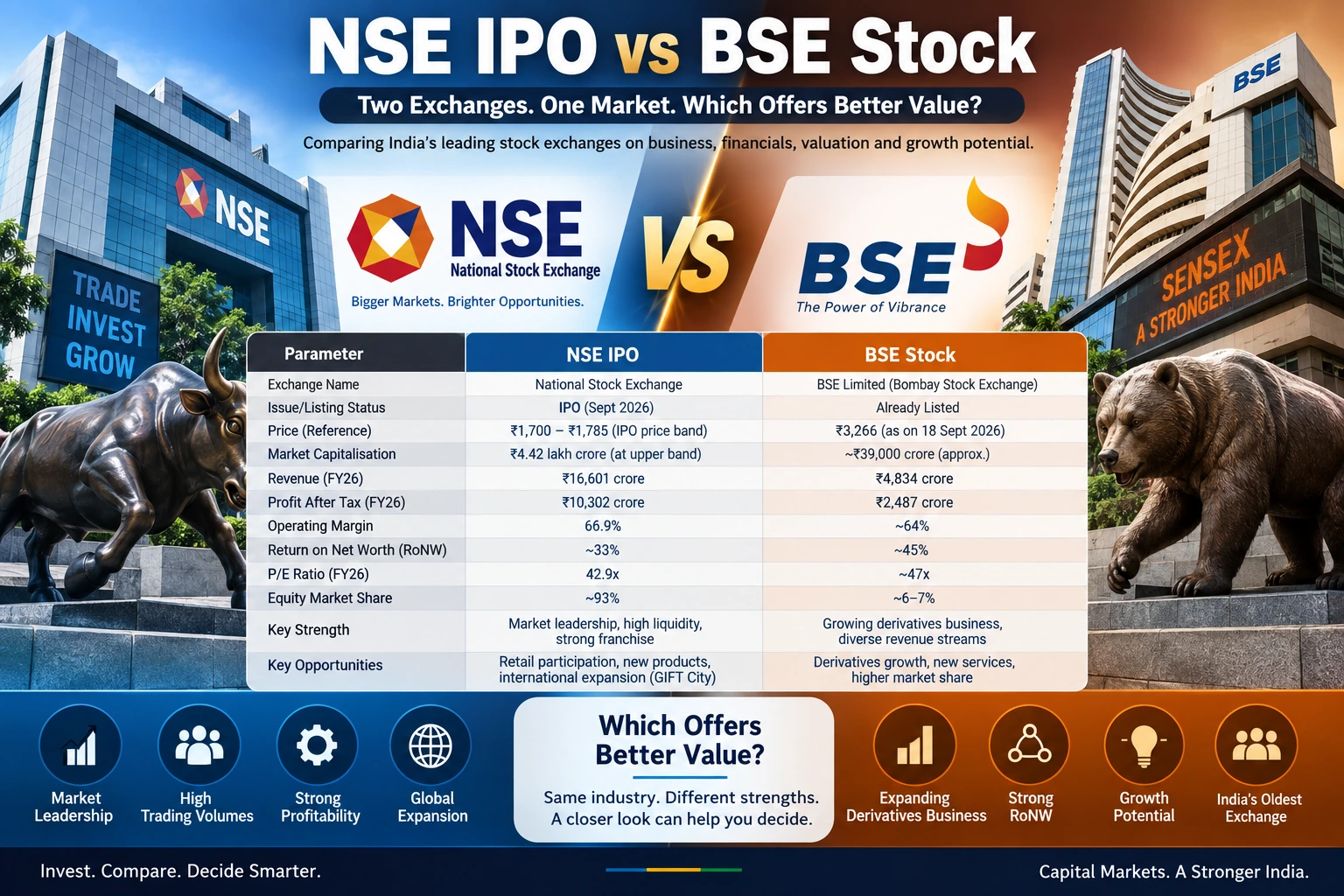
The exchange’s IPO was priced in a band of ₹1,700–₹1,785 per share, with the issue receiving substantial institutional participation.
The offering was entirely an offer for sale, meaning existing shareholders sold their shares rather than NSE issuing new equity to raise capital for its own operations.
The IPO closed with an overall subscription of approximately 5.71 times, according to the final subscription figures reported by The Economic Times.
NSE shares made their market debut on September 24, 2026, at ₹1,800, slightly above the upper end of the IPO price band.
Why Did NSE List on BSE?
NSE’s listing on BSE reflects the regulatory framework governing stock exchanges.
A stock exchange cannot list its own shares on its own trading platform. NSE therefore entered the public market through another exchange.
The development is particularly significant because NSE was originally created to challenge the trading practices and market structure associated with BSE.
To understand the importance of this milestone, it is necessary to revisit India’s stock market during the early 1990s.
NSE IPO Subscription Analysis
Final subscription figures across investor categories.
🏛️ How BSE Dominated India’s Stock Market Before NSE
Before NSE began operations, the Bombay Stock Exchange occupied a central position in India’s equity market.
Trading largely depended on brokers operating through a physical trading floor.
Investors outside Mumbai often relied on intermediaries to execute transactions.
BSE’s traditional membership structure also created barriers to entry.
Broker-members held trading privileges and participated in the exchange’s governance, while membership cards were limited and expensive.
According to the historical account published by The Economic Times, BSE accounted for approximately 70% of stock market activity before NSE’s emergence.
The existing structure presented challenges for investors seeking broader market access, transparent price discovery, and efficient transaction processing.
The Idea Behind India’s National Stock Exchange
Manohar J. Pherwani, a prominent figure in India’s financial institutions, played an important role in the proposal for a national stock exchange.
The idea gained relevance during India’s economic liberalization.
Rather than establishing numerous regional exchanges, policymakers explored the possibility of creating a nationwide market connected through computers.
The proposed institution would allow participants from different cities to trade through a common electronic platform.
This vision eventually contributed to the establishment of NSE in 1992.
💻 How NSE Changed Stock Trading in India
NSE introduced an electronic trading model that reduced dependence on physical trading floors.
Its nationwide network connected trading terminals across India, allowing market participants to submit orders electronically.
The system matched buy and sell orders through a centralized electronic order book.
This changed how investors and brokers accessed the market.
A participant operating outside Mumbai could trade through the same exchange infrastructure as a participant located in the country’s financial capital.
The new system also reduced the importance of personal relationships between brokers when matching transactions.
NSE began wholesale debt market operations in June 1994 and launched equity trading in November of the same year.
Why Electronic Trading Made a Difference
Electronic trading introduced several important changes to India’s financial markets.
Greater market accessibility: Trading terminals connected participants across different cities.
Improved price transparency: Electronic order books displayed market information more systematically.
Reduced geographical barriers: Investors no longer depended entirely on access to Mumbai’s physical trading infrastructure.
Broader broker participation: NSE’s membership structure provided an alternative to purchasing expensive traditional exchange membership cards.
These changes helped establish electronic trading as a central feature of India’s modern stock market.
⚔️ NSE vs BSE: How the Competition Changed Dalal Street
NSE’s rapid expansion challenged BSE’s established position.
By October 1995, NSE had overtaken BSE in equity trading activity, according to the historical account published by The Economic Times.
Its network had expanded to 48 cities, including 32 that did not have their own stock exchanges.
BSE also adopted electronic trading through its BOLT system, which became operational in March 1995.
However, NSE had already established a nationwide electronic trading network and attracted participants seeking an alternative to the traditional market structure.
The competition accelerated technological modernization across India’s securities market.
The Role of Regulation and Market Reforms
The 1992 securities scam exposed weaknesses in India’s financial system and increased attention on market supervision and settlement practices.
During this period, the Securities and Exchange Board of India (SEBI) strengthened its regulatory role.
NSE’s development coincided with broader efforts to improve market infrastructure, strengthen oversight, and reduce operational risks.
Its emergence was therefore part of a wider transformation involving technology, financial regulation, and institutional reform.
📊 NSE vs BSE: Important Historical Milestones
The following timeline illustrates how India’s stock exchange landscape changed during the 1990s.
| Year | Major Development |
|---|---|
| 1992 | NSE was incorporated. |
| June 1994 | NSE began wholesale debt market operations. |
| November 1994 | NSE launched equity trading. |
| March 1995 | BSE introduced its BOLT electronic trading system. |
| October 1995 | NSE overtook BSE in equity trading activity. |
| September 2026 | NSE completed its IPO and entered the public market. |
These milestones illustrate the transition from a predominantly physical trading system to nationwide electronic market infrastructure.
NSE vs BSE: Important Historical Milestones
Explore the major events that transformed India’s stock market from traditional trading floors to modern electronic exchanges.
🏛️ Bombay Stock Exchange Is Established
The Bombay Stock Exchange (BSE) was established in 1875, becoming Asia’s oldest stock exchange.
🚀 National Stock Exchange Is Incorporated
The National Stock Exchange (NSE) was incorporated in 1992 to establish a nationwide, technology-driven securities market in India.
📜 NSE Receives Stock Exchange Recognition
The Securities and Exchange Board of India (SEBI) recognised NSE as a stock exchange, paving the way for its trading operations.
💻 NSE Begins Wholesale Debt Trading
NSE commenced operations in the wholesale debt market, introducing technology-driven trading infrastructure to India’s financial markets.
📈 NSE Launches Electronic Equity Trading
NSE began trading in its equity segment using a nationwide electronic trading system.This allowed market participants across India to trade through computer-based terminals.
⚡ BSE Introduces Its BOLT Trading System
BSE introduced the BSE On-Line Trading (BOLT) system, beginning its transition from traditional open-outcry trading to computer-based transactions.
🏆 NSE Overtakes BSE in Trading Volume
Within approximately one year of launching equity trading, NSE overtook BSE in trading volume.Its electronic trading infrastructure and nationwide network helped attract market participants.
📊 NSE Launches the Nifty 50 Index
NSE launched the Nifty 50, which became one of India’s most widely followed benchmark stock market indices.
📉 NSE Introduces Equity Derivatives Trading
NSE launched trading in Nifty 50 index futures, marking the beginning of exchange-traded equity derivatives in India.
🔔 NSE IPO: A New Chapter in Its History
NSE’s long-awaited initial public offering marked another major milestone in the exchange’s journey.The development brought renewed attention to NSE’s transformation from a technology-driven market challenger into a major financial market infrastructure company.
💰 NSE IPO 2026: What Investors Should Understand
NSE’s stock market debut introduces a new investment opportunity involving one of India’s major financial market infrastructure companies.
However, the exchange’s historical success and its future share price performance are separate considerations.
Investors evaluating NSE shares need to consider its earnings, valuation, competitive position, regulatory exposure, and dependence on trading activity.
The Financial Times reported that equity options accounted for approximately 77% of NSE’s transaction revenue in its latest financial year.
This concentration makes changes in derivatives trading rules an important consideration when assessing the company’s financial performance.
The report also highlighted the effect of tighter derivatives regulations on NSE’s recent profitability.
What Does NSE’s Listing Mean for BSE?
NSE and BSE continue to operate as competing stock exchanges.
Their business performance depends on factors including trading volumes, market participation, product offerings, technology, and regulatory developments.
NSE’s listing on BSE does not eliminate competition between the two exchanges.
Instead, it introduces another dimension to their relationship: NSE is now a publicly traded company whose shares can be bought and sold through a competing exchange’s platform.
❓ NSE IPO 2026: Frequently Asked Questions
1. When did NSE shares list on the stock market?
NSE shares made their public market debut on September 24, 2026, following the completion of the exchange’s initial public offering.
2. What was the NSE IPO price?
The NSE IPO price band was ₹1,700–₹1,785 per share. Its shares debuted at ₹1,800 on September 24, 2026.
3. Why did NSE overtake BSE?
NSE introduced nationwide electronic trading, a different membership structure, and centralized order matching. These changes helped attract trading activity and broaden market participation.
4. Who founded the National Stock Exchange?
NSE was established in 1992 with the support of leading Indian financial institutions. Manohar J. Pherwani played an important role in its conception, while R. H. Patil became its founding managing director.
5. Is NSE the same as the Nifty 50?
No. NSE is a stock exchange, while the Nifty 50 is a benchmark index representing 50 major companies listed on the exchange.
6. Does NSE’s IPO mean its shares will continue rising?
No. An IPO provides access to publicly traded shares but does not guarantee future returns. NSE’s share price will depend on market conditions, company performance, valuation, investor demand, and regulatory developments.
📝 Conclusion
The NSE IPO represents an important milestone in the development of India’s financial markets.
From introducing nationwide electronic trading in the 1990s to becoming a publicly listed company in September 2026, NSE’s journey reflects the impact of technological modernization and financial market reforms.
Its competition with BSE helped reshape market access, trading infrastructure, and the role of traditional intermediaries.
For investors, NSE’s listing creates an opportunity to examine the business of operating a stock exchange while considering the financial and regulatory risks associated with that business.
The larger historical significance is clear: an institution created to modernize India’s stock market has now entered the public market itself.