
 bobby
bobby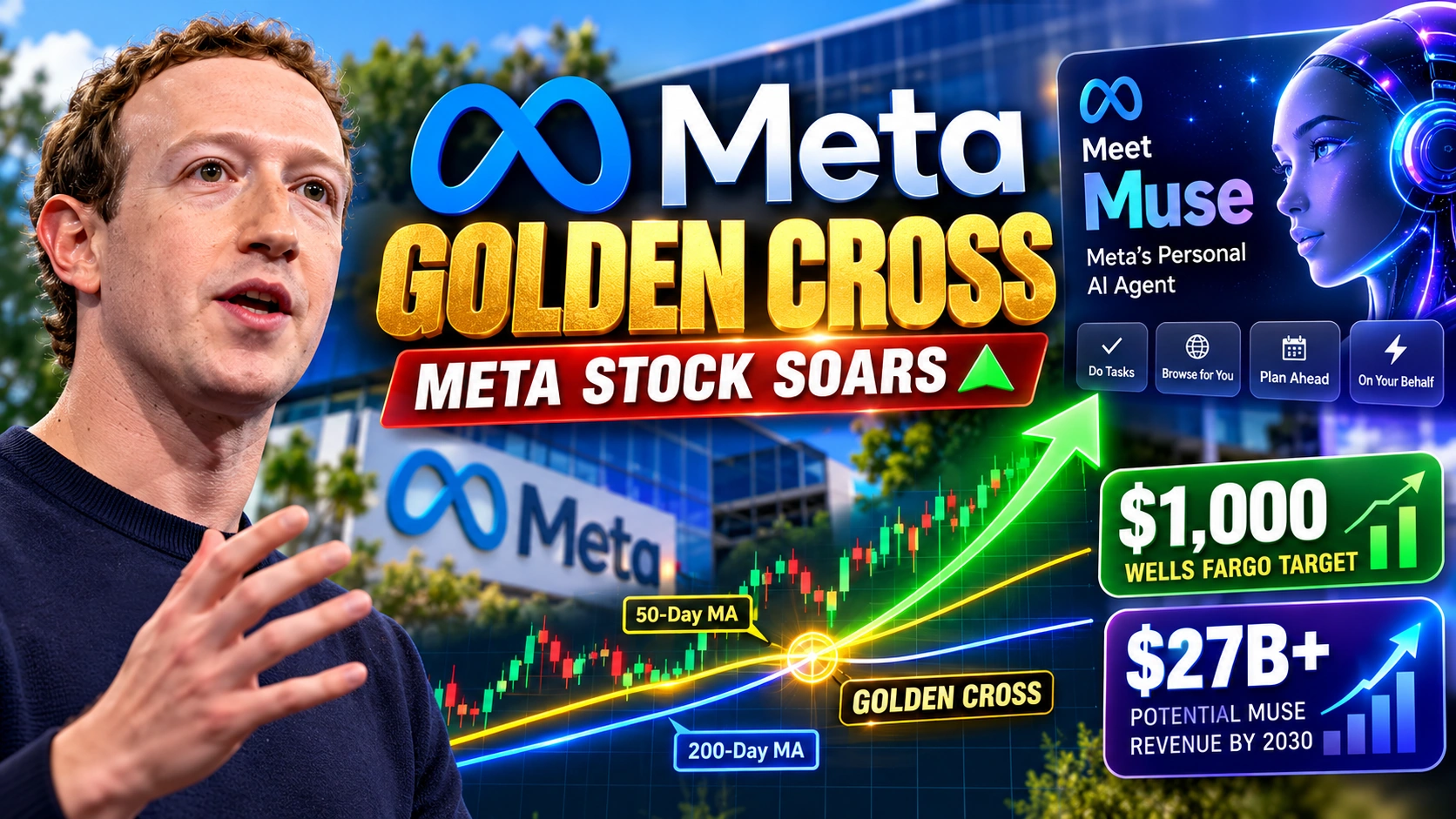
Meta Stock Golden Cross: Meta stock has flashed a closely watched bullish technical signal just as enthusiasm around the company’s new Muse AI agent accelerates. Meta Platforms (META) has formed a “golden cross,” with its 50-day moving average moving above its 200-day moving average, according to MarketWatch.
The development has caught investors’ attention because it comes during growing optimism surrounding Muse, Meta’s personal AI agent launched on September 8, 2026. Meta describes Muse as an agent capable not merely of answering questions but of performing tasks on a user’s behalf, including browser-based actions and longer-running projects.
Yet a golden cross is a technical indicator—not a guarantee that META shares will continue rising. Investors now have to weigh bullish momentum and Muse’s early adoption against a crucial question: Can Meta eventually turn its enormous AI investment into sustainable profits?
🔥 Meta Stock: Key Takeaways
MarketWatch reports that this is the seventh golden cross in Meta’s stock-market history, and that shares were higher one month after each of the previous six occurrences.
The bigger fundamental story is Muse. The AI agent has generated strong early interest, while Wall Street is beginning to consider what a successful agent platform could mean for Meta’s enormous ecosystem.
At the bullish end of Wall Street, Wells Fargo raised its META price target to $1,000, compared with an average analyst target of just under $797 reported by FactSet in MarketWatch’s coverage.
📊 What Is a Golden Cross in Meta Stock?
A golden cross occurs when a shorter-term moving average—commonly the 50-day moving average—crosses above a longer-term moving average, usually the 200-day.
Traders often interpret this pattern as evidence that recent price momentum has strengthened enough to overtake the stock’s longer-term trend.
In Meta’s case, the 50-day average has crossed above the 200-day average. MarketWatch says previous Meta golden crosses were followed by higher share prices one month later on all six prior occasions
That sounds highly bullish, but investors should be careful about interpreting technical patterns.
Moving averages are lagging indicators because they are calculated from historical prices. A golden cross tells investors something about momentum that has already developed; it cannot independently predict earnings, competition, economic conditions or future investor sentiment.
That makes Meta’s underlying AI story particularly important.
🤖 Why Meta Muse Is Driving Investor Excitement
Meta officially introduced Muse on September 8, 2026, describing it as a personal AI agent designed to take actions rather than simply generate responses.
According to Meta, Muse can perform tasks such as using a browser, filling out forms and helping coordinate longer-term goals. Users control which services it can access, and Meta says the product includes dedicated privacy and security mechanisms.
That matters strategically because Meta already operates enormous consumer platforms including Facebook, Instagram, WhatsApp and Messenger.
If agentic AI becomes a major interface through which consumers shop, communicate and complete everyday tasks, Meta potentially has multiple ways to distribute AI experiences at massive scale.
And the company is not limiting Muse to a standalone application.
At Connect 2026, Meta announced plans to bring Muse to its AI glasses, enabling people to interact with the agent hands-free and potentially ask it to take actions based on what they are seeing.
That could make Muse part of a broader ecosystem rather than simply another chatbot.
🚀 Meta Is Taking Muse Beyond Consumers
One of the most interesting developments for long-term investors is Meta’s push into business AI.
On September 28, Meta announced the Meta Enterprise Platform, which the company says will combine technologies including Muse, Meta Business Agent, Muse API and Muse Code for businesses and developers
This creates a potential second avenue for monetization.
Instead of relying entirely on consumer subscriptions, Meta could eventually generate AI-related revenue from businesses and developers adopting its infrastructure and agents.
Citigroup sees substantial potential. Reuters reported that Citi believes Muse could generate more than $27 billion in revenue by 2030, based on strong adoption and engagement assumptions. That is an analyst forecast, however, rather than Meta guidance or guaranteed revenue.
💰 Why Wells Fargo Sees META Reaching $1,000
Wall Street optimism intensified when Wells Fargo analyst Ken Gawrelski raised his Meta price target from $796 to $1,000, the highest target among analysts tracked by FactSet at the time of MarketWatch’s report.
The bullish argument goes beyond short-term app popularity.
Wells Fargo believes Muse could potentially create a significant AI-driven product cycle, while Meta continues benefiting from Reels and its core advertising operations. In the firm’s particularly optimistic scenario, those forces could support an even higher valuation.
But investors should not confuse an analyst price target with a prediction guaranteed to materialize. Targets depend on assumptions about revenue growth, margins, spending, competitive conditions and valuation multiples.
⚠️ Meta’s AI Opportunity Comes With Huge Costs
This is where the bullish story becomes more complicated.
AI agents require enormous computing infrastructure.
MarketWatch reported that Wells Fargo expects Meta’s 2027 capital expenditures could reach $250 billion, compared with Meta’s projected 2026 capital expenditure range of $130 billion to $145 billion. Wells Fargo also expects 2027 operating expenses of roughly $210 billion to $215 billion.
Those figures illustrate the central META investment debate.
If Muse becomes an enormous revenue and engagement engine, heavy infrastructure investment could ultimately look justified. If monetization develops more slowly than anticipated, however, those expenditures could pressure profitability and free cash flow.
Investors therefore need to watch more than download rankings.
🔍 What Could Determine Meta Stock’s Next Move?
Three issues stand out.
First is Muse engagement. Initial downloads can generate excitement, but long-term value depends on whether people continue using the agent regularly.
Second is monetization. Meta needs to demonstrate how AI agents can eventually contribute meaningful revenue through subscriptions, commerce, advertising, enterprise products or other services.
Third is AI spending discipline. Meta must convince shareholders that its rapidly expanding infrastructure commitments can eventually produce attractive returns.
This makes upcoming earnings reports particularly important. Investors will likely scrutinize management commentary on capital expenditure, AI infrastructure, engagement and the timeline for monetizing its new products.
📈 Is Meta’s Golden Cross a Buy Signal?
The golden cross strengthens the technical bull case, but it should not be treated as a standalone investment decision.
Meta currently has two potentially supportive narratives working together: improving chart momentum and enthusiasm around a major new AI product.
But neither eliminates fundamental risks.
Muse still has to prove durable consumer engagement and monetization, while Meta is committing extraordinary amounts of capital to AI infrastructure.
For long-term investors, therefore, the more important question may not be whether META’s 50-day average crossed its 200-day average. It is whether Muse and Meta’s broader AI ecosystem can eventually generate returns large enough to justify the spending required to build them.
❓ Frequently Asked Questions
What is the Meta stock golden cross?
A golden cross occurs when a stock’s shorter-term moving average, typically the 50-day average, crosses above its longer-term 200-day moving average. Traders generally regard it as a bullish momentum signal.
How many golden crosses has Meta stock recorded?
According to MarketWatch, the latest occurrence represents the seventh golden cross in Meta’s history. Shares were higher one month after each of the previous six, although past performance cannot guarantee another gain.
What is Meta Muse?
Muse is Meta’s personal AI agent. Meta says it can help users accomplish tasks, work toward goals and take permitted actions through connected services rather than functioning solely as a conversational chatbot.
Why is Muse important for Meta stock?
Investors see Muse as a potential new AI growth platform spanning consumers, commerce, businesses and Meta’s hardware ecosystem. However, its long-term financial contribution remains uncertain.
Does Wells Fargo expect Meta stock to reach $1,000?
Wells Fargo raised its price target to $1,000 on October 6. A price target represents an analyst’s valuation estimate and is not a guarantee that the stock will reach that level.
Is META guaranteed to rise after the golden cross?
No. Technical indicators can fail, and Meta remains exposed to risks including high AI spending, competition, regulation, economic conditions and uncertainty over Muse monetization.