 bobby
bobby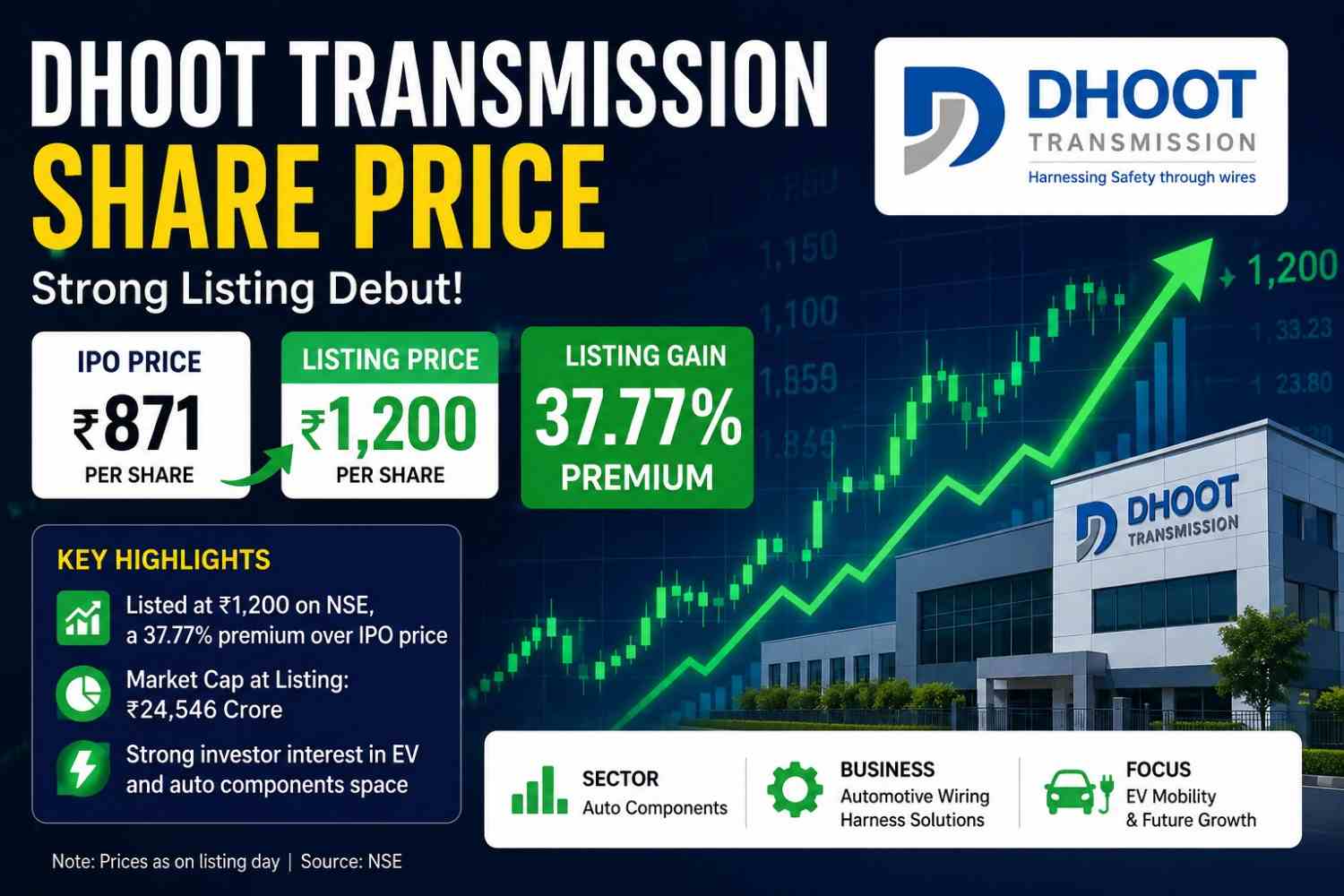
Dhoot Transmission Share Price: Dhoot Transmission share price made a strong stock-market debut on August 17, 2026, listing at ₹1,200 per share on the NSE against its ₹871 IPO issue price. That represents a 37.77% premium and gives investors a very different valuation equation from the one they faced during the IPO.
The key question now is no longer whether Dhoot Transmission can deliver a strong listing gain. It is whether future earnings growth can catch up with the higher valuation following the sharp debut.
Reuters reported that the Bain Capital-backed automotive-component maker surged as much as 38.3% during its debut, highlighting strong investor interest in its manufacturing expansion and exposure to India’s growing EV market.
🔑 Dhoot Transmission IPO: Key Takeaways
- IPO issue price: ₹871 per share
- NSE listing price: ₹1,200 per share
- Listing premium: 37.77%
- Listing date: August 17, 2026
- IPO size: About ₹3,067 crore
- Business: Automotive electrical and electronic components
- Major growth theme: EV adoption and vehicle electrification
- Key concern: Whether earnings growth can justify the higher post-listing valuation
Dhoot Transmission’s strong debut is clearly positive for investor sentiment. However, a sharp rise in the share price also means that expectations from the company have increased.
📈 Dhoot Transmission Share Price: What Happened on Listing Day?
Dhoot Transmission listed at ₹1,200 on the NSE, compared with its ₹871 issue price.
That means an investor who received shares at the upper end of the IPO price band saw a listing gain of approximately ₹329 per share, or 37.77%.
The stock opened at ₹1,193.80 on the BSE, while the NSE debut price was ₹1,200.
The strong listing indicates that market participants were willing to pay a significant premium over the IPO price.
But investors should remember an important distinction:
A strong IPO listing shows demand for the shares. It does not, by itself, prove that the shares are attractively valued for the long term.
That distinction becomes particularly important after a stock rises nearly 38% in a single session.
💰 Dhoot Transmission Valuation: Has the Stock Become Expensive?
This is where the post-listing analysis becomes more interesting.
At the IPO price of ₹871, Dhoot Transmission’s FY26 earnings valuation was around 35.69 times earnings, based on FY26 EPS of ₹24.40. The peer comparison cited in IPO analysis showed an average P/E of approximately 55.31 times.
After the stock listed at ₹1,200, investors were paying substantially more for each rupee of current earnings.
Using the same FY26 EPS of ₹24.40, ₹1,200 divided by ₹24.40 gives an implied P/E of approximately 49.2 times.
That calculation is important because it shows how quickly valuation can change when the share price rises while earnings remain unchanged.
What does P/E mean?
The price-to-earnings (P/E) ratio tells investors approximately how much they are paying for every ₹1 of a company’s earnings.
For example, a 50x P/E means investors are paying roughly ₹50 for every ₹1 of annual earnings.
A higher P/E can be justified when a company has:
- Faster earnings growth
- Strong competitive advantages
- Attractive long-term industry exposure
- High returns on capital
- Strong cash generation
- Sustainable margins
But the higher the valuation, the greater the expectation for future performance.
⚡ Why Is Dhoot Transmission Interesting?
Dhoot Transmission operates in the automotive components industry, with wiring harnesses as a major part of its business.
The company has also built a significant position in EV-related wiring harnesses. Company filings highlighted a market share of more than 70% in electric two-wheeler and three-wheeler wiring harnesses in FY25.
That gives the company exposure to one of India’s major structural automotive trends: vehicle electrification.
Its customer base includes major automotive manufacturers such as Bajaj Auto, TVS Motor Company, Honda Motorcycle and Scooter India and Royal Enfield.
Reuters also reported that Dhoot is expanding beyond traditional wiring harnesses into EV-focused components including battery assemblies, DC-DC converters, onboard chargers and charging guns.
This diversification could become an important part of the company’s long-term growth story.
📊 Can Dhoot Transmission Earnings Catch Up?
This is the central question after the 38% listing gain.
Dhoot Transmission’s financial growth has been strong. According to company filing-based information, revenue from operations increased from ₹2,125.86 crore in FY23 to ₹3,444.86 crore in FY25, while profit after tax more than doubled from ₹163.91 crore to ₹353.89 crore.
More recent FY26 figures cited in IPO analysis indicate total income of approximately ₹4,563.70 crore and PAT of around ₹396.84 crore.
However, revenue growth alone is not enough.
The market will ultimately want to see whether profit growth can accelerate and remain sustainable.
If earnings grow rapidly, today’s higher P/E could become more reasonable over time.
If earnings growth slows while the valuation remains elevated, the stock could face pressure even if the underlying business continues to expand.
The earnings equation is simple:
Higher share price + unchanged earnings = higher valuation
Higher share price + strong earnings growth = potentially more sustainable valuation
That is why upcoming quarterly results will be particularly important.
🏭 Margins Matter Too
Investors should not focus only on revenue.
Dhoot Transmission’s FY26 EBITDA was approximately ₹710.99 crore, according to IPO-related analysis, while its EBITDA margin was around 15.71%.
A company can report strong sales growth while its profitability fails to keep pace.
For Dhoot Transmission, investors should therefore monitor:
- EBITDA growth
- EBITDA margin
- PAT growth
- Cash flow
- Working capital
- Borrowings
- Return on capital
If revenue rises rapidly but margins deteriorate, the market may become less willing to award the company a premium valuation.
⚠️ Key Risks Investors Should Watch
1. Customer concentration
Customer concentration is one of the most important risks.
IPO-related data showed that the company’s top 10 customers accounted for approximately 81.81% of FY25 revenue from operations.
Reuters also reported that Bajaj Auto contributes roughly one-third of Dhoot Transmission’s revenue.
This makes customer retention and order visibility particularly important.
2. Margin pressure
Raw-material costs, pricing pressure and the competitive automotive-component environment can affect profitability.
If revenue continues growing but margins decline, earnings may not rise quickly enough to support the stock’s valuation.
3. Capital requirements
Automotive-component manufacturing requires investment in plants, machinery, capacity and working capital.
Dhoot Transmission has been investing heavily in capacity expansion, making capital allocation and balance-sheet management important areas to monitor.
4. EV transition risk
EV exposure is a major opportunity, but it is not risk-free.
Changes in EV adoption rates, OEM strategies, technology, government policies or competitive dynamics could affect future growth.
5. Valuation risk
This may be the biggest near-term issue after the strong listing.
At ₹871, investors were buying the IPO at a substantially lower earnings multiple than the valuation implied by the ₹1,200 listing price.
The company therefore needs continued earnings growth to justify the higher share price.
👀 What Should Investors Track After the Dhoot Transmission IPO?
Quarterly earnings
Watch revenue growth, EBITDA, EBITDA margin and PAT growth.
EV business
Track whether the company’s EV exposure translates into meaningful incremental revenue and profit.
Customer diversification
A broader customer base could reduce dependence on a small number of large OEMs.
Cash flow
Strong accounting profits are more valuable when they translate into operating cash flow.
Debt and working capital
Investors should monitor whether expansion requires increasingly large amounts of borrowed capital or working capital.
Capacity expansion
New manufacturing capacity should eventually contribute to revenue and profitability. Investors should therefore monitor commissioning timelines and utilisation.
🧑💼 Who Might Consider Dhoot Transmission at This Stage?
Short-term traders
The strong listing and high investor interest may make the stock attractive to traders focused on momentum.
However, newly listed stocks can experience significant volatility.
Medium-term investors
The key question is whether quarterly earnings can support the higher valuation.
Investors in this category should focus on earnings growth rather than simply the listing gain.
Long-term investors
The EV transition, automotive electrification and Dhoot Transmission’s position in wiring harnesses provide a potentially attractive long-term business opportunity.
However, the entry valuation matters.
Conservative investors
A strong business does not automatically mean a low-risk stock.
The sharp increase from ₹871 to ₹1,200 means investors entering after listing need to consider valuation risk alongside business quality.
🔍 Dhoot Transmission IPO: What Comes Next?
The first-day performance has answered one question: investor demand was strong.
The next question is much harder:
Can Dhoot Transmission deliver enough earnings growth to justify the higher post-listing valuation?
The company has several structural positives, including automotive electrification, EV exposure, manufacturing expansion and relationships with major OEMs. Its historical revenue and profit growth also provide a strong foundation for the investment story.
But investors now have less valuation cushion than they had at the IPO price.
The stock’s future performance will therefore depend increasingly on earnings growth, margins, cash generation and execution rather than the excitement surrounding its IPO debut.
🏁 Final Verdict: Strong Listing, Bigger Earnings Test
Dhoot Transmission’s ₹1,200 NSE listing price—37.77% above its ₹871 IPO price—is a strong debut and reflects significant market interest.
But the listing gain should not be confused with proof of future returns.
The more important investment question is whether Dhoot Transmission can grow earnings quickly enough to support the higher valuation.
Its EV exposure, wiring-harness market position and relationships with major automotive manufacturers provide meaningful growth opportunities. At the same time, customer concentration, margins, capital requirements and valuation remain important risks.
In short: the IPO debut was impressive, but the real test begins after the listing. Investors should watch the next few quarterly results to see whether earnings can catch up with the stock’s new valuation.
❓ Dhoot Transmission IPO & Share Price FAQs
What was Dhoot Transmission’s IPO issue price?
Dhoot Transmission’s IPO was priced at ₹871 per share at the upper end of the price band. The IPO price band was ₹829–₹871.
What was Dhoot Transmission’s NSE listing price?
Dhoot Transmission listed at ₹1,200 per share on the NSE on August 17, 2026.
What was the Dhoot Transmission IPO listing gain?
At ₹1,200 against the ₹871 issue price, the NSE listing represented a 37.77% premium.
Why did Dhoot Transmission shares list at a premium?
The strong debut reflected investor demand and optimism around the company’s automotive-component business, manufacturing expansion and exposure to India’s EV transition.
Is Dhoot Transmission expensive after listing?
The valuation is higher after the sharp rise in the share price. Using FY26 EPS of ₹24.40, the ₹1,200 listing price implies a P/E of approximately 49.2x, compared with about 35.7x at the ₹871 IPO price.
Whether that valuation is justified will depend largely on future earnings growth.
What is Dhoot Transmission’s EV exposure?
Dhoot Transmission has a strong position in EV wiring harnesses for two-wheelers and three-wheelers, with company-related IPO materials indicating more than 70% market share in that segment in FY25.
What are the biggest risks for Dhoot Transmission investors?
Key risks include customer concentration, margin pressure, capital requirements, working-capital needs, automotive-sector cyclicality and the possibility that earnings growth may not justify the higher post-listing valuation.
Should investors buy Dhoot Transmission shares after listing?
There is no one-size-fits-all answer. Investors should evaluate the stock based on their own risk tolerance, investment horizon, valuation expectations and financial goals. The company’s upcoming earnings, margins and cash-flow performance will be important indicators.
📌 Financial Disclaimer
This article is for informational and educational purposes only and does not constitute investment advice, a recommendation to buy or sell securities, or a guarantee of future returns. Stock prices can be volatile. Investors should review official company filings, exchange disclosures and regulatory documents and consult a qualified financial adviser before making investment decisions.
Keypoints
Dhoot Transmission IPO, Dhoot Transmission listing, Dhoot Transmission stock, Dhoot Transmission IPO listing price, Dhoot Transmission share price today, Dhoot Transmission valuation, Dhoot Transmission P/E, Dhoot Transmission earnings, Dhoot Transmission EV business, Dhoot Transmission IPO listing gain