 bobby
bobby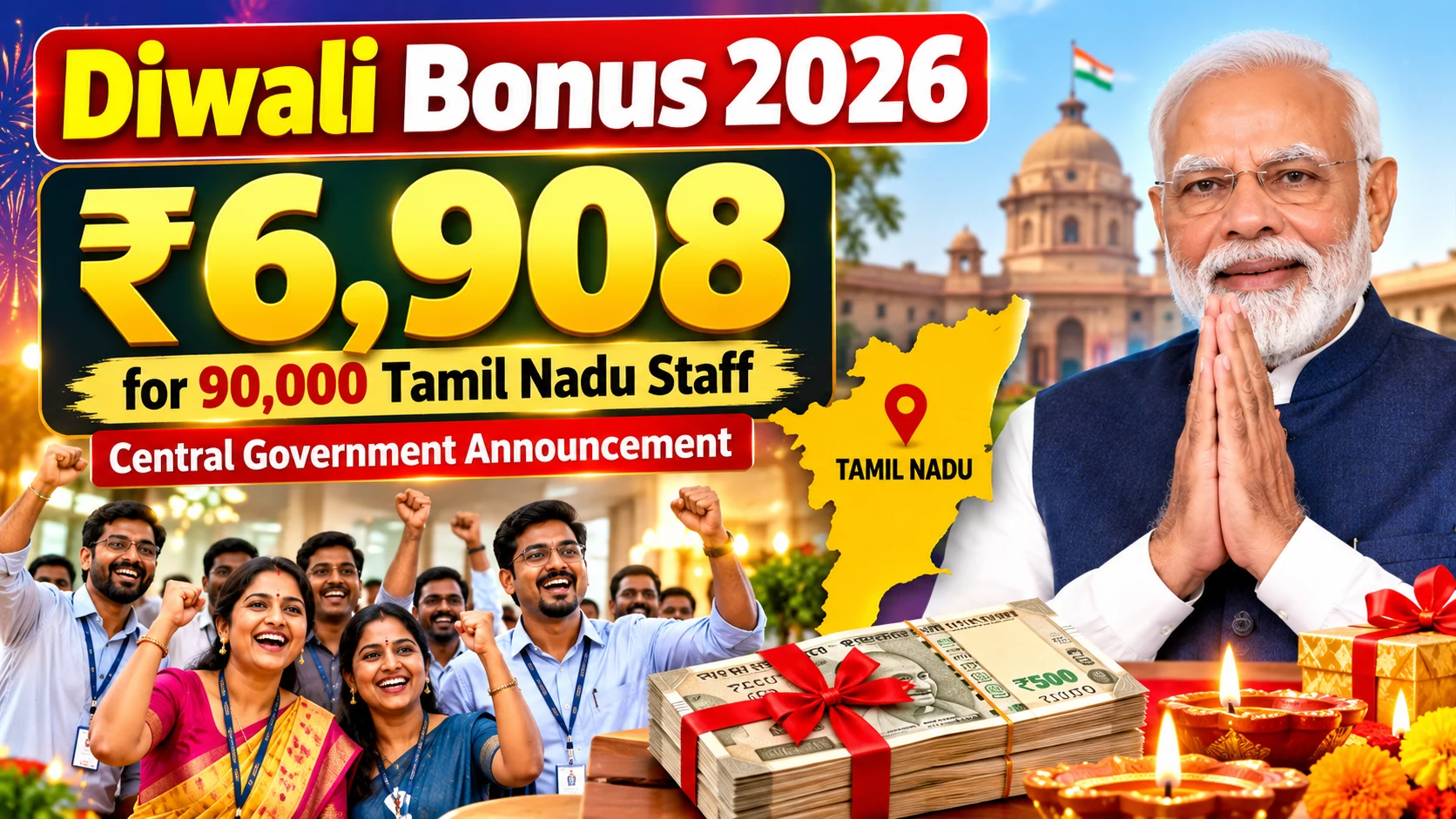
Diwali Bonus 2026: The Central Government has announced festive bonus benefits for eligible employees ahead of Diwali, bringing financial relief to thousands of families. Approximately 90,000 employees in Tamil Nadu are expected to benefit from the announcement, while around 30.67 lakh employees across India are covered.
Under the Non-Productivity Linked Bonus (NPLB) arrangement for the financial year 2025–26, eligible employees can receive a maximum bonus of ₹6,908, subject to applicable service and eligibility conditions.
The announcement is particularly important for Group C employees, eligible non-gazetted Group B employees, and certain other categories covered by the government’s bonus rules.
Here is everything employees need to know about the bonus amount, eligibility requirements, calculation method, and important conditions.
🎉 Central Government Diwali Bonus 2026: Major Announcement
The Ministry of Finance’s Department of Expenditure has announced an ad hoc bonus for eligible Central Government employees for the financial year 2025–26.
The announcement comes ahead of the festive season, when many households face additional expenses related to celebrations, travel, shopping, and family gatherings.
According to the reported details, approximately 30.67 lakh employees nationwide are expected to benefit from the scheme.
Tamil Nadu alone accounts for around 90,000 potential beneficiaries.
Unlike a general salary increase, this bonus is a separate payment calculated according to prescribed government rules.
The maximum amount payable under this particular announcement is ₹6,908.
Importantly, the bonus is not automatically available to every Central Government employee. Eligibility depends on employee category, service duration, and other applicable conditions.
💰 How Much Diwali Bonus Will Employees Receive?
The government has announced a bonus equivalent to 30 days of emoluments, calculated using a monthly ceiling of ₹7,000.
The maximum amount works out to approximately ₹6,908.
📊 Diwali Bonus 2026 Calculation Explained
The calculation follows the standard bonus formula based on average monthly emoluments and the prescribed number of days.
Maximum Bonus = ₹7,000 × 30 ÷ 30.4
This produces approximately ₹6,907.89, rounded to ₹6,908.
The figure represents the maximum under the announced calculation method.
Employees should not assume that everyone will receive exactly ₹6,908.
The final amount may depend on qualifying service, applicable rules, and individual employment circumstances.
For workers who meet only the minimum service requirement, a proportionate payment may apply.
👨💼 Who Is Eligible for the Diwali Bonus 2026?
The announcement primarily covers specified categories of Central Government employees.
✅ Group C Employees
Eligible Group C employees working under the Central Government are among the main beneficiaries.
These employees perform various administrative, clerical, technical, and operational duties across government departments.
✅ Non-Gazetted Group B Employees
Certain non-gazetted Group B employees are also covered.
However, employees receiving benefits under another applicable bonus arrangement may not qualify for this particular scheme.
✅ Eligible Armed Forces and Paramilitary Personnel
The announcement also extends to eligible personnel in the Central Armed Police Forces and Armed Forces, subject to the relevant conditions.
✅ Union Territory Administration Employees
Employees working in Union Territory administrations may qualify where the Central Government pay structure applies and they are not covered by another bonus or ex gratia arrangement.
✅ Eligible Casual Workers
Certain casual or temporary workers may also receive benefits if they satisfy the prescribed service requirements and other conditions.
Their eligibility should not be assumed solely from their employment status.
🎉 Diwali Bonus 2026
Central Government Employees
Maximum Non-Productivity Linked Bonus
📊 Bonus & Eligibility Details
📅 Important Eligibility Conditions for 2025–26
The bonus relates to the financial year ending on March 31, 2026.
Employees generally need to satisfy the following conditions:
- They must have been in service on March 31, 2026.
- They must have completed at least six months of continuous qualifying service during 2025–26.
- Their employment category must be covered by the announcement.
- They must satisfy the relevant bonus rules and exclusions.
- Employees with less than a full year of qualifying service may receive a proportionate bonus.
These conditions are important because the announcement does not provide an unconditional payment to every employee.
Workers should check their department’s implementation instructions to determine their individual eligibility.
🌟 90,000 Tamil Nadu Employees Expected to Benefit
Tamil Nadu is expected to see a significant number of beneficiaries under the Central Government’s festive bonus announcement.
Approximately 90,000 eligible employees in the state may receive the benefit.
The announcement could provide additional financial support to households preparing for Diwali celebrations.
Employees may use the money for festival shopping, household expenses, travel, savings, or other personal needs.
The payment may also provide a modest seasonal boost to local businesses, although the actual economic effect will depend on how recipients spend or save the money.
It is important to understand that this announcement concerns eligible Central Government employees working in Tamil Nadu.
It does not mean that all Tamil Nadu State Government employees or all residents of the state will receive ₹6,908.
🇮🇳 Over 30 Lakh Employees Across India Covered
The benefits extend well beyond Tamil Nadu.
According to the reported announcement, approximately 30.67 lakh employees across the country are expected to benefit.
This makes the decision relevant to government workers and their families in several states and Union Territories.
For eligible employees, the bonus represents an additional payment separate from regular monthly salary.
However, the exact amount credited to an individual employee will depend on the applicable calculation and service conditions.
🚆 Is the ₹6,908 Bonus the Same as the Railway Diwali Bonus?
No. The two announcements concern different bonus arrangements.
The Central Government’s ad hoc, non-productivity-linked bonus carries a reported maximum of ₹6,908 for eligible employees.
Separately, the Union Cabinet approved a productivity-linked bonus equivalent to 78 days of wages for eligible non-gazetted railway employees.
The maximum amount under that railway scheme is ₹17,951.
Approximately 11.40 lakh railway employees are covered by the separate railway announcement.
Therefore, employees should not confuse the ₹6,908 non-productivity-linked bonus with the ₹17,951 railway productivity-linked bonus.
The eligibility rules and calculation methods are different.
🏦 When Will Employees Receive the Diwali Bonus?
The announcement is connected with the festive season, but employees should distinguish the government decision from the actual payment date.
A confirmed universal bank-credit date for every eligible employee has not been established in the reported details.
Payment processing may depend on departmental instructions, payroll procedures, and administrative approvals.
Employees should follow communications issued by their respective offices, accounts departments, or authorised payroll authorities.
They should also verify payment information through official salary records rather than relying on unverified social media messages.
📋 Diwali Bonus 2026: Key Details at a Glance
| Particulars | Details |
|---|---|
| Scheme | Non-Productivity Linked Bonus |
| Financial year | 2025–26 |
| Maximum bonus | ₹6,908 |
| Calculation ceiling | ₹7,000 per month |
| Bonus calculation | 30 days |
| Beneficiaries across India | Approximately 30.67 lakh |
| Beneficiaries in Tamil Nadu | Approximately 90,000 |
| Minimum qualifying service | Six continuous months |
| Relevant service date | March 31, 2026 |
| Payment date | Subject to official processing |
❓ Diwali Bonus 2026: Frequently Asked Questions
1. How much is the Central Government Diwali Bonus 2026?
Eligible employees can receive a maximum of ₹6,908 under the announced non-productivity-linked bonus arrangement for 2025–26.
2. How many employees in Tamil Nadu will receive the bonus?
Approximately 90,000 eligible Central Government employees in Tamil Nadu are expected to benefit.
3. Are all Central Government employees eligible?
No. The announcement covers specified employee categories, including eligible Group C and non-gazetted Group B staff, subject to service conditions and exclusions.
4. What is the minimum service required?
Employees generally need at least six months of continuous qualifying service during 2025–26 and must meet the relevant March 31, 2026 service condition.
5. Will employees with less than one year of service receive a bonus?
Eligible employees with at least six months but less than a full year of qualifying service may receive a proportionate payment.
6. Is the ₹6,908 bonus available to railway employees?
The ₹6,908 announcement is separate from the railway productivity-linked bonus, under which eligible railway employees may receive up to ₹17,951.
7. Has the government announced an exact payment date?
The reported information does not establish a single confirmed credit date for all beneficiaries. Employees should check their departmental payroll notifications.
🎊 Final Words
The Central Government Diwali Bonus 2026 announcement brings welcome financial news for eligible employees ahead of the festive season.
With approximately 90,000 potential beneficiaries in Tamil Nadu and around 30.67 lakh across India, the decision has considerable reach.
The maximum payment of ₹6,908 may help employees manage additional festive expenses.
However, eligibility is not universal, and the final amount depends on the applicable service conditions and calculation rules.
Employees should review official departmental communications to confirm their entitlement and payment status.
The key takeaway: eligible employees may receive up to ₹6,908, but individual eligibility and payment details must be verified through the appropriate government department.