 bobby
bobby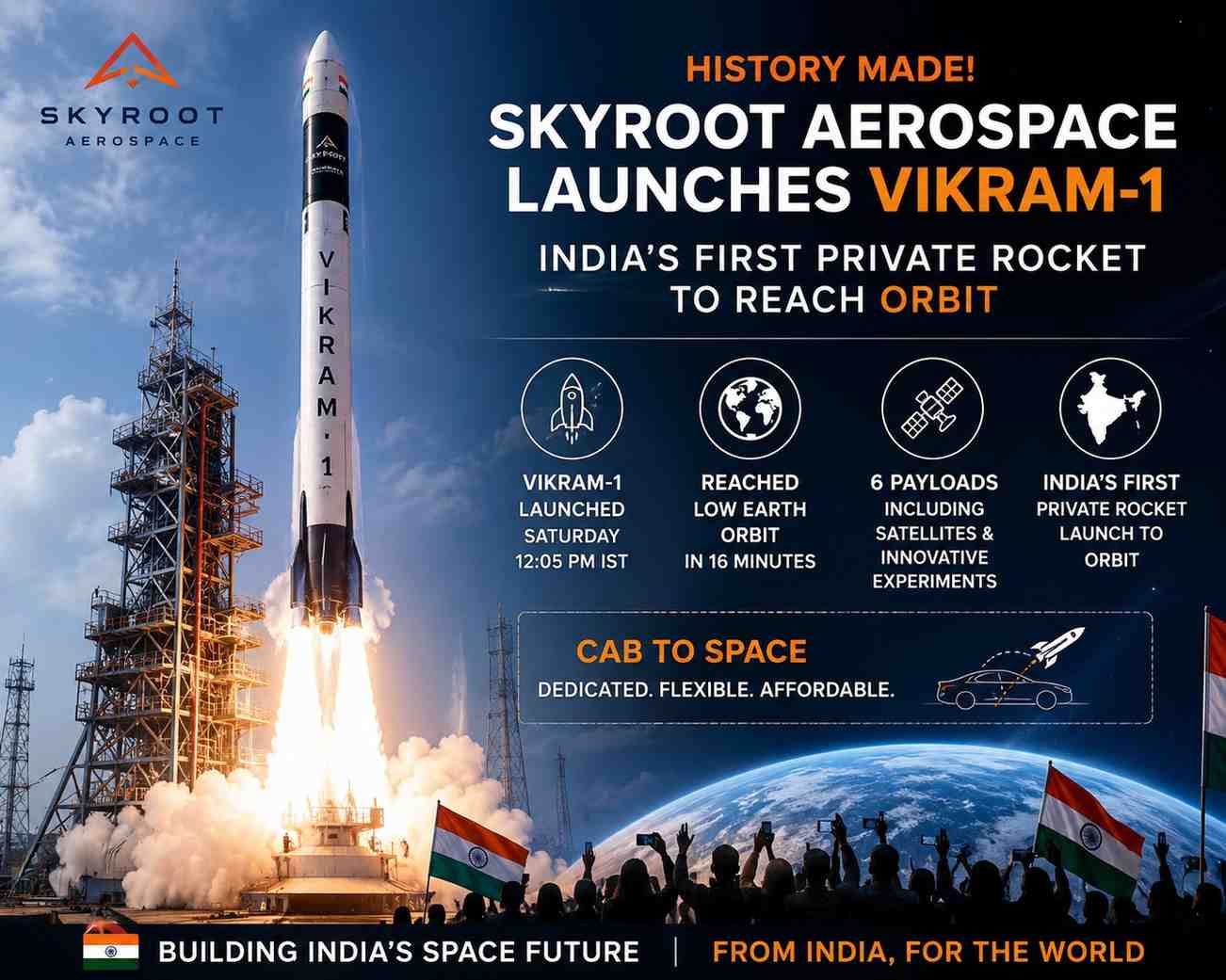
India’s Space Ambitions: India has entered a new chapter in its rapidly growing space journey. Hyderabad-based Skyroot Aerospace successfully launched Vikram-1, becoming the first private Indian company to send a rocket into orbit.
The historic mission not only strengthens India’s position in the global space race but also moves Skyroot closer to its ambitious dream of offering a “cab to space” service for satellite operators across the world. 🌍
The achievement places India alongside the United States and China as one of only three countries with private companies capable of launching rockets into orbit.
🚀 Vikram-1 Successfully Reaches Orbit
Launched from the Indian Space Research Organisation (ISRO) launch complex at Sriharikota on Saturday, Vikram-1 lifted off at 12:05 PM IST (06:35 GMT).
The seven-storey rocket completed its mission in just 16 minutes, climbing nearly 450 kilometres (280 miles) into Low Earth Orbit (LEO).
After the successful launch, Skyroot Aerospace celebrated on X, saying:
“Vikram-1 Test Flight-1 has reached orbit… History is made.” 🎉
This marks one of the biggest milestones for India’s private space industry.
🌌 What Is Skyroot Aerospace’s ‘Cab to Space’ Concept?
Imagine booking a rocket launch just like booking an Uber.
That’s exactly what Skyroot Aerospace wants to make possible.
Instead of satellite companies waiting months—or even years—for space on large rockets, Skyroot plans to offer dedicated launches for small satellites.
CEO and co-founder Pawan Kumar Chandana explained:
“If you want to visit a friend, you don’t wait for a train—you book a cab. We’re bringing the same idea to space.”
This means customers can choose:
- 🚀 Their own launch schedule
- 🛰️ Their preferred orbit
- ⏳ Faster deployment
- 💰 Lower operational delays
The model is similar to specialized small-launch providers like Rocket Lab, but designed for India’s growing commercial space sector.
🛰️ Why Vikram-1 Is a Game Changer
Vikram-1 is named after Dr. Vikram Sarabhai, widely regarded as the father of India’s space programme.
Although relatively compact, the rocket can carry payloads weighing up to 350 kilograms, making it ideal for:
- Earth observation satellites
- Climate monitoring
- Scientific research
- Defence applications
- Communication satellites
- Technology demonstrations
Small satellite launches are among the fastest-growing segments of the global space industry, making Skyroot’s timing particularly significant.
💎 Diamond Lotus and Tiny Golden Rocket Among Unique Payloads
The Aagman Mission—named after the Sanskrit word for “arrival”—carried six payloads into orbit.
Among them were several cutting-edge scientific instruments, including:
- 🤖 A robotic arm designed to remove space debris
- 📷 An Earth observation camera
- 🛰️ Multiple satellites, including one from Germany
But two symbolic payloads attracted worldwide attention.
💎 Cosmic Bloom
One payload featured a beautiful lotus crafted from lab-grown diamonds, known as Cosmic Bloom.
Created by Cosmos Diamonds, the artwork celebrates India’s innovation and artistic creativity while paying tribute to humanity’s fascination with space.
🥇 Tiny Golden Rocket Honours India’s Greatest Scientists
Another remarkable payload was a tiny golden rocket containing microscopic sculptures—each smaller than a grain of rice—of three legendary Indian scientists:
- 🇮🇳 Dr. Vikram Sarabhai
- 🏆 Nobel Prize-winning physicist C.V. Raman
- 🚀 Former President and aerospace pioneer Dr. A.P.J. Abdul Kalam
According to Chandana, the tribute recognizes the visionaries whose work laid the foundation for India’s remarkable achievements in space exploration.
🏭 Built in Hyderabad, Ready for Monthly Rocket Production
Skyroot Aerospace says it already has the manufacturing capacity to produce one rocket every month at its Hyderabad facility.
The company plans:
✅ Second test flight in 2026
✅ Commercial launches beginning next year
This production capability could significantly reduce waiting times for satellite launches worldwide.
🇮🇳 How Skyroot Aerospace Started
Founded in 2018 by former ISRO engineers Pawan Kumar Chandana and Naga Bharath Daka, Skyroot began with a simple mission:
Make access to space affordable, faster and more flexible.
The startup received a major boost after India opened its space sector to private companies in 2020, allowing startups to:
- Build rockets
- Develop satellites
- Use ISRO launch facilities
Today, India has more than 400 space startups, but Skyroot remains the country’s most successful space-tech company and its first space unicorn, valued at over $1.1 billion.
🌍 Why This Launch Matters for India
India has rapidly emerged as one of the world’s leading space powers.
Recent achievements include:
🌕 Chandrayaan Moon missions
☀️ Aditya-L1 Solar Mission
🔴 Mars Orbiter Mission
Coming next:
👨🚀 India’s first human spaceflight mission
♀️ Venus Orbiter Mission
🛰️ India’s own space station by 2035
Skyroot’s commercial launch services could play an important role in supporting these ambitious missions while serving customers across the globe.
💼 Massive Global Business Opportunity
According to Chandana, 70–80% of Skyroot’s future customers are expected to come from international markets.
Potential applications include satellites supporting:
- 🌾 Agriculture
- 🎣 Fisheries
- 🌪️ Disaster management
- 📡 Telecommunications
- 🛰️ GPS and navigation
- 🛡️ National security
- 🌍 Climate monitoring
As demand for small satellite launches continues to grow, Skyroot aims to become one of the world’s leading commercial launch providers.
🚀 The Future of India’s Private Space Industry
Skyroot Aerospace’s successful Vikram-1 mission is more than just a rocket launch—it signals the arrival of a new era for India’s private space industry.
With reusable technology, dedicated satellite launches, and a bold “cab to space” vision, the company is positioning itself to compete with some of the biggest names in the global space business.
If successful, booking a satellite launch could one day become almost as easy as booking a ride through a smartphone app.
And that future may have officially begun with Vikram-1. 🚀✨
🔍 Keypoints
Skyroot Aerospace, Vikram-1 launch, India private rocket launch, India’s first private orbital rocket, Vikram-1 mission, Skyroot Aerospace news, ISRO private space company, cab to space, Indian space startup, satellite launch India, commercial rocket launch, Low Earth Orbit, Indian space industry, private space company India, Skyroot unicorn.