 bobby
bobby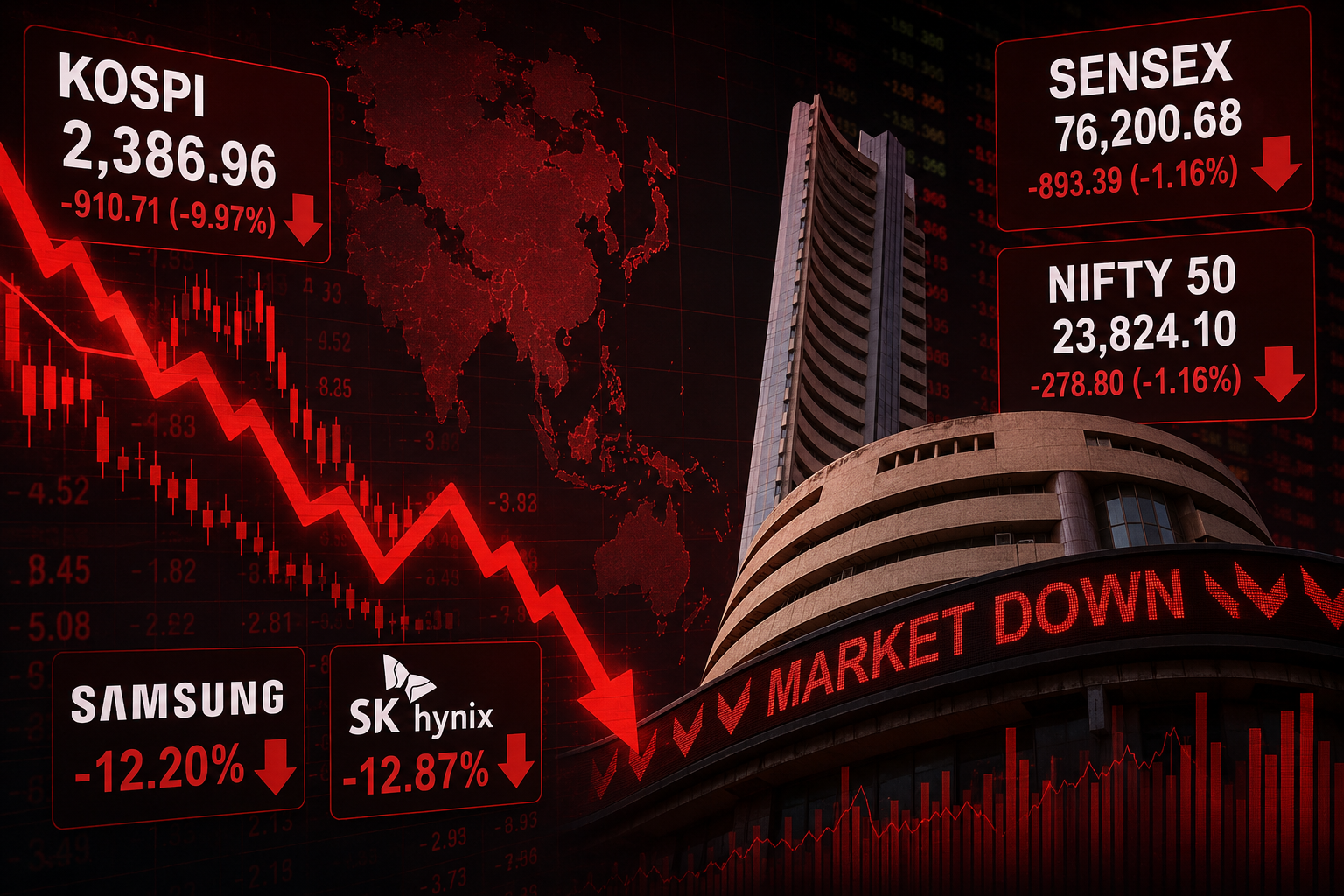
🔥 What Triggered the KOSPI Crash?
South Korea’s benchmark KOSPI index suffered a near-10% crash on June 23, marking its steepest single-day decline since March. The selloff was driven by heavy foreign investor exits from semiconductor giants Samsung Electronics and SK Hynix, after regulators raised concerns over excessive leverage, speculative trading, and overheating valuations in the market.
The KOSPI ended the session down 910.71 points, with Samsung and SK Hynix plunging more than 12% each, wiping out billions of dollars in market capitalization. A temporary 20-minute trading halt was triggered after the index fell over 8% intraday, but panic selling intensified once trading resumed.
🤖 AI Rally Meets Reality Check
For months, South Korean technology stocks had been riding the global artificial intelligence (AI) boom. However, market experts warn that soaring valuations and record levels of margin debt made the rally increasingly fragile.
Regulators specifically highlighted the growing use of leveraged single-stock ETFs, which amplified market volatility. Before the correction, SK Hynix had surged nearly 350% year-to-date, reflecting the extraordinary enthusiasm surrounding AI-linked semiconductor stocks.
Despite the sharp correction, the KOSPI remains up more than 90% in 2025, underscoring both the strength of the AI-driven rally and the risks associated with excessive speculation.
🇮🇳 Sensex and Nifty Tumble as Shockwaves Reach India
The KOSPI-led selloff quickly spread across Asian markets, dragging Indian equities lower.
The BSE Sensex plunged 893.39 points (1.16%) to close at 76,200.68, while the Nifty 50 dropped 278.80 points (1.16%) to settle at 23,824.10.
The sharp decline erased approximately ₹5.77 lakh crore in investor wealth in a single trading session.
📊 Market Snapshot
| Index/Sector | Change | Major Movers |
|---|---|---|
| Sensex | -893.39 pts (-1.16%) | Infosys, TCS, HCL Tech declined; Power Grid, Axis Bank gained |
| Nifty 50 | -278.80 pts (-1.16%) | Infosys, TCS among top losers; Cipla, Dr Reddy’s advanced |
| Nifty IT | -2.2% | Infosys, TCS, Wipro led declines |
Technology stocks bore the brunt of the selloff as investors reduced exposure to globally linked IT companies amid concerns over weakening sentiment in international markets.
🌏 Asian Markets Bleed as Risk-Off Sentiment Intensifies
The market rout was not limited to South Korea.
- 🇯🇵 Japan’s Nikkei 225 fell more than 3%
- 🇭🇰 Hong Kong’s Hang Seng Index dropped nearly 2%
- 🇨🇳 China’s Shanghai Composite slipped as much as 2%
The weakness mirrored declines in U.S. technology futures, where investors are increasingly questioning whether AI-related stocks have run too far ahead of earnings growth.
A stronger U.S. dollar, persistent foreign institutional investor (FII) selling, and concerns about future interest rate decisions further amplified risk aversion across global markets.
⚠️ Why Markets Could Remain Volatile
Market analysts believe volatility may persist in the near term due to several factors:
✅ Elevated valuations in technology stocks
✅ Record-high margin debt levels
✅ Profit booking after a massive AI-driven rally
✅ Continued foreign investor selling
✅ Uncertainty surrounding global interest rates
While the long-term growth story for technology and AI remains intact, experts caution that short-term corrections could continue as investors reassess risk and earnings expectations.
🔮 Outlook: Correction or Beginning of a Bigger Downturn?
The sharp KOSPI crash serves as a reminder that markets can quickly reverse when valuations become stretched and leverage builds up.
For Indian investors, the recent fall in Sensex and Nifty highlights the growing interconnectedness of global markets. While the broader long-term trend remains positive, traders should brace for heightened volatility as global investors navigate concerns over AI valuations, monetary policy, and slowing economic growth.
Key Takeaway 📌
The KOSPI crash triggered a wave of selling across Asian markets, dragging down the Sensex and Nifty and wiping out ₹5.77 lakh crore in investor wealth. With concerns over leverage, overheated AI stocks, and global economic uncertainty growing, market volatility is likely to remain elevated in the coming weeks.