
 bobby
bobby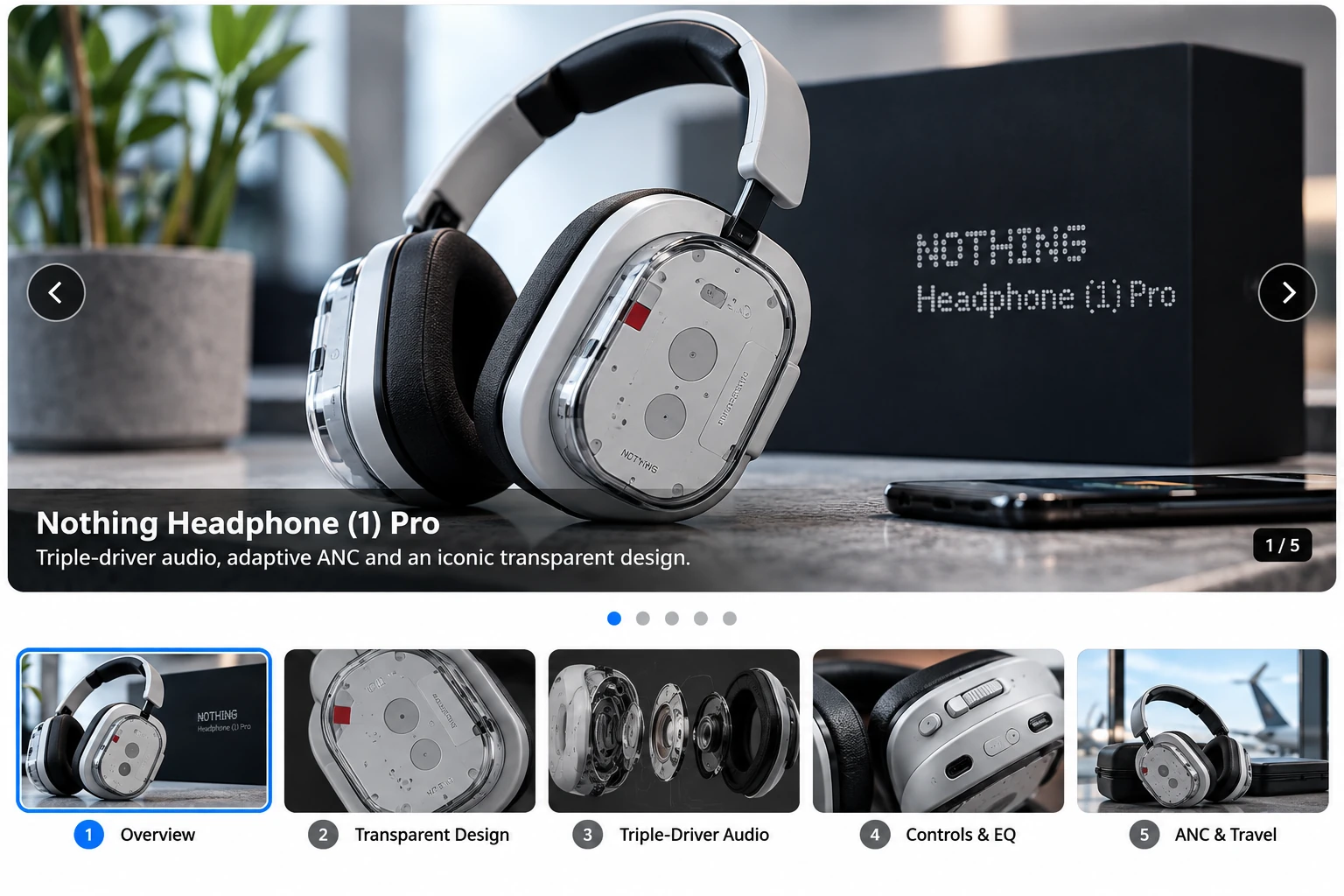
Nothing Headphone 1 Pro review: The Nothing Headphone (1) Pro represents a major step up for a company better known for transparent phones, earbuds, and unconventional industrial design.
Priced at $399 in the US, these flagship over-ear headphones move Nothing directly into premium territory. Instead of relying only on distinctive styling to stand out, Nothing has equipped its new headphones with a three-driver architecture, adaptive active noise cancellation, high-resolution audio, Bluetooth 6.1, Auracast, physical controls, advanced EQ options, and a dedicated Flat EQ switch.
That makes the Headphone (1) Pro much more ambitious than a simple fashion-focused pair of wireless headphones.
But with established alternatives from Sony, Bose, Apple and other audio specialists competing for the same buyers, distinctive looks alone aren’t enough.
So, what makes Nothing’s flagship headphones interesting, and who should actually consider buying them?
Here is everything you need to know. 👇
Nothing Headphone (1) Pro: Key Specifications
| Feature | Nothing Headphone (1) Pro |
|---|---|
| US Price | $399 |
| Driver System | Triple-driver architecture |
| Bass Driver | 40mm dynamic |
| Mid/Precision Driver | 13 × 8mm dynamic |
| Treble Driver | xMEMS solid-state driver |
| Frequency Response | 20Hz–40kHz |
| Active Noise Cancellation (ANC) | Real-time adaptive ANC, rated up to 46dB |
| Microphones | 10 total |
| Bluetooth | Bluetooth 6.1 |
| Audio Codecs | AAC, SBC, LDAC; LC3 for broadcast audio |
| USB-C Audio | Up to 24-bit/192kHz lossless |
| AUX Audio | Up to 24-bit/96kHz |
| Battery — ANC Off | Up to 68 hours with AAC |
| Battery — ANC On | Up to 30 hours with AAC |
| Fast Charging | 5 minutes for up to 4 hours of playback with ANC off |
| Weight | 327g |
| Water/Dust Resistance | IP52 |
| Dual Device Connection | Yes |
| Auracast | Yes |
Those numbers already make the Headphone (1) Pro one of Nothing’s most technically ambitious audio products.
Design: Nothing Still Looks Like Nothing ✨
Nothing has wisely resisted making another anonymous pair of black oval headphones.
The Headphone (1) Pro retains the company’s recognizable visual language, including transparent elements that provide glimpses of the hardware underneath.
The external window uses scratch-resistant glass, while the structure incorporates machined aluminium and titanium-alloy arms. According to Nothing, the titanium-alloy arms are substantially lighter than those used on the original Headphone (1).
At 327g, however, these are not ultralight headphones.
The upside is that Nothing has also worked on comfort. The Pro model uses softer dual-layer ear cushions, a wider headband and thicker headband padding compared with Headphone (1).
The result is a headphone that aims to combine a substantial premium construction with enough padding for longer listening sessions.
Nothing’s styling remains subjective. Minimalists may prefer something more discreet, while buyers bored with nearly identical premium headphones may find the transparent, technical aesthetic refreshing.
And that’s arguably the point.
These headphones are designed to be noticed.
Triple-Driver Sound Is the Main Attraction 🔊
The biggest technical story isn’t actually the transparent design.
It’s what’s behind it.
Most mainstream wireless over-ear headphones rely on one main driver for each ear. The Headphone (1) Pro instead uses three drivers per side, with different drivers handling different areas of the frequency spectrum.
There is a 40mm dynamic driver focused on bass, a separate 13 × 8mm precision dynamic driver, and an xMEMS solid-state treble driver.
Why does that matter?
In principle, dividing frequencies between specialized drivers allows each component to concentrate on a narrower part of the audible range rather than asking one driver to reproduce everything.
Nothing specifies a frequency response of 20Hz to 40kHz and has partnered with London’s Metropolis Studios on the headphone’s tuning.
The default Balanced profile emphasizes detail and presence. Users who want a different character have considerably more control through the Nothing X app.
That customization could be one of the Headphone (1) Pro’s strongest attractions for audio enthusiasts.
Flat EQ Switch: Gimmick or Useful Tool?
One of the strangest — and potentially most interesting — additions is a physical Flat EQ switch.
Rather than digging through an app whenever you want a less processed presentation, you can physically switch between your regular EQ configuration and Flat EQ.
Nothing says Flat EQ was developed with engineers at Metropolis Studios and is intended for applications such as reviewing, producing or mixing music.
For an ordinary Spotify listener, this feature may not transform the experience.
For creators, musicians and people who frequently experiment with different EQ profiles, however, having a physical switch is an unusually convenient idea.
Importantly, users aren’t limited to Flat EQ.
The Nothing X app also provides Advanced EQ, simpler adjustments, presets and Personal Sound functionality.
That combination gives the Headphone (1) Pro far more tuning flexibility than buyers who simply want a fixed out-of-box sound signature may ever need.
Hi-Res, LDAC and USB-C Lossless Audio
The audio connectivity is equally comprehensive.
The Headphone (1) Pro supports LDAC for compatible wireless devices and is Hi-Res certified for wired and wireless listening.
USB-C playback supports lossless audio at up to 24-bit/192kHz, while the 3.5mm auxiliary connection supports high-resolution audio up to 24-bit/96kHz.
That flexibility matters.
You can use Bluetooth for everyday convenience, LDAC with compatible devices when prioritizing wireless quality, USB-C for high-resolution digital playback, or a conventional 3.5mm connection with other audio equipment.
For a $399 flagship headphone, that’s exactly the sort of versatility enthusiasts should expect.
Active Noise Cancellation: Up to 46dB 🤫
Nothing rates the Headphone (1) Pro’s adaptive ANC at up to 46dB under its laboratory conditions.
The system uses 10 microphones in total, with feed-forward and feedback microphones helping the headphones analyze external noise.
Adaptive ANC can adjust according to environmental conditions and the headphone’s fit.
There’s also Transparency Mode for situations where you need greater awareness of voices, traffic or announcements.
Early independent hands-on impressions suggest Nothing has made a meaningful improvement in ANC performance, particularly against low-frequency sounds such as air-conditioning systems and aircraft rumble.
That said, shoppers primarily concerned with getting the strongest possible ANC should compare the Headphone (1) Pro directly with the latest premium Sony, Bose and Apple alternatives before purchasing.
Nothing is competing in a category where the established leaders have spent years refining noise cancellation.
Battery Life: Strong, But Not Class-Leading in Every Mode 🔋
Battery life is another major part of the package.
With the AAC codec, Nothing rates the headphones for:
Up to 68 hours with ANC off
Up to 30 hours with ANC on
Using LDAC reduces those numbers to up to 53 hours without ANC and 28 hours with ANC.
Those figures are manufacturer laboratory estimates, so actual endurance will vary depending on volume, codec, ANC, features, connection conditions and other factors.
Fast charging is particularly convenient.
A five-minute charge is rated to provide up to four hours of playback with ANC disabled, or about two hours with ANC enabled.
A complete wired charge is specified at around two hours.
For travelers and commuters, being able to obtain several hours of listening from a few minutes of charging can be more valuable than an impressive maximum battery figure.
Physical Controls Are Refreshingly Practical 🎛️
Nothing continues to favor tactile hardware controls instead of making everything touch-sensitive.
That’s a good decision.
The Roller adjusts volume and can be pressed for playback functions.
The Paddle handles track navigation and calls.
A customizable Button can activate additional functions.
And the new Switch controls Flat EQ.
Physical controls are particularly useful when traveling, walking or wearing gloves because you can learn their positions through muscle memory instead of repeatedly swiping at an ear cup.
The headphones also support wearing detection, allowing playback to respond when you remove or put them back on.
Bluetooth 6.1, Dual Connection and Auracast
Connectivity is thoroughly modern.
The Headphone (1) Pro uses Bluetooth 6.1 and supports simultaneous connection to two devices.
Multipoint-style dual connectivity is extremely useful if, for example, you regularly move between a laptop and smartphone.
There’s also support for Auracast.
Auracast is based on Bluetooth broadcast audio technology and enables compatible devices to share or receive broadcast audio streams.
Its usefulness will increase as adoption expands across consumer electronics and public environments.
The headphones additionally support Google Fast Pair and Microsoft Swift Pair, while Nothing lists compatibility with Android and iOS.
Spatial Audio and Head Tracking
Spatial audio is included too.
Nothing’s Dynamic Spatial Audio system can expand the perceived soundstage and works with upgraded head tracking.
Whether you’ll love this feature depends heavily on your content and personal preferences.
Spatial processing can make movies and certain recordings feel more immersive, but some listeners prefer conventional stereo for music because it preserves the original presentation more directly.
The good news is that Nothing gives users options rather than forcing one processing mode.
Calls and Microphones 📞
Nothing uses multiple microphones for ANC and voice processing, with its Clear Voice technology designed to reduce environmental interference during calls and voice notes.
The company says its environmental-noise-cancellation system has been trained using millions of scenarios.
That’s promising, but call performance is one area where independent real-world testing matters more than marketing numbers.
Wind, traffic, cafés, train stations and other unpredictable environments can expose weaknesses that controlled demonstrations may not reveal.
If voice calls are your number-one priority, look for detailed microphone samples and longer-term testing before making a $399 purchase decision.
Carrying Case and Durability
The Headphone (1) Pro is IP52 rated for dust and water resistance.
That doesn’t make it a swimming or heavy-rain headphone, but some environmental protection is useful for an everyday portable product.
Nothing also includes a hardshell case with protective TPU lining.
The case is unusual because it protects the ear cups while leaving the headband exposed so that the headband effectively becomes part of the carrying design.
It’s clever and visually distinctive, although people who frequently throw their headphones into tightly packed luggage may prefer a case that encloses the entire headset.
Pros and Cons
✅ Pros
- Distinctive design: The transparent industrial styling is instantly recognizable.
- Advanced triple-driver architecture: A rare configuration among mainstream wireless flagship headphones.
- Excellent connectivity: Bluetooth 6.1, LDAC, USB-C audio, 3.5mm AUX, dual-device connection and Auracast provide plenty of flexibility.
- Advanced EQ controls: Personal Sound, Advanced EQ and the dedicated Flat EQ switch appeal to enthusiasts.
- Strong battery specifications: Up to 68 hours of AAC playback with ANC disabled is impressive.
- Useful physical controls: The Roller, Paddle and switches avoid overreliance on touch gestures.
- IP52 rating: Welcome additional protection for a portable premium product.
❌ Cons
- $399 isn’t cheap: Nothing is now competing directly with established premium headphone brands.
- 327g weight: Buyers who prioritize extremely lightweight headphones should take note.
- Design won’t suit everyone: Nothing’s transparent aesthetic deliberately attracts attention.
- Flat EQ has a niche audience: It is interesting, but many mainstream listeners may rarely use it.
- Case leaves the headband exposed: Travelers may prefer complete protection.
Who Should Buy the Nothing Headphone (1) Pro?
The Headphone (1) Pro makes the most sense for buyers who want premium wireless headphones but are tired of conservative flagship designs.
It is particularly interesting if you value:
High-resolution audio support, extensive EQ customization, tactile physical controls, wired and wireless flexibility, distinctive design, long battery life and newer technologies such as Auracast.
Creators and audio enthusiasts may also appreciate the Flat EQ concept and USB-C lossless playback.
On the other hand, if your priorities are simply the lightest construction or the strongest established ANC reputation, it makes sense to compare competing flagships carefully before buying.
Is the Nothing Headphone (1) Pro Worth $399? 💰
On specifications alone, Nothing has built a genuinely ambitious flagship.
The Headphone (1) Pro isn’t merely a cosmetic upgrade built around transparent panels. Its triple-driver architecture, advanced EQ system, adaptive ANC, Bluetooth 6.1, Auracast, LDAC, high-resolution wired playback and comprehensive physical controls give it a distinctive technical identity.
The biggest question is value.
At $399, buyers have plenty of excellent premium headphones to consider, and sound preferences are inherently personal.
Still, Nothing is no longer competing primarily by being cheaper.
It is trying to offer something meaningfully different.
For buyers attracted to the company’s design language and who will actually use features such as Advanced EQ, USB-C lossless audio, dual-device connectivity and physical controls, the Headphone (1) Pro deserves serious consideration.
For everyone else, the decision should come down to comfort, preferred sound signature, ANC requirements and how the headphones compare with similarly priced alternatives.
Nothing Headphone (1) Pro FAQ
How much does the Nothing Headphone (1) Pro cost?
The Nothing Headphone (1) Pro launched at $399 in the United States. Prices and availability can differ by country and retailer.
How many drivers does the Headphone (1) Pro have?
It uses three drivers per side: a 40mm dynamic bass driver, a smaller precision dynamic driver and an xMEMS solid-state treble driver.
Does Nothing Headphone (1) Pro have ANC?
Yes. It features real-time adaptive active noise cancellation using a 10-microphone system. Nothing rates maximum ANC depth at up to 46dB under its specified test conditions.
What is the Nothing Headphone (1) Pro battery life?
Nothing rates AAC playback at up to 68 hours with ANC disabled and up to 30 hours with ANC enabled. LDAC playback is rated at up to 53 and 28 hours respectively.
Does it support LDAC?
Yes. The Headphone (1) Pro supports SBC, AAC and LDAC for music playback, while LC3 is supported for broadcast audio.
Does the Headphone (1) Pro support wired audio?
Yes. It supports both USB-C digital audio and 3.5mm AUX. USB-C lossless playback reaches up to 24-bit/192kHz according to Nothing.
Does it support two devices simultaneously?
Yes. Nothing lists dual-device connection as supported.
Is the Nothing Headphone (1) Pro waterproof?
No. It has an IP52 dust- and water-resistance rating, which provides limited environmental protection but does not make the headphones waterproof.
Final Take 🎧
The Nothing Headphone (1) Pro is an intriguing evolution of Nothing’s audio strategy.
The design gets attention, but the technology underneath it is the more important story.
A triple-driver system, Metropolis Studios collaboration, physical Flat EQ switch, extensive equalization, adaptive ANC, LDAC, Bluetooth 6.1, Auracast, dual-device connectivity and high-resolution USB-C playback give these headphones enough substance to stand apart from competitors.
The $399 price means Nothing now has to compete with some of the strongest premium headphones available, so buyers should compare comfort, sound and ANC rather than purchasing on specifications alone.
But one thing is clear: Nothing is no longer treating over-ear headphones as a side project.
The Headphone (1) Pro is designed to compete at the flagship level — and to look unmistakably different while doing it.