 bobby
bobby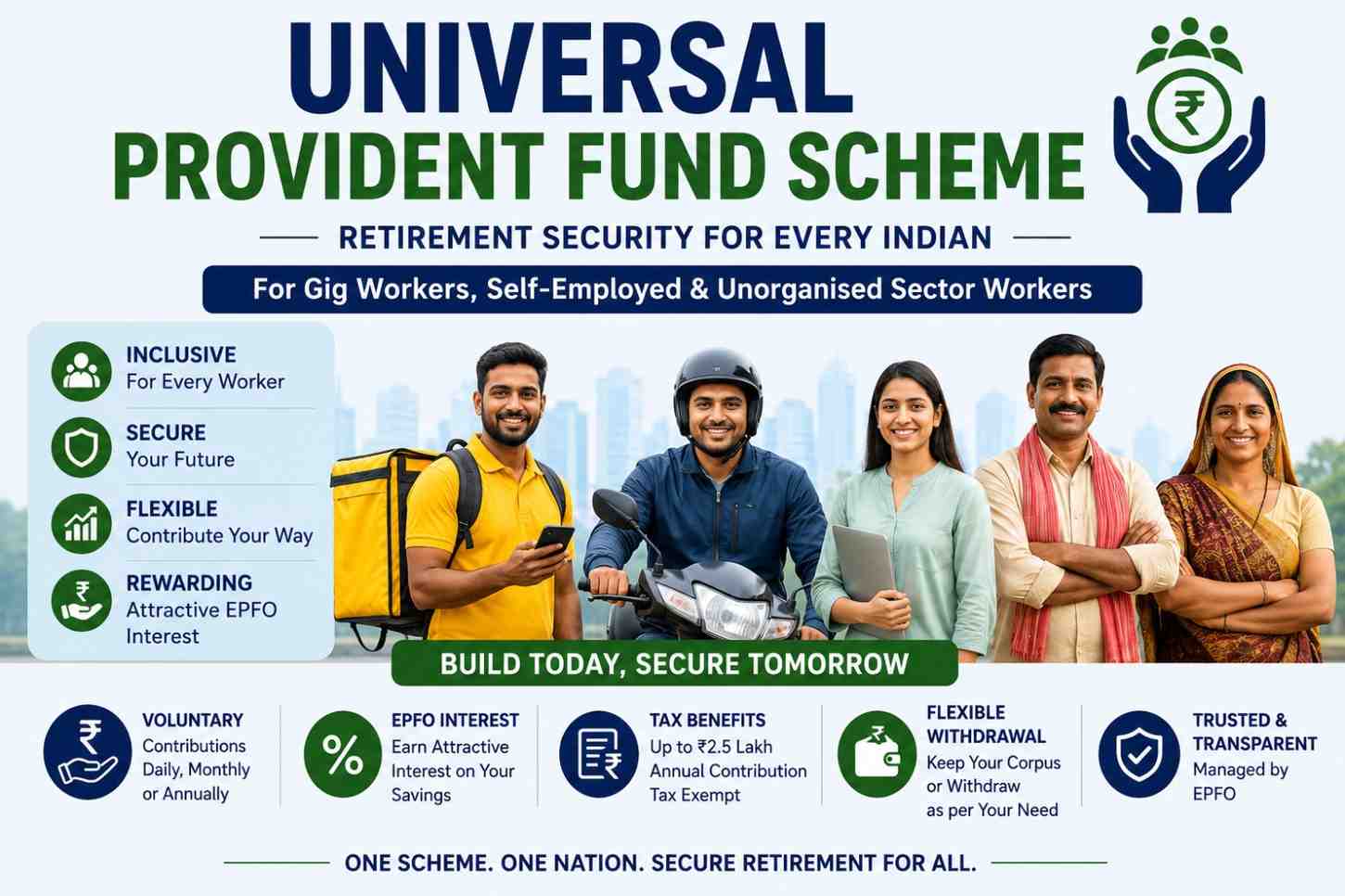
Universal Provident Fund Scheme: India could soon witness one of the biggest social security reforms in decades. The government is working on a Universal Provident Fund (UPF) Scheme that aims to extend provident fund benefits beyond salaried employees to include gig workers, freelancers, self-employed professionals, and workers in the unorganised sector.
If implemented, the scheme could bring millions of Indians under a formal retirement savings system for the first time.
From food delivery executives and cab drivers to freelance consultants, shop owners and independent professionals, the proposed Universal PF Scheme promises to make retirement planning easier, more flexible and more inclusive.
📌 What is the Universal Provident Fund Scheme?
The Employees’ Provident Fund Organisation (EPFO) is working on a framework that would allow individuals outside traditional employment to voluntarily contribute towards retirement savings.
Unlike the existing EPF system, which depends on employer contributions, the Universal PF Scheme would enable workers to save independently while earning EPFO’s annual interest rate.
Simply put, anyone earning an income—even without a formal employer—could potentially build a retirement corpus through EPFO.
⭐ Key Highlights of the Universal PF Scheme
✅ Retirement savings for gig workers and freelancers
✅ Open to self-employed professionals
✅ Voluntary contributions
✅ Flexible deposit frequency (daily, monthly or annually)
✅ EPFO interest rate on savings
✅ Tax benefits similar to EPF
✅ Flexible withdrawal after retirement
✅ Fully digital contribution model
👥 Who Can Benefit?
If the proposal becomes a reality, these individuals could become eligible:
- 🚕 Cab drivers
- 🍔 Food delivery partners
- 🛵 Bike taxi riders
- 💻 Freelancers
- 📱 Content creators
- 👨💼 Consultants
- 🏪 Small business owners
- 👩💻 Self-employed professionals
- 👷 Workers in the unorganised sector
Millions of Indians who currently lack formal retirement protection could finally receive access to a structured long-term savings platform.
💰 How Will the Universal PF Scheme Work?
According to reports, the contribution mechanism is expected to resemble the existing EPF system.
Workers may be allowed to:
✔ Contribute daily
✔ Contribute weekly
✔ Contribute monthly
✔ Contribute annually
This flexibility is particularly important for gig workers whose income varies from month to month.
Unlike salaried employees, there will likely be no employer contribution, meaning subscribers themselves will finance the retirement corpus.
💹 Will You Earn Interest?
Yes.
One of the biggest attractions of the proposed scheme is that deposits would earn annual interest declared by EPFO, similar to existing provident fund accounts.
Historically, EPFO has offered relatively stable returns compared to many fixed-income investment options.
🧾 Tax Benefits: Will They Be Similar to EPF?
The proposal suggests tax benefits comparable to the existing EPF framework.
Proposed benefits include:
✅ Contributions up to ₹2.5 lakh annually could remain tax exempt.
✅ The scheme may continue to enjoy EEE (Exempt-Exempt-Exempt) status.
This means:
- Contributions may qualify for tax benefits.
- Interest earned may remain tax-free.
- Eligible withdrawals could also remain tax exempt.
🔄 What Could Change in Withdrawal Rules?
This is where the Universal PF Scheme could become truly revolutionary.
Instead of forcing subscribers to withdraw the entire amount after retirement, the proposal reportedly allows them to:
- Continue keeping money with EPFO
- Withdraw funds gradually
- Choose a Systematic Withdrawal Plan (SWP)
- Opt for flexible payout schedules
Subscribers may even be allowed larger withdrawals during the initial years of retirement or later, depending on personal financial needs.
Officials have reportedly studied international retirement systems, including Singapore’s CPF model.
📲 Why the Government is Focusing on Gig Workers
India’s gig economy is expanding rapidly.
Millions now work through:
- Food delivery apps
- Ride-hailing platforms
- E-commerce delivery companies
- Digital freelancing platforms
The government has already made registration mandatory for platform workers through a dedicated portal, paving the way for broader social security coverage.
The Universal PF proposal builds upon these efforts.
📊 Why is the Universal Provident Fund Scheme Important?
For decades, provident fund benefits have largely remained limited to formal salaried employment.
That leaves a massive section of India’s workforce without structured retirement savings.
The proposed scheme seeks to change this by making retirement planning individual-centric rather than employer-centric.
Experts believe this could become one of India’s most inclusive social security reforms.
🎯 Major Benefits of the Universal PF Scheme
1️⃣ Retirement Security
Millions of workers currently have no formal retirement plan.
Universal PF could help them build a long-term retirement corpus.
2️⃣ Financial Discipline
Regular contributions encourage consistent savings habits throughout one’s working life.
3️⃣ Portability
Workers changing careers—from salaried jobs to freelancing or entrepreneurship—could continue using the same retirement account.
4️⃣ Trusted EPFO Platform
EPFO already manages retirement savings for crores of employees.
The organisation’s credibility could encourage wider participation.
5️⃣ Better Than Keeping Idle Savings
Instead of leaving money unused in savings accounts, workers could earn annual EPFO interest while building retirement wealth.
⚖️ Universal PF vs NPS: What’s the Difference?
| Feature | Universal PF | National Pension System (NPS) |
|---|---|---|
| Returns | EPFO interest | Market-linked |
| Risk | Lower | Depends on investments |
| Suitable For | Conservative investors | Long-term wealth seekers |
| Contribution | Flexible | Flexible |
| Employer Required | No | No |
The Universal PF Scheme could complement—not replace—existing retirement options like NPS and PPF.
🚧 Biggest Challenges
Despite its promise, several challenges remain.
Irregular Income
Gig workers often experience fluctuating monthly earnings.
Maintaining consistent contributions may prove difficult.
Digital Adoption
The platform must offer:
- Easy registration
- Simple contributions
- Mobile-friendly interface
- Quick withdrawals
- Transparent account management
EPFO 3.0 is expected to play a key role in improving digital infrastructure.
Awareness
Many workers may not understand the importance of retirement planning.
Public awareness campaigns will be essential.
Incentives
Experts believe higher participation will depend upon:
- Attractive tax benefits
- Easy withdrawals
- Transparent administration
- Good interest rates
- User-friendly technology
🌍 Could This Become India’s Universal Retirement Scheme?
Many experts believe so.
Unlike traditional EPF, which depends on where someone works, the proposed Universal PF would focus on the individual.
That means retirement savings would follow the worker—not the employer.
If implemented effectively, this could become India’s most inclusive retirement savings platform.
❓Frequently Asked Questions (FAQs)
Is the Universal Provident Fund Scheme launched?
No. It is currently under consideration and the framework is being developed.
Who can join the scheme?
The proposal aims to cover gig workers, freelancers, self-employed professionals and workers in the unorganised sector.
Will contributions be mandatory?
No. Reports indicate the scheme will be voluntary.
Will there be employer contributions?
No. Subscribers are expected to contribute their own money.
Will the scheme offer tax benefits?
The proposal envisages tax treatment similar to EPF, including benefits under the EEE framework, subject to final government approval.
Can retirees keep money with EPFO?
Yes. The proposal reportedly allows subscribers to retain their retirement corpus and withdraw it gradually after retirement.
📌 Final Take
The proposed Universal Provident Fund Scheme has the potential to redefine retirement planning in India. By extending provident fund benefits to gig workers, freelancers and the self-employed, it could bridge one of the country’s biggest social security gaps.
While the proposal is still under development, its success will depend on simple digital access, attractive tax incentives, flexible contribution options and sustained public participation.
If implemented as envisioned, the Universal PF Scheme could become one of the most transformative financial reforms in India’s social security landscape—bringing retirement security within reach of millions who have long remained outside the formal system.