
 bobby
bobby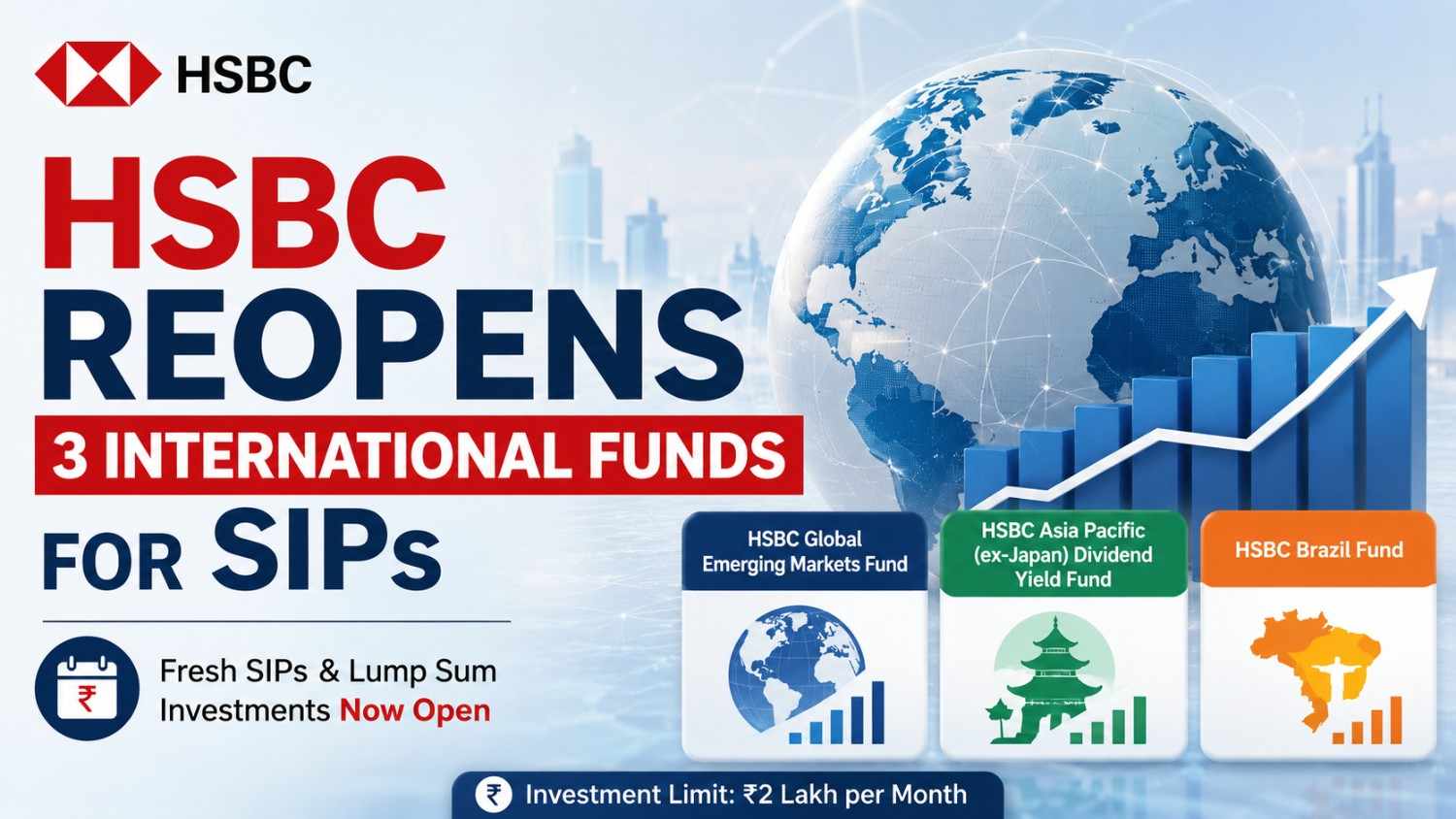
HSBC Reopens 3 International Funds for SIPs: Investors looking to diversify beyond Indian equities have received fresh options. HSBC Mutual Fund has reopened subscriptions in three international mutual funds, allowing investors to start fresh SIPs as well as make lump-sum investments.
The three schemes are HSBC Global Emerging Markets Fund, HSBC Asia Pacific (ex-Japan) Dividend Yield Fund, and HSBC Brazil Fund.
According to Value Research data cited for this article, the three funds reopened for fresh SIP and lump-sum investments from August 18, 2026, with investments capped at ₹2 lakh per month.
The development is significant because access to international mutual funds in India has remained constrained by overseas investment limits. But does reopening mean investors should immediately start an SIP? Not necessarily.
Here is what investors should understand before making a decision.
📌 Key Takeaways
- HSBC has reopened three international mutual funds for fresh investments.
- Fresh SIPs and lump-sum investments resumed from August 18, 2026, according to Value Research data.
- Investments are capped at ₹2 lakh per month.
- The funds provide exposure to emerging markets, Asia-Pacific equities and Brazil, respectively.
- Their recent returns differ considerably, but past performance should not be the primary reason to invest.
- Investors should consider geographical concentration, currency movements, volatility and their existing portfolio allocation before investing.
📈 Which HSBC International Mutual Funds Have Reopened?
The three reopened schemes follow very different investment mandates. That distinction matters because buying an international fund is not simply a decision to “invest globally”—investors must also decide where and how they want their overseas exposure.
| Fund | 1-Year Return | 3-Year Return | 5-Year Return |
|---|---|---|---|
| HSBC Global Emerging Markets Fund | 53.6% | 28.9% | 12.8% |
| HSBC Asia Pacific (ex-Japan) Dividend Yield Fund | 40.3% | 27.9% | 15.1% |
| HSBC Brazil Fund | 28.9% | 12.5% | 7.1% |
Returns are for direct plans as of August 19, 2026. Source: Value Research. Past performance does not guarantee future returns.
Among the three, HSBC Global Emerging Markets Fund recorded the strongest one-year performance at 53.6%. HSBC Asia Pacific (ex-Japan) Dividend Yield Fund returned 40.3%, while HSBC Brazil Fund delivered 28.9%.
Those numbers may attract attention, but investors should avoid selecting a scheme purely because it topped the recent return chart.
🌎 What Do These Three HSBC Funds Invest In?
The three schemes offer different types of international exposure.
HSBC Global Emerging Markets Fund
This scheme gives investors exposure to emerging markets rather than restricting the portfolio to one country.
It may therefore appeal to investors seeking broader emerging-market exposure, although emerging-market equities can experience sharp swings due to economic conditions, interest rates, geopolitical developments and currency movements.
HSBC Asia Pacific (ex-Japan) Dividend Yield Fund
This fund focuses on the Asia-Pacific region excluding Japan, with a dividend-yield-oriented investment strategy.
Its geographical and investment approach differs materially from a diversified global equity fund, so investors should understand its underlying mandate rather than judging it solely by historical returns.
HSBC Brazil Fund
HSBC Brazil Fund provides much more concentrated geographical exposure.
That can make the scheme particularly sensitive to developments affecting the Brazilian economy, equity market, commodities, domestic policy and currency.
⚠️ Investor takeaway: A country-specific fund can carry substantially different concentration risks compared with a geographically diversified international fund.
💰 Why Have International Mutual Funds Been Restricting Fresh Investments?
The changing availability of international mutual funds is closely connected to the overseas investment limits applicable to India’s mutual fund industry.
When an asset management company approaches the overseas investment capacity available to it, it may restrict or suspend new subscriptions into affected international schemes.
If sufficient investment headroom subsequently becomes available, an AMC may reopen subscriptions.
This is why an international mutual fund can be available for investment at one point and restrict fresh inflows later.
For investors, this means fund availability should not be confused with an investment recommendation.
A scheme reopening merely creates an opportunity to invest; whether it belongs in a portfolio is a separate question.
📊 Why SIPs May Be Useful for International Investing
International equity markets can be volatile, particularly when investing in emerging markets or individual countries.
A systematic investment plan allows investors to spread their investments across different market levels instead of committing their intended allocation on a single date.
This can reduce the importance of trying to identify the “perfect” entry point.
However, an SIP does not eliminate investment risk or guarantee positive returns. If the underlying market declines over a prolonged period, an international equity SIP can also generate losses.
🌍 HSBC Isn’t the Only AMC Seeing Changes in International Fund Access
The HSBC reopening comes amid other changes in international mutual fund subscriptions.
Separately, Invesco resumed existing SIP instalments in three international schemes from August 18:
- Invesco India Pan European Equity Fund of Fund
- Invesco India Global Equity Income Fund of Fund
- Invesco India Global Consumer Trends Fund of Fund
The important distinction is that HSBC’s reopening provides investors with three additional options for fresh international SIPs, based on the subscription information cited for this article.
🤔 Should You Invest in These HSBC International Funds?
The reopening itself should not determine the investment decision.
Investors should first ask whether international equities serve a genuine purpose within their overall asset allocation.
1. Check Your Existing International Exposure
Investors may already have indirect global exposure through Indian companies with substantial overseas revenues or through other international investments.
Adding another fund without examining the entire portfolio could result in unnecessary overlap.
2. Understand Geography Before Looking at Returns
A Brazil-focused fund, an Asia-Pacific fund and an emerging-markets fund can behave very differently.
The geographical mandate may therefore be more important to a long-term allocation decision than whichever fund delivered the highest one-year return.
3. Don’t Chase the 1-Year Performance 🚨
A 53.6% one-year return can naturally attract investor attention.
But entering an equity fund immediately after a strong rally purely because of recent performance can expose investors to return-chasing risk.
Look at the investment mandate, portfolio, risk profile, costs and longer-term consistency rather than relying on one performance period.
4. Consider Currency Risk
International investments introduce another important variable: currency movements.
Returns experienced by an Indian investor can be influenced not only by movements in the underlying overseas equities but also by changes between the Indian rupee and relevant foreign currencies.
Currency movements can enhance or reduce returns.
5. Consider Concentration Risk
Not all “international funds” provide broad global diversification.
A single-country fund such as a Brazil-focused scheme can be considerably more concentrated than a diversified international strategy.
Investors should therefore understand exactly what type of diversification they are adding.
6. Think Long Term
International equities are generally better viewed as a strategic portfolio allocation rather than a short-term trade based on recent performance.
Investors should assess whether they can tolerate periods when overseas markets significantly underperform Indian equities.
⚠️ Key Risks Investors Should Know
International mutual funds can provide diversification, but they introduce risks that should not be ignored.
Market risk: Overseas stock markets can decline sharply.
Currency risk: Exchange-rate movements can affect rupee-denominated investor returns.
Geographical risk: Country- or region-specific funds may be affected heavily by local economic and political developments.
Concentration risk: A narrowly focused international fund may provide less diversification than its “international” label suggests.
Regulatory and subscription risk: Overseas investment limits can affect whether fresh investments are accepted.
Performance-chasing risk: Exceptional recent returns can encourage investors to enter after markets have already rallied.
❓ Frequently Asked Questions
Which HSBC international mutual funds have reopened for fresh SIPs?
The three schemes are HSBC Global Emerging Markets Fund, HSBC Asia Pacific (ex-Japan) Dividend Yield Fund and HSBC Brazil Fund.
When did HSBC reopen these international funds?
According to Value Research data cited for this article, fresh SIP and lump-sum investments reopened from August 18, 2026.
What is the investment limit?
The cited subscription information indicates investments are capped at ₹2 lakh per month. Investors should check the AMC’s latest official subscription rules before placing an investment because limits can change.
Which HSBC international fund delivered the highest one-year return?
Based on direct-plan returns as of August 19, 2026, HSBC Global Emerging Markets Fund had the highest one-year return among the three at 53.6%.
However, historical returns do not guarantee future performance.
Can I start a new SIP in these HSBC international funds?
The cited data indicates that fresh SIP subscriptions reopened in the three schemes from August 18, subject to the applicable investment limits and AMC rules.
Is an international mutual fund good for diversification?
International funds can diversify a portfolio geographically by providing exposure to companies and markets outside India. However, the diversification benefit depends on the fund’s mandate. A single-country fund, for example, carries greater geographical concentration than a broadly diversified global strategy.
Should I invest because these funds have recently delivered high returns?
Recent performance alone should not determine an investment decision. Investors should consider their goals, time horizon, risk tolerance, existing asset allocation, fund mandate, costs and geographical exposure before investing.
🎯 Final Takeaway
The reopening of HSBC Global Emerging Markets Fund, HSBC Asia Pacific (ex-Japan) Dividend Yield Fund and HSBC Brazil Fund expands the international mutual fund choices currently available to Indian investors.
But reopening is an opportunity—not an investment signal.
Recent returns, particularly the 53.6% one-year return reported for HSBC Global Emerging Markets Fund, may look attractive. Investors should nevertheless resist choosing an international fund purely by looking at the highest recent return.
The more important question is whether the fund’s geography, investment strategy, risk profile and role within your overall portfolio match your long-term objectives.
For investors who have already decided that international equities belong in their asset allocation, the reopening provides additional options for building that exposure systematically.
Disclaimer: This article is for informational and educational purposes only and does not constitute investment advice. Mutual fund investments are subject to market risks. Investors should read all scheme-related documents carefully and consider consulting a qualified financial adviser before making investment decisions.
Keypoints:
HSBC Mutual Fund, international mutual funds, international mutual fund SIP, HSBC Global Emerging Markets Fund, HSBC Brazil Fund, HSBC Asia Pacific Fund, international funds India, global mutual funds India, overseas mutual funds, international SIP