
 bobby
bobby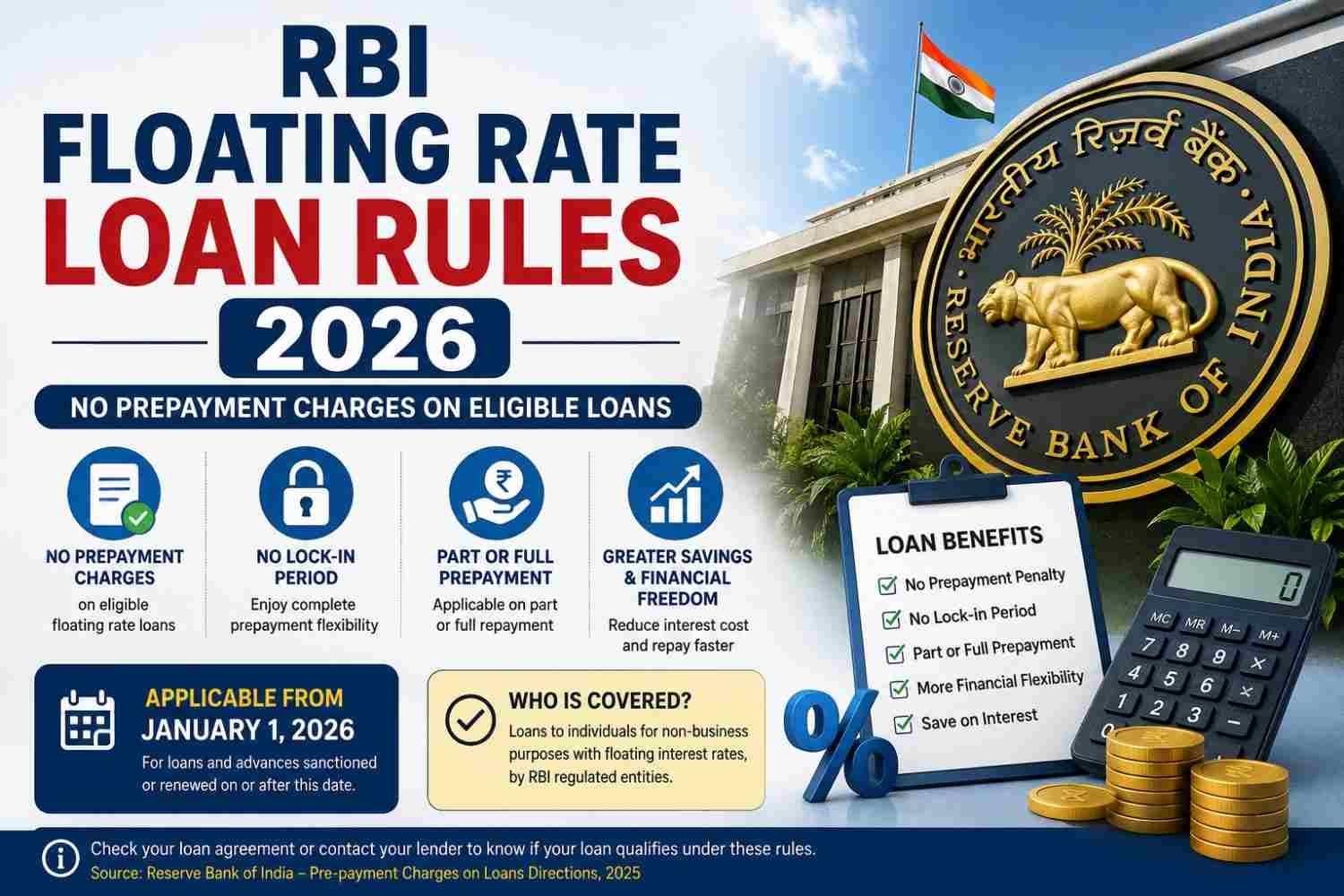
RBI Floating Rate Loan Rules 2026: If you are planning to repay a loan before its scheduled tenure ends, an important Reserve Bank of India (RBI) rule could save you money. 💰
Under the Reserve Bank of India (Pre-payment Charges on Loans) Directions, 2025, new rules apply to loans and advances sanctioned or renewed on or after January 1, 2026.
One of the biggest changes concerns floating-rate loans. For eligible loans taken by individuals for non-business purposes, regulated lenders cannot impose prepayment charges when borrowers repay the loan early.
That means eligible borrowers can make a part-prepayment or completely close their floating-rate loan without being hit by a prepayment penalty.
However, there is an important catch: this does not mean that every loan or every personal loan in India is automatically free from foreclosure charges.
The interest-rate structure and purpose of the loan matter.
🔥 RBI Loan Rules 2026: Key Takeaways
Here is what borrowers should know:
- ✅ New Directions apply to loans and advances sanctioned or renewed on or after January 1, 2026.
- ✅ Individuals with eligible floating-rate loans for non-business purposes cannot be charged prepayment fees.
- ✅ The protection applies to part-prepayment as well as full prepayment.
- ✅ The source of money used to repay the loan does not affect this protection.
- ✅ No minimum lock-in period can be imposed for loans covered by these provisions.
- ⚠️ Fixed-rate loans are not automatically covered by the same prohibition.
- ⚠️ Dual or special-rate loans depend on whether the loan is floating-rate at the time of prepayment.
- 🏦 The Directions cover regulated entities including applicable commercial banks, co-operative banks, NBFCs and All India Financial Institutions.
🏦 What Are RBI’s New Prepayment Rules From 2026?
The RBI introduced the new framework to bring greater consistency and transparency to loan prepayment practices.
For floating-rate loans granted to individuals for purposes other than business, regulated entities covered by the Directions cannot levy prepayment charges.
This can be particularly valuable for borrowers who receive a bonus, inheritance or other surplus funds and want to reduce their outstanding debt ahead of schedule.
It may also make it easier for eligible borrowers to consider moving to another lender offering better terms because a prepayment penalty will not create the same barrier.
💰 Who Can Get Zero Prepayment Charges?
For an individual borrower, the basic situation is straightforward.
If your loan:
1. Is a floating-rate loan,
2. Is for a purpose other than business, and
3. Falls within the applicable RBI framework,
the regulated entity cannot levy a prepayment charge under these provisions.
The Directions apply whether the borrower has taken the loan individually or with co-obligant(s).
Example
Suppose Rahul has an eligible floating-rate loan and receives a large annual bonus.
Instead of continuing to pay interest over the remaining tenure, Rahul wants to use the bonus to repay a substantial portion of his outstanding loan.
If his loan falls within the RBI’s no-prepayment-charge provisions, the lender cannot impose a prepayment fee simply because Rahul is paying the covered loan early.
🚫 No Minimum Lock-In Period for Covered Loans
Another significant provision concerns lock-in periods.
For floating-rate loans covered by the RBI’s specified no-prepayment-charge provisions, the protection applies without any minimum lock-in period.
In simple terms, a lender cannot avoid the rule merely by requiring the borrower to wait for a minimum period before making an otherwise covered prepayment.
This gives eligible borrowers considerably more flexibility in managing their debt.
💳 Part-Payment or Full Foreclosure: Are Both Covered?
Yes, for loans covered by the relevant provisions.
The RBI Directions state that the rules apply irrespective of the source of funds used for prepayment and whether repayment is made in part or in full.
Therefore, an eligible borrower could potentially:
- Make an additional lump-sum payment toward the principal;
- Reduce the outstanding loan balance;
- Shorten the loan tenure; or
- Fully prepay/close the loan.
This flexibility can help borrowers reduce their overall interest burden.
📊 Floating-Rate vs Fixed-Rate Loans: What’s the Difference?
Understanding your interest-rate type is crucial before attempting to foreclose a loan.
| Feature | Floating-Rate Loan | Fixed-Rate Loan |
|---|---|---|
| Interest rate | Can change | Generally fixed for the agreed period |
| Linked to benchmark | Often yes | Generally no |
| EMI/tenure | May change following rate resets | More predictable |
| 2026 prepayment protection | Applies to eligible loans | Not automatically covered |
| Prepayment charges | Prohibited where RBI conditions are met | May apply according to applicable rules/lender policy |
🌊 What Is a Floating-Rate Loan?
A floating-rate loan has an interest rate that does not remain fixed throughout its tenure.
Its rate can change according to the applicable benchmark and terms of the loan.
Depending on the loan structure, a rate reset may affect the borrower’s:
- EMI;
- Remaining tenure; or
- Both EMI and tenure.
Because the cost can change over time, borrowers should understand which benchmark their loan follows and how frequently the interest rate is reset.
🔒 What Is a Fixed-Rate Loan?
A fixed-rate loan generally keeps the agreed interest rate fixed for the applicable period.
This provides greater predictability because normal movements in benchmark rates do not automatically change the interest rate in the same way as a floating-rate product.
But borrowers need to remember one crucial point:
The RBI’s 2026 prohibition discussed here should not be interpreted as a blanket ban on foreclosure charges for every fixed-rate loan.
Where a loan is outside the categories protected by the Directions, prepayment charges may be imposed according to the lender’s approved policy and other applicable requirements.
⚠️ What About Dual or Special-Rate Loans?
Some loans combine fixed and floating interest-rate structures.
For these dual or special-rate loans, the RBI rules look at the loan’s status at the time of prepayment.
If the loan is on a floating rate when the borrower makes the prepayment, the relevant floating-rate protections may apply if the other eligibility conditions are satisfied.
This makes checking your current loan status particularly important.
🏢 Do RBI’s Rules Cover Business Loans?
The RBI framework also contains protections for certain floating-rate loans granted for business purposes to individuals and Micro and Small Enterprises (MSEs).
However, the exact protection can depend on the type of regulated lender and, in some cases, the sanctioned loan amount or limit.
For example, certain categories of regulated entities have broader restrictions, while for specified lenders the no-prepayment-charge protection for qualifying business loans can be subject to a ₹50 lakh sanctioned amount/limit threshold.
Therefore, business borrowers should check the specific RBI provision applicable to their lender rather than assuming every business loan qualifies.
🏦 Which Lenders Are Covered?
The RBI’s 2025 Directions apply to regulated entities including:
- Commercial banks, excluding payments banks;
- Co-operative banks;
- Non-Banking Financial Companies (NBFCs); and
- All India Financial Institutions.
Specific conditions can differ for certain business-purpose loans, so borrowers should check the category of their lender and loan.
📝 What Should You Check Before Prepaying Your Loan?
Before transferring a large amount of money to close or reduce your loan, check these important details.
1. Check Whether Your Loan Is Fixed or Floating
This should be your first step.
Look at your loan agreement, sanction letter and other documentation to determine whether your interest rate is fixed, floating or a combination of both.
2. Check When Your Loan Was Sanctioned or Renewed
The RBI’s 2025 Directions state that the new framework applies to loans and advances sanctioned or renewed on or after January 1, 2026.
Older loans may be governed by pre-existing RBI requirements applicable to the relevant lender and loan category.
3. Read Your Key Facts Statement (KFS) 📄
Review your loan’s Key Facts Statement, where applicable, along with your sanction letter and loan agreement.
Pay particular attention to:
- Interest-rate type;
- Annual Percentage Rate (APR);
- Applicable fees;
- Prepayment terms;
- Foreclosure terms; and
- Other charges.
4. Calculate Your Potential Interest Savings 🧮
Even when no prepayment penalty applies, consider whether using your available cash to repay the loan makes financial sense.
Compare:
Remaining interest cost vs. potential savings from early repayment.
Also consider your emergency fund and near-term financial needs before committing a large amount of cash to loan repayment.
5. Request a Foreclosure Statement
Before fully closing a loan, ask the lender for an official foreclosure or loan-closure statement showing the outstanding amount and any applicable charges.
Check the figures carefully before paying.
💡 Why RBI’s New Rule Matters for Borrowers
Prepayment charges can discourage borrowers from repaying debt early or switching to another lender.
Removing these charges from covered floating-rate loans can give eligible borrowers greater freedom to manage their debt.
For example, borrowers may be able to use surplus income to reduce principal, shorten the repayment period or completely repay a covered loan without worrying about an additional prepayment penalty.
However, early repayment is not automatically the best financial decision for everyone. Liquidity, emergency savings, alternative uses of money and the effective cost of the loan should also be considered.
❓ Frequently Asked Questions (FAQs)
1. What is the RBI’s new loan prepayment rule for 2026?
The RBI’s Pre-payment Charges on Loans Directions establish rules restricting prepayment charges on specified floating-rate loans. The framework applies to loans and advances sanctioned or renewed on or after January 1, 2026.
2. Can banks charge foreclosure fees on floating-rate loans in 2026?
For floating-rate loans granted to individuals for purposes other than business that fall within the relevant RBI provisions, regulated entities cannot levy prepayment charges.
3. Does the RBI rule apply to all personal loans?
No. Borrowers should not assume that every personal loan is automatically covered. The interest-rate structure is crucial. A fixed-rate personal loan is not automatically protected by the floating-rate prohibition discussed here.
4. Can I prepay only part of my floating-rate loan without charges?
If the loan qualifies under the relevant RBI provisions, the protection applies to prepayment in part or in full.
5. Is there a lock-in period before I can prepay?
For loans covered by the specified no-prepayment-charge provisions, RBI states that the protection applies without any minimum lock-in period.
6. What happens if my loan is fixed-rate?
Fixed-rate loans do not automatically receive the same protection. Depending on the applicable rules, a lender may levy prepayment charges according to its approved policy and the loan’s terms.
7. What happens with a dual-rate loan?
For a dual or special-rate loan combining fixed and floating rates, applicability depends on whether the loan is on a floating rate at the time of prepayment.
8. Are business loans also covered?
Certain floating-rate business loans to individuals and MSEs are covered, but the precise conditions depend on the category of lender and, for certain regulated entities, the sanctioned amount or limit.
9. When did the RBI’s new prepayment rules become applicable?
The RBI Directions apply to loans and advances sanctioned or renewed on or after January 1, 2026.
🎯 Bottom Line
The RBI floating rate loan rules applicable from 2026 strengthen protection for borrowers who want the freedom to repay eligible loans ahead of schedule.
For individuals with qualifying floating-rate loans taken for non-business purposes, regulated lenders cannot levy prepayment charges. The relevant protection applies to both part and full prepayment, irrespective of the source of funds, and without a minimum lock-in period.
But remember: this is not a blanket waiver for every loan in India. ⚠️
Before closing a loan, confirm whether your loan is fixed or floating, determine which RBI provision applies, and carefully review your sanction letter, loan agreement and Key Facts Statement (KFS).
Doing that could prevent an expensive misunderstanding—and help you make a smarter decision about becoming debt-free sooner. 💰✅