
 bobby
bobby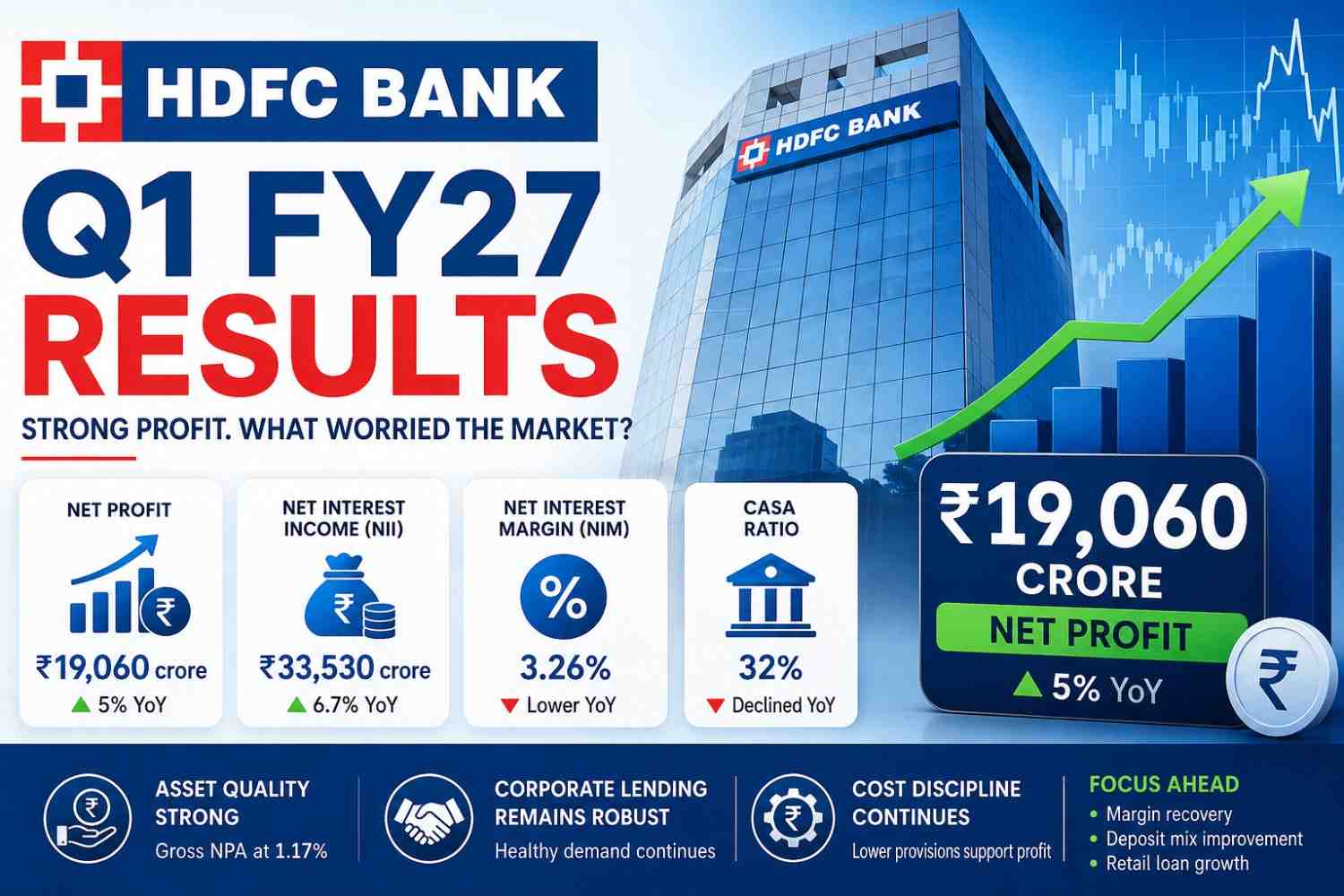
HDFC Bank Q1 FY27 Results: India’s largest private lender reported a standalone net profit of ₹19,060 crore for the first quarter of FY27, with profit rising 5% year-on-year (YoY) and Net Interest Income (NII) growing nearly 7%.
On paper, the numbers looked impressive.
So why did HDFC Bank shares plunge over 5% after the results? 🤔
The answer lies beyond the headline profit. Investors were less concerned about what the bank earned this quarter and more worried about what the earnings signal for future profitability.
Let’s break it down.
📌 HDFC Bank Q1 FY27 at a Glance
| Metric | Q1 FY27 | Q1 FY26 | Change |
|---|---|---|---|
| 💰 Net Profit | ₹19,060 crore | ₹18,160 crore | ▲ 5% |
| 📈 Net Interest Income | ₹33,530 crore | ₹31,440 crore | ▲ 6.7% |
| 📉 Net Interest Margin (NIM) | 3.26% | 3.40% | ▼ Lower |
| 🏦 CASA Ratio | 32% | Higher last year | ▼ Declined |
Source: HDFC Bank Q1 FY27 Investor Presentation
🤔 Why Did HDFC Bank Stock Fall Despite Record Profit?
Although the bank reported another profitable quarter, investors focused on future earnings potential rather than current profits.
Here are the four biggest reasons behind the sharp selloff.
1️⃣ Net Interest Margin (NIM) Fell to Its Lowest Level Since the Merger 📉
The biggest disappointment was Net Interest Margin (NIM).
NIM dropped to 3.26%, the lowest level since the HDFC Ltd merger.
Why does NIM matter?
Think of NIM as the bank’s profit margin.
It is the difference between:
- Interest earned from loans
- Interest paid on deposits
A falling NIM means the bank earns less money from every rupee it lends, even if loan growth remains healthy.
For long-term investors, declining margins often signal slower earnings growth ahead.
2️⃣ CASA Ratio Continued to Decline 🏦
Another major concern was the bank’s CASA ratio, which slipped to 32%.
What is CASA?
CASA stands for:
- Current Account
- Savings Account
These deposits are inexpensive for banks because they pay relatively low interest.
A lower CASA ratio means:
✅ Banks rely more on expensive fixed deposits.
❌ Funding costs increase.
❌ Profit margins shrink.
That is exactly what worried investors this quarter.
3️⃣ The Headline Profit Didn’t Tell the Whole Story 📊
While net profit increased, the underlying business wasn’t as strong as the headline suggested.
Some income streams were weaker than expected, while last year’s earnings included a one-time gain that wasn’t repeated this quarter.
This is an important lesson for investors:
Higher profit doesn’t always mean stronger business performance.
Markets often reward quality of earnings, not just bigger profit numbers.
4️⃣ Retail Loan Growth Remained Soft 🚗🏠
Corporate lending continued to perform well.
However, retail loans—including:
- Home loans
- Personal loans
- Auto loans
grew slower than analysts had expected.
Retail loans generally generate higher margins than corporate loans.
Slower retail growth therefore raises concerns about future profitability.
📉 Why Investors Are Worried
The market isn’t questioning whether HDFC Bank is a strong bank.
It is asking whether the bank can restore its profitability quickly after the HDFC Ltd merger.
Even after reporting healthy earnings, HDFC Bank shares are now down roughly 21% in 2026, reflecting investor concerns over:
- Lower margins
- Higher funding costs
- Slower profitability recovery
✅ What HDFC Bank Got Right
Despite the market’s negative reaction, the quarter had several positives.
🟢 Asset Quality Remains Strong
Gross NPAs remained low at 1.17%.
This indicates borrowers continue to repay loans on time and credit quality remains healthy.
🟢 Corporate Lending Stayed Robust
The bank continued to report healthy growth in:
- Corporate loans
- Commercial banking
- Business banking
These segments helped offset slower retail loan growth.
🟢 Cost Control Protected Earnings
Lower credit provisions cushioned the impact of weaker margins.
As a result, HDFC Bank still delivered another quarter of profit growth despite a challenging deposit environment.
💬 What Are Analysts Saying?
Most brokerage firms described the quarter as weaker than expected.
The biggest concerns included:
- Falling NIM
- Softer core operating performance
- Continued pressure on deposit costs
However, analysts continue to believe HDFC Bank remains one of India’s strongest private-sector banks over the long term.
The key question is no longer whether HDFC Bank is fundamentally strong.
Instead, investors want to know:
How quickly can margins recover?
👀 What Investors Should Watch Next
The next few quarters will likely matter more than this quarter’s profit.
Keep an eye on:
✅ Net Interest Margin (NIM)
✅ CASA Ratio
✅ Deposit growth
✅ Retail loan growth
✅ Funding costs
✅ Management’s outlook on profitability
📌 Key Takeaways
✔️ Net profit rose 5% to ₹19,060 crore
✔️ Net Interest Income increased nearly 7%
✔️ NIM fell to 3.26%, worrying investors
✔️ CASA ratio declined to 32%
✔️ Retail loan growth remained soft
✔️ Asset quality stayed strong
✔️ Corporate lending continued to perform well
✔️ Investors are focused on future profitability rather than current earnings
📢 Final Verdict
HDFC Bank’s Q1 FY27 results tell two very different stories.
On one hand, India’s largest private bank continues to generate record profits, maintain excellent asset quality, and grow its loan book.
On the other hand, shrinking margins, rising funding costs, and a weaker deposit mix suggest that earnings growth may remain under pressure for some time.
That is why the market reacted negatively despite a ₹19,060 crore profit.
For long-term investors, the next few quarters will be crucial. If Net Interest Margin improves, CASA stabilizes, and retail lending accelerates, investor confidence could return. Until then, the market is likely to remain focused on profitability rather than headline earnings.