 bobby
bobby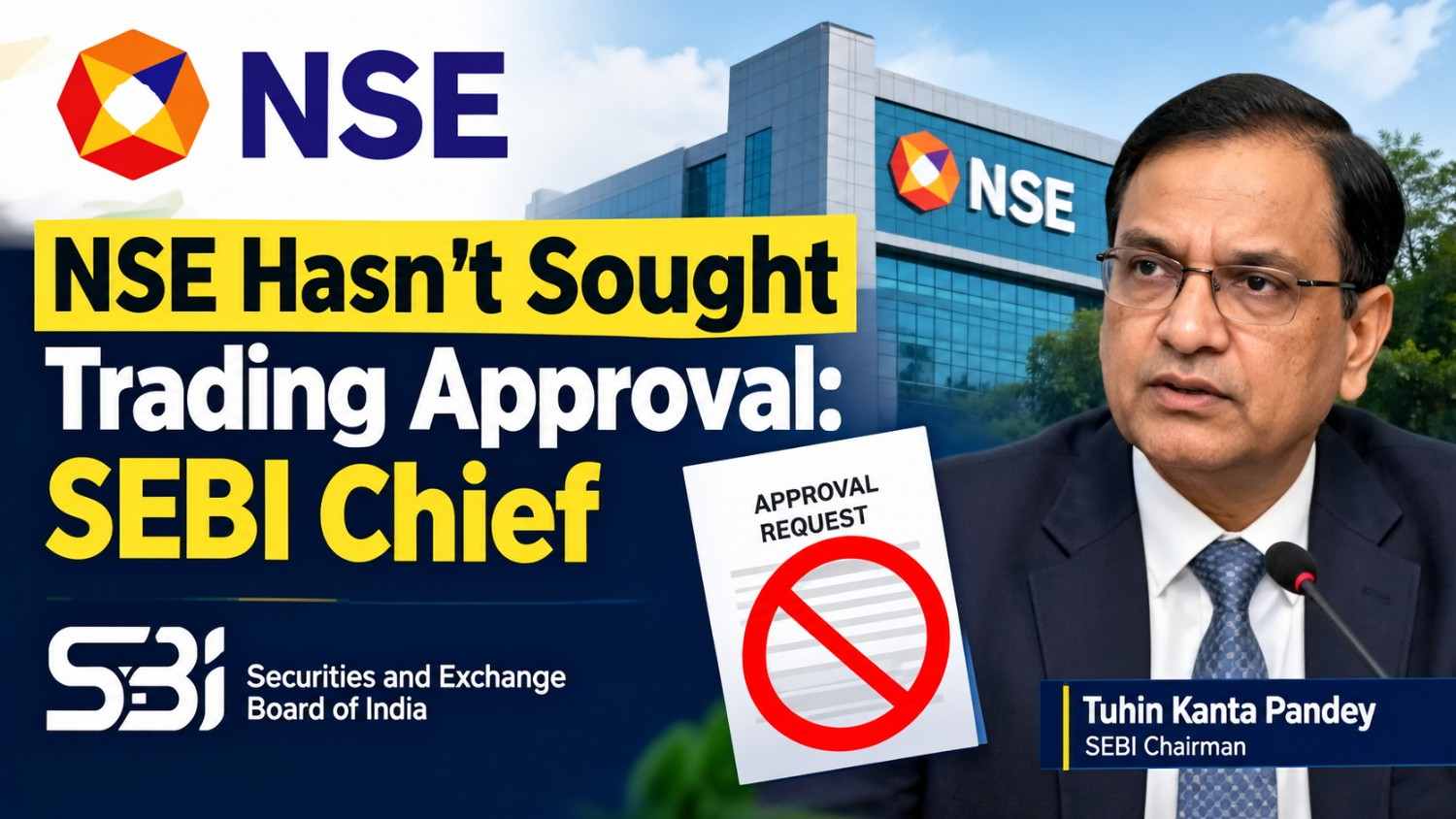
NSE Hasn’t Sought Trading Approval: SEBI Chairman Tuhin Kanta Pandey said on Thursday, September 17, 2026, that the market regulator has received no proposal from the National Stock Exchange (NSE) seeking permission to trade its shares on its own platform after listing.
The clarification comes as NSE’s long-awaited initial public offering (IPO) opened for subscription, drawing significant attention from investors.
📢 What Did SEBI Chief Tuhin Kanta Pandey Say About NSE?
Speaking to reporters on the sidelines of the NaBFID Infrastructure Conclave 2026, Pandey rejected suggestions that NSE had approached the Securities and Exchange Board of India (SEBI) for permission to trade its shares on its own exchange after listing.
“No, there is no such letter, and there is no such requirement.”
Pandey also indicated that such trading cannot be permitted under the present framework.
The clarification is significant because NSE is itself a stock exchange, making the question of where its shares can trade after listing different from that of a conventional listed company.
📈 NSE IPO Opens for Subscription
The development coincided with the opening of NSE’s much-awaited IPO on September 17, 2026.
The public issue is entirely an offer for sale (OFS), meaning existing shareholders are selling their holdings and NSE itself will not receive the proceeds from the share sale.
NSE IPO Key Details
- IPO size: Around ₹22,569 crore
- Issue type: 100% Offer for Sale (OFS)
- Shares offered: 12.64 crore equity shares
- Price band: ₹1,700–₹1,785 per share
- IPO opening date: September 17, 2026
- IPO closing date: September 21, 2026
- Fresh issue: None
Because the IPO is entirely an OFS, proceeds—after applicable issue expenses—will go to the selling shareholders rather than NSE.
💳 SEBI to Examine Concerns Over New UPI MDR
Pandey also addressed concerns raised by sections of the brokerage and asset-management industries over the new UPI Merchant Discount Rate (MDR) framework.
He acknowledged that there were issues requiring examination and said SEBI would consider how concerns affecting market participants could be addressed.
“I think there are some important issues there. We will certainly look into it and see how we can ease them.”
Under the new framework, qualifying person-to-merchant UPI transactions above ₹2,000 will attract an MDR of 0.4%, subject to specified exemptions and concessions.
The MDR is capped at ₹300 per transaction, meaning the standard percentage-based charge does not increase beyond that level for transactions of ₹75,000 or more.
The framework is scheduled to take effect on October 15, 2026.
Importantly, the MDR is a merchant-side charge. Person-to-person UPI transactions continue to remain outside this merchant-fee framework.
📱 Why Is the New UPI MDR Important?
The introduction of MDR represents a significant change for India’s UPI ecosystem after years of a zero-MDR framework.
The earlier regime helped accelerate the adoption of digital payments across India. However, banks and payment-industry participants have also raised questions over the long-term cost of operating and expanding UPI infrastructure.
The latest framework attempts to balance continued digital-payment adoption with the cost of maintaining the payment ecosystem.
For capital-market participants, SEBI’s decision to examine industry concerns will therefore be closely watched.
📉 SEBI Study Flags Continued Losses Among F&O Traders
Pandey also discussed SEBI’s research into futures and options (F&O) trading, highlighting the risks faced by individual traders.
According to the SEBI chairman, research findings indicate that a number of traders continue suffering losses even after spending several years in the derivatives market.
“Even after 3-4 years of trading, there are many people in continued losses.”
Pandey said investors need to assess carefully whether F&O trading is suitable for them.
The findings put renewed focus on investor awareness and the risks associated with derivatives trading, particularly for individual market participants.
🏙️ Municipal Bonds: Governance and Repayment Capacity Remain Key
The SEBI chairman also spoke about the development of India’s municipal bond market.
Pandey identified two major areas that need attention: the quality of municipal governance and the ability of municipal bodies to repay their obligations.
He said the regulatory framework is now in place, while mechanisms have also been developed to strengthen the market.
An escrow mechanism has been introduced to provide recourse, while proposals for greater use of pooled financing vehicles are also being considered.
Greater participation by municipalities in the bond market could encourage more urban local bodies to use bonds to finance infrastructure projects.
The Centre is also providing incentives to municipalities that raise funds through municipal bonds.
🔎 Why This Matters for Investors
SEBI’s clarification comes at a crucial time for NSE as its IPO reaches the public market.
For investors, the key point is that NSE has not sought SEBI’s approval to allow its shares to trade on its own exchange, according to the regulator’s chairman.
At the same time, SEBI is dealing with several broader market issues—from concerns surrounding UPI MDR and persistent retail losses in F&O trading to efforts to deepen India’s municipal bond market.
These developments could remain important for investors, brokers, asset managers and other participants across India’s financial markets.
❓ Frequently Asked Questions (FAQs)
1. Has NSE asked SEBI to allow its shares to trade on NSE?
No. SEBI Chairman Tuhin Kanta Pandey said on September 17, 2026, that the regulator had received no such proposal from NSE.
2. Can NSE shares trade on NSE after the company is listed?
Pandey said such trading cannot be permitted at present. NSE has not submitted a proposal seeking such approval.
3. What is the NSE IPO price band?
The NSE IPO price band has been fixed at ₹1,700 to ₹1,785 per equity share.
4. When does the NSE IPO close?
The IPO opened on September 17, 2026, and is scheduled to close on September 21, 2026.
5. Will NSE receive money from its IPO?
No. The IPO is entirely an offer for sale, so NSE will not receive proceeds from a fresh issue of shares. The offer proceeds, after applicable expenses, go to the selling shareholders.
6. What is the new UPI MDR?
Under the new framework, qualifying person-to-merchant UPI transactions above ₹2,000 will attract a 0.4% MDR, capped at ₹300 per transaction. The framework is scheduled to take effect from October 15, 2026.
7. What did SEBI say about F&O traders?
Pandey said SEBI’s research showed that many traders continue to incur losses even after three to four years of participating in F&O markets, highlighting the need for investors to assess whether derivatives trading is suitable for them.
Disclaimer: This article is for informational purposes only and should not be considered investment advice. Investors should conduct their own research and consult qualified financial professionals before making investment decisions.