
 bobby
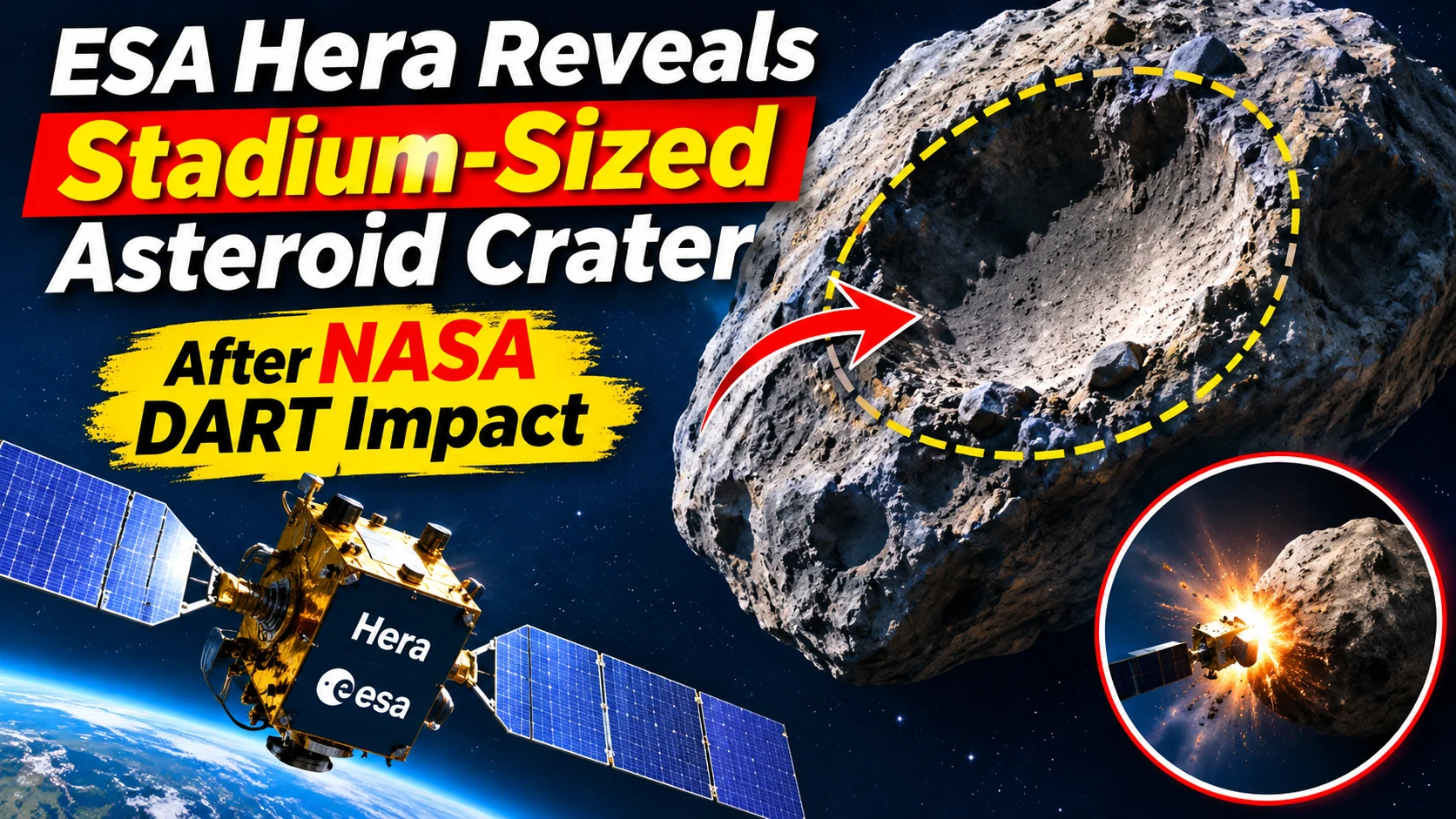
ESA Hera Reveals Stadium-Sized: Humanity has taken another significant step towards protecting Earth from potentially dangerous asteroids. The European Space Agency’s Hera spacecraft has captured remarkable images of Dimorphos, revealing the enormous crater created by NASA’s historic asteroid deflection experiment in 2022.
The latest observations reveal significant changes to the asteroid’s surface and rotation, offering scientists valuable information about how celestial objects respond to deliberate spacecraft collisions.
The discovery, announced on November 25, 2026, marks an important milestone in international planetary defence research.
🚀 ESA Hera Mission: Key Highlights
- Hera has identified a stadium-sized crater on Dimorphos.
- NASA’s DART spacecraft deliberately struck the asteroid in September 2022.
- Dimorphos measures approximately 151 metres across.
- The collision reduced its orbital period by 33 minutes.
- Scientists have discovered hundreds of previously unidentified boulders near the asteroid system.
- Two miniature spacecraft are scheduled for deployment in January 2027.
☄️ ESA Hera Asteroid Mission 2026
Asteroid Diameter Comparison (Metres)
🚀 Key Mission Statistics
Orbital Period Reduction
Distance From Earth
Hera Observation Distance
Planned CubeSat Deployment
Scientific Discovery: NASA’s 2022 DART impact left a stadium-sized crater on Dimorphos and successfully altered its orbital period.
Source: European Space Agency (ESA) | November 25, 2026
☄️ NASA’s Asteroid Collision Leaves an Enormous Crater
When NASA deliberately crashed a spacecraft into Dimorphos four years ago, scientists wanted to determine whether a controlled collision could redirect an asteroid.
The experiment succeeded in changing the asteroid’s orbit, but researchers could not immediately examine the full extent of the physical damage.
Hera’s new observations are helping answer that question.
The images reveal that the collision affected nearly the entire impacted side of Dimorphos. Its previously rounded profile now includes a broad, flattened impact region comparable in scale to a sports stadium.
Interestingly, other parts of the asteroid show relatively little visible alteration. Recognisable rocky features remain present away from the collision site.
This contrast provides researchers with an opportunity to investigate how impact energy travels through small celestial bodies.
🛰️ What Is the ESA Hera Mission?
Hera is a planetary defence spacecraft developed by the European Space Agency to examine the consequences of NASA’s Double Asteroid Redirection Test, commonly known as DART.
Rather than performing another collision, Hera is conducting a scientific investigation of the asteroid system.
Its instruments help researchers study the surface, temperature, physical characteristics and surrounding environment of the two asteroids.
The investigation is particularly important because asteroids differ considerably in composition. Some may contain relatively solid material, while others consist of loosely connected rocks and debris.
Understanding these differences could help scientists predict how future asteroid deflection attempts might perform under different conditions.
🌍 Dimorphos vs Didymos: Understanding the Asteroid System
Dimorphos is the smaller member of a binary asteroid system that also contains Didymos.
Didymos measures approximately 730 metres in diameter, making it nearly five times wider than its smaller companion.
Neither asteroid was selected because it threatened Earth. Instead, the system provided researchers with an opportunity to test asteroid deflection and measure the resulting orbital changes.
Studying an asteroid with a natural companion allows scientists to observe changes in its movement relative to the larger body.
This makes the pair an especially useful environment for planetary defence experiments.
💥 How NASA’s DART Mission Changed an Asteroid’s Orbit
On September 26, 2022, NASA completed its experimental spacecraft collision with Dimorphos.
The mission used a technique known as kinetic impact, which involves transferring momentum from a moving spacecraft to an asteroid.
The objective was not to destroy the asteroid but to change its movement.
Measurements following the experiment confirmed that Dimorphos completed its journey around Didymos approximately 33 minutes faster than before.
This result demonstrated that humans can deliberately produce a measurable change in an asteroid’s orbit.
In a future planetary defence operation, a sufficiently early intervention could potentially alter a dangerous asteroid’s trajectory enough to prevent a collision with Earth.
However, the effectiveness would depend on the object’s physical properties, its trajectory and the available warning time.
🔄 Hera Discovers Unexpected Asteroid Movement
One of Hera’s important findings concerns the rotational behaviour of Dimorphos.
Observations indicate that the smaller asteroid is experiencing irregular rotation while travelling around Didymos.
This suggests that the spacecraft collision affected more than its orbital period.
For scientists, rotational changes are important because they provide clues about how momentum was distributed during the impact.
Hera also detected hundreds of rocky objects moving through the surrounding region.
Researchers still need additional observations to establish the precise origins of these objects. Their presence must also be considered when planning closer spacecraft operations.
🔬 Advanced Instruments Help Scientists Examine Dimorphos
Hera carries specialised scientific equipment designed to examine different aspects of the asteroid system.
Asteroid Framing Camera
This camera records detailed images that help researchers examine geological features and compare observations with photographs obtained before the experiment.
Hyperscout H
This multispectral instrument collects information across different wavelengths, helping scientists investigate variations in surface materials.
Thermal Infrared Imager
Provided by Japan’s space agency, JAXA, this instrument examines thermal properties that may reveal differences between rocky regions and other surface materials.
Together, these instruments provide complementary information about the asteroids and their physical environment.
📅 What Happens Next in the Hera Mission?
ESA’s current mission plan includes progressively closer observations during December 2026.
The next major milestone is expected in January 2027, when Hera plans to release two compact research spacecraft.
Named Juventas and Milani, these CubeSats have different scientific responsibilities.
Juventas will investigate internal asteroid properties using radar, while Milani will examine surface materials and the surrounding dust environment.
Their findings could improve scientific understanding of how the collision influenced Dimorphos.
These upcoming activities remain subject to mission conditions and operational requirements.
🛡️ Why the Hera Discovery Matters for Earth’s Safety
Planetary defence is not simply about detecting asteroids. It also involves predicting their movements, understanding their physical properties and developing possible methods of intervention.
The DART and Hera missions address different parts of this challenge.
NASA demonstrated that a deliberate impact can alter orbital motion. ESA is investigating the consequences so that scientists can better understand and predict the effectiveness of similar techniques.
This international collaboration could become increasingly important as astronomers continue identifying and monitoring near-Earth objects.
❓ Frequently Asked Questions (FAQs)
1. What did ESA’s Hera spacecraft discover?
Hera identified a huge impact crater on Dimorphos, irregular asteroid rotation and numerous rocky objects surrounding the binary asteroid system.
2. How large is the Dimorphos asteroid crater?
The crater is comparable in scale to a sports stadium and extends across the impacted side of the asteroid. Its precise dimensions require further investigation.
3. When did NASA’s DART spacecraft hit Dimorphos?
The deliberate spacecraft collision occurred on September 26, 2022.
4. How much did DART change the asteroid’s orbit?
The experiment reduced Dimorphos’s orbital period around Didymos by approximately 33 minutes.
5. Is Dimorphos dangerous to Earth?
No. Dimorphos and Didymos were selected for scientific experimentation and do not threaten Earth.
6. Can NASA prevent an asteroid from hitting Earth?
DART demonstrated that asteroid deflection is possible. Whether a future intervention succeeds would depend on several factors, including asteroid composition and advance warning.
7. When will Hera deploy its CubeSats?
ESA plans to deploy Juventas and Milani in January 2027.
📝 Conclusion
ESA’s Hera asteroid crater discovery represents an important development in planetary defence science. By examining the aftermath of NASA’s DART experiment, researchers are gaining practical knowledge that could contribute to future asteroid deflection strategies.
Although further investigation is necessary, the combined missions demonstrate how international scientific cooperation can help humanity prepare for potential threats from space.
Source: European Space Agency (ESA), official mission announcement, November 25, 2026.