
 bobby
bobby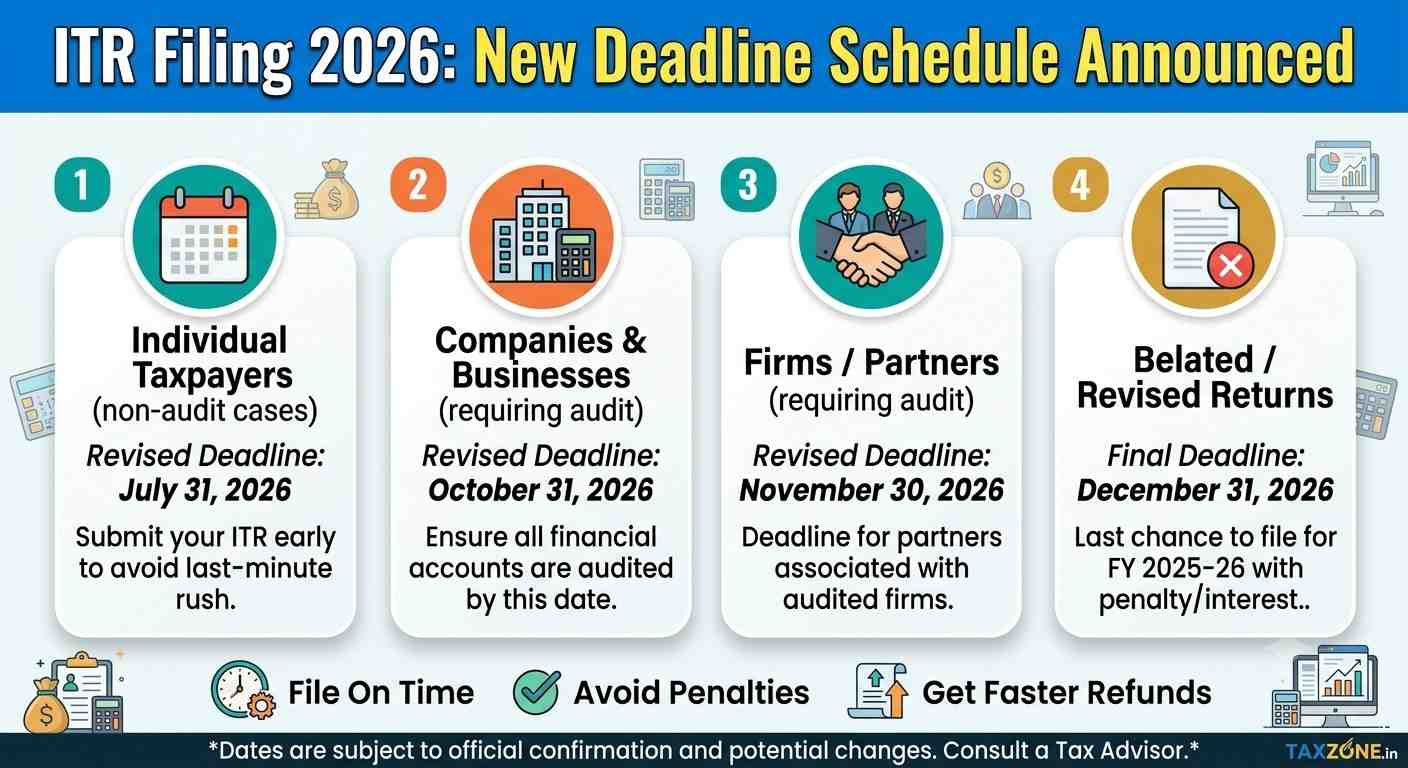
ITR Filing 2026 : If you’ve been filing your Income Tax Return (ITR) every July out of habit, it’s time to rethink your schedule. Assessment Year (AY) 2026-27—covering income earned during Financial Year (FY) 2025-26—brings a major change to the ITR filing deadline.
The familiar 31 July deadline no longer applies to everyone. Instead, the due date now depends on the ITR form you are required to file.
Here’s everything taxpayers need to know. 👇
📅 ITR Filing 2026: New Due Dates Announced
The government has introduced staggered ITR filing deadlines, replacing the old one-size-fits-all approach. The objective is to ease compliance and give taxpayers—especially those with business or professional income—more time to prepare accurate returns.
👨💼 Salaried Individuals: No Change
If you are a salaried employee, pensioner or investor filing ITR-1 (Sahaj) or ITR-2, your due date remains:
✅ 31 July 2026
This applies to taxpayers with:
- Salary or pension income
- Interest income
- Capital gains (where applicable under ITR-2)
- Income from one or two house properties
- Other eligible sources of income
💼 Business Owners & Professionals Get Extra Time
The biggest relief is for taxpayers filing ITR-3 or ITR-4 who are not subject to tax audit.
Their new deadline is:
✅ 31 August 2026
This additional month benefits:
- Freelancers
- Consultants
- Doctors
- Lawyers
- Chartered professionals
- Small business owners
- Proprietors
- Partnership firms
- Taxpayers under the presumptive taxation scheme
The extra time allows better bookkeeping, reconciliation of accounts and more accurate tax filing.
📌 ITR Filing Due Dates for AY 2026-27 (FY 2025-26)
| Taxpayer Category | Due Date |
|---|---|
| ITR-1 & ITR-2 | 31 July 2026 |
| ITR-3 & ITR-4 (Non-Audit Cases) | 31 August 2026 |
| Tax Audit Cases | 31 October 2026 |
| Transfer Pricing Cases | 30 November 2026 |
| Belated Return | 31 December 2026 |
| Revised Return | 31 March 2027 |
✍️ Revised Return Deadline Extended Until March 2027
Another significant taxpayer-friendly change is the extension of the revised return filing window.
Earlier, taxpayers could revise their ITR only until 31 December of the assessment year.
Now, for AY 2026-27, the deadline has been extended to:
✅ 31 March 2027
This gives taxpayers three additional months to correct mistakes such as:
- Missing deductions under Section 80C
- Errors in income reporting
- Mismatches with Annual Information Statement (AIS)
- Incorrect tax credit claims
- Form 26AS discrepancies
The longer window reduces the pressure of filing a perfect return on the first attempt.
⚠️ Missing the Deadline Can Be Expensive
Even if you miss the due date, you can still file a belated return until 31 December 2026.
However, late filing comes at a cost.
You may have to pay:
- 💰 Late fee of ₹5,000 under Section 234F
- 💰 ₹1,000 if your total income does not exceed ₹5 lakh
- 💰 Interest on outstanding tax liability, wherever applicable
But the financial impact goes beyond the penalty.
If you file late, you could:
❌ Lose the option to choose the old tax regime, if applicable under the law.
❌ Lose the benefit of carrying forward certain losses, which could increase your future tax liability.
That’s why filing on time is always the smarter choice.
📖 Why AY 2026-27 Is an Important Filing Season
This is a landmark year for taxpayers.
AY 2026-27 is the final assessment year governed by the Income-tax Act, 1961.
Although the Income Tax Act, 2025 came into force on 1 April 2026, taxpayers filing returns for FY 2025-26 will continue to use the existing ITR forms under the old law.
The transition to the new tax legislation will be reflected in the next filing cycle.
✅ Before Filing Your ITR, Don’t Forget This Checklist
To ensure a smooth filing experience:
✔️ Match your Form 16 with Form 26AS
✔️ Verify all transactions in your Annual Information Statement (AIS)
✔️ Compare the old and new tax regimes before selecting one
✔️ Report all sources of income correctly
✔️ Claim all eligible deductions and exemptions
✔️ Complete e-verification within 30 days of submitting your return
Following these steps can help you avoid notices, delays in refunds and unnecessary revisions.
Bottom Line
The biggest takeaway from ITR Filing 2026 is simple: not everyone now has the same tax filing deadline.
While salaried taxpayers continue to face the 31 July 2026 deadline, business owners and professionals filing ITR-3 or ITR-4 (non-audit cases) now have until 31 August 2026. Taxpayers also get additional breathing room with the revised return deadline extended to 31 March 2027.
Knowing the correct due date and filing early can save you from penalties, preserve important tax benefits and ensure a hassle-free refund process.